


Cramér's theorem (large deviations)
Cramér's theorem is a fundamental result in the theory of large deviations, a subdiscipline of probability theory. It determines the rate function of a series of iid random variables. A weak version of this result was first shown by Harald Cramér in 1938.
Statement
[edit]The logarithmic moment generating function (which is the cumulant-generating function) of a random variable is defined as:
![{\displaystyle \Lambda (t)=\log \operatorname {E} [\exp(tX_{1})].}](https://wikimedia.org/api/rest_v1/media/math/render/svg/143a2b3402497b075bf804b6053e753fc635291c)
Let be a sequence of iid real random variables with finite logarithmic moment generating function, i.e. for all .


Then the Legendre transform of :


satisfies,

![{\displaystyle x>\operatorname {E} [X_{1}].}](https://wikimedia.org/api/rest_v1/media/math/render/svg/2bd29dc383615150efb700ed059c773cd0e04966)
In the terminology of the theory of large deviations the result can be reformulated as follows:
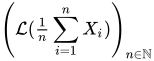
If is a series of iid random variables, then the distributions satisfy a large deviation principle with rate function , where denotes the distribution of the random variable .[1]: 514


References
[edit]- 1 2 Klenke, Achim (2008). Probability Theory. Berlin: Springer. doi:10.1007/978-1-84800-048-3. ISBN 978-1-84800-047-6.
- "Cramér theorem", Encyclopedia of Mathematics, EMS Press, 2001 [1994]