From Wikipedia, the free encyclopedia
The Fejér kernel has many equivalent definitions. Three such definitions are outlined below:
1) The traditional definition expresses the Fejér kernel  in terms of the Dirichlet kernel
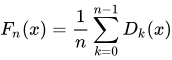
where
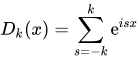
is the  th order Dirichlet kernel.
2) The Fejér kernel may also be written in a closed form expression as follows[1]

This closed form expression may be derived from the definitions used above. A proof of this result goes as follows.
Using the fact that the Dirichlet kernel may be written as:[2]
 ,
,
one obtains from the definition of the Fejér kernel above:
![{\displaystyle F_{n}(x)={\frac {1}{n}}\sum _{k=0}^{n-1}D_{k}(x)={\frac {1}{n}}\sum _{k=0}^{n-1}{\frac {\sin((k+{\frac {1}{2}})x)}{\sin({\frac {x}{2}})}}={\frac {1}{n}}{\frac {1}{\sin({\frac {x}{2}})}}\sum _{k=0}^{n-1}\sin((k+{\frac {1}{2}})x)={\frac {1}{n}}{\frac {1}{\sin ^{2}({\frac {x}{2}})}}\sum _{k=0}^{n-1}{\big [}\sin((k+{\frac {1}{2}})x)\cdot \sin({\frac {x}{2}}){\big ]}}](https://wikimedia.org/api/rest_v1/media/math/render/svg/e1dd24f02724011520a90012721eff5fa323f09d)
By the trigonometric identity:  , one has
![{\displaystyle F_{n}(x)={\frac {1}{n}}{\frac {1}{\sin ^{2}({\frac {x}{2}})}}\sum _{k=0}^{n-1}[\sin((k+{\frac {1}{2}})x)\cdot \sin({\frac {x}{2}})]={\frac {1}{n}}{\frac {1}{2\sin ^{2}({\frac {x}{2}})}}\sum _{k=0}^{n-1}[\cos(kx)-\cos((k+1)x)],}](https://wikimedia.org/api/rest_v1/media/math/render/svg/5c6e476f1b7ec1c4ff2bf0b0009942cfd25b9b57)
which allows evaluation of as a telescoping sum:

3) The Fejér kernel can also be expressed as:
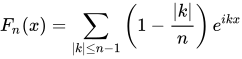
The Fejér kernel is a positive summability kernel. An important property of the Fejér kernel is  with average value of
  .
.
The convolution  is positive: for
  of period
  it satisfies

Since

we have

which is Cesàro summation of Fourier series.
By Young's convolution inequality,
![{\displaystyle \|F_{n}*f\|_{L^{p}([-\pi ,\pi ])}\leq \|f\|_{L^{p}([-\pi ,\pi ])}{\text{ for every }}1\leq p\leq \infty \ {\text{for}}\ f\in L^{p}.}](https://wikimedia.org/api/rest_v1/media/math/render/svg/73eb1ec3a144184af4352e249ff51792856d55af)
Additionally, if ![{\displaystyle f\in L^{1}([-\pi ,\pi ])}](https://wikimedia.org/api/rest_v1/media/math/render/svg/7e3515a00783d75e503eb19294f26d84c49402fe) , then
, then
 a.e.
a.e.
Since ![{\displaystyle [-\pi ,\pi ]}](https://wikimedia.org/api/rest_v1/media/math/render/svg/cb064fd6c55820cfa660eabeeda0f6e3c4935ae6) is finite,
is finite, ![{\displaystyle L^{1}([-\pi ,\pi ])\supset L^{2}([-\pi ,\pi ])\supset \cdots \supset L^{\infty }([-\pi ,\pi ])}](https://wikimedia.org/api/rest_v1/media/math/render/svg/46f6aab539f73c629502ceebd84a0f671e9c0178) , so the result holds for other
, so the result holds for other  spaces,
  as well.
If  is continuous, then the convergence is uniform, yielding a proof of the Weierstrass theorem.
- One consequence of the pointwise a.e. convergence is the uniqueness of Fourier coefficients: If
 with
with  , then
  a.e. This follows from writing

which depends only on the Fourier coefficients.
- A second consequence is that if
 exists a.e., then
 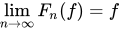 a.e., since Cesàro means
  converge to the original sequence limit if it exists.
- ↑ Hoffman, Kenneth (1988). Banach Spaces of Analytic Functions. Dover. p. 17. ISBN 0-486-45874-1.
- ↑ Königsberger, Konrad. Analysis 1 (in German) (6th ed.). Springer. p. 322.




