


Mahler's theorem
In mathematics, Mahler's theorem, introduced by Kurt Mahler (1958), expresses any continuous p-adic function as an infinite series of certain special polynomials. This series is referred to as a Mahler series[1] or Mahler expansion,[2] or as Mahler's expansion.[3] It is the p-adic counterpart to the Stone–Weierstrass theorem for continuous real-valued functions on a closed interval.
Statement
[edit]Let be the forward difference operator. Then for any p-adic function , Mahler's theorem states that is continuous if and only if its Newton series converges everywhere to , so that for all we have



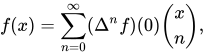
where

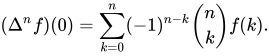
is the th binomial coefficient polynomial. Here, the th forward difference is computed by the binomial transform, so thatMoreover, we have that is continuous if and only if the coefficients in as .



It is remarkable that as weak an assumption as continuity is enough in the p-adic setting to establish convergence of Newton series. By contrast, Newton series on the field of complex numbers are far more tightly constrained, and require Carlson's theorem to hold.
References
[edit]- ↑ Anashin, Vladimir (2021). "The p-adic Theory of Automata Functions". Advances in Non-Archimedean Analysis and Applications. STEAM-H: Science, Technology, Engineering, Agriculture, Mathematics & Health. pp. 9–113. doi:10.1007/978-3-030-81976-7_2. ISBN 978-3-030-81975-0.
- ↑ Duran, Ugur; Acikgoz, Mehmet (2019). "On applications for Mahler expansion associated with p-adic q-integrals". International Journal of Number Theory. 15: 67–84. doi:10.1142/S1793042118501737.
- ↑ Van Hamme, Lucien (1990). "Three generalizations of Mahler's expansion for continuous functions on ℤp". P-adic Analysis. Lecture Notes in Mathematics. Vol. 1454. pp. 356–361. doi:10.1007/BFb0091150. ISBN 978-3-540-53477-8.
- Mahler, K. (1958), "An interpolation series for continuous functions of a p-adic variable", Journal für die reine und angewandte Mathematik, 1958 (199): 23–34, doi:10.1515/crll.1958.199.23, ISSN 0075-4102, MR 0095821, S2CID 199546556