From Wikipedia, the free encyclopedia
Definition and basic properties [ edit ] An n -dimensional multi-index is an
n
{\textstyle n}
tuple
α
=
(
α
1
,
α
2
,
…
,
α
n
)
{\displaystyle \alpha =(\alpha _{1},\alpha _{2},\ldots ,\alpha _{n})}
of non-negative integers (i.e. an element of the
n
{\textstyle n}
dimensional set of natural numbers , denoted
N
0
n
{\displaystyle \mathbb {N} _{0}^{n}}
For multi-indices
α
,
β
∈
N
0
n
{\displaystyle \alpha ,\beta \in \mathbb {N} _{0}^{n}}
x
=
(
x
1
,
x
2
,
…
,
x
n
)
∈
R
n
{\displaystyle x=(x_{1},x_{2},\ldots ,x_{n})\in \mathbb {R} ^{n}}
Componentwise sum and difference
α
±
β
=
(
α
1
±
β
1
,
α
2
±
β
2
,
…
,
α
n
±
β
n
)
{\displaystyle \alpha \pm \beta =(\alpha _{1}\pm \beta _{1},\,\alpha _{2}\pm \beta _{2},\ldots ,\,\alpha _{n}\pm \beta _{n})}
Partial order
α
≤
β
⇔
α
i
≤
β
i
∀
i
∈
{
1
,
…
,
n
}
{\displaystyle \alpha \leq \beta \quad \Leftrightarrow \quad \alpha _{i}\leq \beta _{i}\quad \forall \,i\in \{1,\ldots ,n\}}
Sum of components (absolute value)
|
α
|
=
α
1
+
α
2
+
⋯
+
α
n
{\displaystyle |\alpha |=\alpha _{1}+\alpha _{2}+\cdots +\alpha _{n}}
Factorial
α
!
=
α
1
!
⋅
α
2
!
⋯
α
n
!
{\displaystyle \alpha !=\alpha _{1}!\cdot \alpha _{2}!\cdots \alpha _{n}!}
Binomial coefficient
(
α
β
)
=
(
α
1
β
1
)
(
α
2
β
2
)
⋯
(
α
n
β
n
)
=
α
!
β
!
(
α
−
β
)
!
{\displaystyle {\binom {\alpha }{\beta }}={\binom {\alpha _{1}}{\beta _{1}}}{\binom {\alpha _{2}}{\beta _{2}}}\cdots {\binom {\alpha _{n}}{\beta _{n}}}={\frac {\alpha !}{\beta !(\alpha -\beta )!}}}
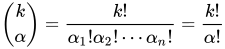
Multinomial coefficient
(
k
α
)
=
k
!
α
1
!
α
2
!
⋯
α
n
!
=
k
!
α
!
{\displaystyle {\binom {k}{\alpha }}={\frac {k!}{\alpha _{1}!\alpha _{2}!\cdots \alpha _{n}!}}={\frac {k!}{\alpha !}}}
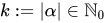
k
:=
|
α
|
∈
N
0
{\displaystyle k:=|\alpha |\in \mathbb {N} _{0}}
Power
x
α
=
x
1
α
1
x
2
α
2
…
x
n
α
n
{\displaystyle x^{\alpha }=x_{1}^{\alpha _{1}}x_{2}^{\alpha _{2}}\ldots x_{n}^{\alpha _{n}}}
Higher-order partial derivative
∂
α
=
∂
1
α
1
∂
2
α
2
…
∂
n
α
n
,
{\displaystyle \partial ^{\alpha }=\partial _{1}^{\alpha _{1}}\partial _{2}^{\alpha _{2}}\ldots \partial _{n}^{\alpha _{n}},}
∂
i
α
i
:=
∂
α
i
/
∂
x
i
α
i
{\displaystyle \partial _{i}^{\alpha _{i}}:=\partial ^{\alpha _{i}}/\partial x_{i}^{\alpha _{i}}}
4-gradient ). Sometimes the notation
D
α
=
∂
α
{\displaystyle D^{\alpha }=\partial ^{\alpha }}
[ 1]
The multi-index notation allows the extension of many formulae from elementary calculus to the corresponding multi-variable case. Below are some examples. In all the following,
x
,
y
,
h
∈
C
n
{\displaystyle x,y,h\in \mathbb {C} ^{n}}
R
n
{\displaystyle \mathbb {R} ^{n}}
α
,
β
,
ν
∈
N
0
n
{\displaystyle \alpha ,\beta ,\nu \in \mathbb {N} _{0}^{n}}
Derivative of a monomial [ edit ]
∂
α
x
β
=
{
β
!
(
β
−
α
)
!
x
β
−
α
,
if
α
≤
β
,
0
,
otherwise.
{\displaystyle \partial ^{\alpha }x^{\beta }={\begin{cases}{\frac {\beta !}{(\beta -\alpha )!}}x^{\beta -\alpha },&{\text{if}}~\alpha \leq \beta ,\\0,&{\text{otherwise.}}\end{cases}}}
Multinomial theorem [ edit ]
(
∑
i
=
1
n
x
i
)
k
=
∑
|
α
|
=
k
(
k
α
)
x
α
.
{\displaystyle \left(\sum _{i=1}^{n}x_{i}\right)^{k}=\sum _{|\alpha |=k}{\binom {k}{\alpha }}\,x^{\alpha }.}
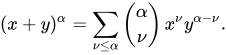
Multi-binomial theorem [ edit ]
(
x
+
y
)
α
=
∑
ν
≤
α
(
α
ν
)
x
ν
y
α
−
ν
.
{\displaystyle (x+y)^{\alpha }=\sum _{\nu \leq \alpha }{\binom {\alpha }{\nu }}\,x^{\nu }y^{\alpha -\nu }.}
x + y α (x 1 + y 1 )α 1 x n y n α n .
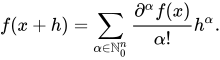
For an analytic function
f
{\textstyle f}
n
{\textstyle n}
f
(
x
+
h
)
=
∑
α
∈
N
0
n
∂
α
f
(
x
)
α
!
h
α
.
{\displaystyle f(x+h)=\sum _{\alpha \in \mathbb {N} _{0}^{n}}{{\frac {\partial ^{\alpha }f(x)}{\alpha !}}h^{\alpha }}.}
Taylor expansion
f
(
x
+
h
)
=
∑
|
α
|
≤
n
∂
α
f
(
x
)
α
!
h
α
+
R
n
(
x
,
h
)
,
{\displaystyle f(x+h)=\sum _{|\alpha |\leq n}{{\frac {\partial ^{\alpha }f(x)}{\alpha !}}h^{\alpha }}+R_{n}(x,h),}
R
n
(
x
,
h
)
=
(
n
+
1
)
∑
|
α
|
=
n
+
1
h
α
α
!
∫
0
1
(
1
−
t
)
n
∂
α
f
(
x
+
t
h
)
d
t
.
{\displaystyle R_{n}(x,h)=(n+1)\sum _{|\alpha |=n+1}{\frac {h^{\alpha }}{\alpha !}}\int _{0}^{1}(1-t)^{n}\partial ^{\alpha }f(x+th)\,dt.}
↑ Reed, M.; Simon, B. (1980). Methods of Modern Mathematical Physics: Functional Analysis I (Revised and enlarged ed.). San Diego: Academic Press. p. 319. ISBN 0-12-585050-6
Saint Raymond, Xavier (1991). Elementary Introduction to the Theory of Pseudodifferential Operators . Chap 1.1 . CRC Press. ISBN 0-8493-7158-9 This article incorporates material from multi-index derivative of a power on PlanetMath , which is licensed under the Creative Commons Attribution/Share-Alike License .