


Pöschl–Teller potential
In mathematical physics, a Pöschl–Teller potential is a special class of potentials for which the one-dimensional Schrödinger equation can be solved in terms of special functions. It is named after the physicists Gertrud Pöschl[a] and Edward Teller who developed it in 1933.[1]
Definition
[edit]In its symmetric form is explicitly given by[2]

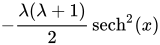
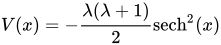
and the solutions of the time-independent Schrödinger equation

with this potential can be found by virtue of the substitution , which yields

- .
![{\displaystyle \left[(1-u^{2})\psi '(u)\right]'+\lambda (\lambda +1)\psi (u)+{\frac {2E}{1-u^{2}}}\psi (u)=0}](https://wikimedia.org/api/rest_v1/media/math/render/svg/9304e92f3b53756e2ed60ba87f7854fc21f370f8)
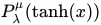
Thus the solutions are just the Legendre functions with , and , . Moreover, eigenvalues and scattering data can be explicitly computed.[3] In the special case of integer , the potential is reflectionless and such potentials also arise as the N-soliton solutions of the Korteweg–De Vries equation.[4]





The more general form of the potential is given by[2]

Related potentials
[edit]The symmetric form of the Poschl–Teller potential is a special case of the Epstein profile, also called Eckart potential or hyperbolic Rosen–Morse potential.

Notes
[edit]- ↑ Some sources cite her as Hertha Pöschl.
References
[edit]- ↑ ""Edward Teller Biographical Memoir." by Stephen B. Libby and Andrew M. Sessler, 2009 (published in Edward Teller Centennial Symposium: modern physics and the scientific legacy of Edward Teller, World Scientific, 2010" (PDF). Archived from the original (PDF) on 2017-01-18. Retrieved 2011-11-29.
- 1 2 Pöschl, G.; Teller, E. (1933). "Bemerkungen zur Quantenmechanik des anharmonischen Oszillators". Zeitschrift für Physik. 83 (3–4): 143–151. Bibcode:1933ZPhy...83..143P. doi:10.1007/BF01331132. S2CID 124830271.
- ↑ Siegfried Flügge Practical Quantum Mechanics (Springer, 1998)
- ↑ Lekner, John (2007). "Reflectionless eigenstates of the sech2 potential". American Journal of Physics. 875 (12): 1151–1157. Bibcode:2007AmJPh..75.1151L. doi:10.1119/1.2787015.
External links
[edit]
 | This quantum mechanics–related article is a stub. You can help Wikipedia by adding missing information. |
 | This mathematical physics–related article is a stub. You can help Wikipedia by adding missing information. |