Raikov's theorem
Raikov’s theorem, named for Russian mathematician Dmitrii Abramovich Raikov, is a result in the probability theory. It is well known that if each of two independent random variables and has a Poisson distribution, then their sum has a Poisson distribution as well. It turns out that the converse is also valid.[1]


Statement of the theorem
[edit source]Suppose that a random variable has a Poisson distribution and admits a decomposition as a sum of two independent random variables. Then the distribution of each summand is a shifted Poisson distribution.

Raikov's theorem is similar to Cramér’s decomposition theorem. The latter result claims that if a sum of two independent random variables has a normal distribution, then each summand is normally distributed as well. It was also proved by Yu. V. Linnik that a convolution of normal distribution and Poisson's distribution possesses a similar property (Linnik's theorem). It follows from the Raikov theorem that the Poisson distribution belongs to the Linnik class .

An extension to locally compact Abelian groups
[edit source]Let be a locally compact Abelian group. Denote by the convolution semigroup of probability distributions on , and by the degenerate distribution concentrated at . Let .



The Poisson distribution generated by the measure is defined as a distribution of the form


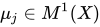
Theorem[2] Let be the Poisson distribution generated by the measure . Suppose that , with . Then each of is a shift of a Poisson distribution if and only if is either an infinite-order element or has order 2.