


Spin representation
In mathematics, the spin representations are particular projective representations of the orthogonal or special orthogonal groups in arbitrary dimension and signature (i.e., including indefinite orthogonal groups). More precisely, they are two equivalent representations of the spin groups, which are double covers of the special orthogonal groups. They are usually studied over the real or complex numbers, but they can be defined over other fields.
Elements of a spin representation are called spinors. They play an important role in the physical description of fermions such as the electron.
The spin representations may be constructed in several ways, but typically the construction involves (perhaps only implicitly) the choice of a maximal isotropic subspace in the vector representation of the group. Over the real numbers, this usually requires using a complexification of the vector representation. For this reason, it is convenient to define the spin representations over the complex numbers first, and derive real representations by introducing real structures.
The properties of the spin representations depend, in a subtle way, on the dimension and signature of the orthogonal group. In particular, spin representations often admit invariant bilinear forms, which can be used to embed the spin groups into classical Lie groups. In low dimensions, these embeddings are surjective and determine special isomorphisms between the spin groups and more familiar Lie groups; this elucidates the properties of spinors in these dimensions.
Set-up
[edit]Let be a finite-dimensional vector space over or , equipped with a nondegenerate quadratic form . The orthogonal group and special orthogonal group of are


Thus denotes the determinant-one subgroup, rather than necessarily the identity component of . If is real and is indefinite, then generally has two connected components; its identity component is denoted by or .


Over , every nondegenerate quadratic form is determined up to isomorphism by the dimension of . One may therefore take and


The corresponding groups and Lie algebra are denoted by , , , and . The group is connected.


Over , Sylvester's law of inertia shows that a nondegenerate quadratic form is determined up to isomorphism by its signature , where . One may take and


The corresponding groups and Lie algebra are denoted by , , , and .


The spin group is defined naturally through the Clifford algebra of . With the convention used here,

so that in . Let be its even subalgebra, and let denote reversion, the anti-automorphism determined by


The spin group may then be defined by

Conjugation in the Clifford algebra gives a homomorphism

In the complex case this gives an exact sequence

In real signature , the corresponding exact sequence is

Thus . The element here is the scalar element of the Clifford algebra and should not be confused with the orthogonal transformation .[1] Although is a twofold covering homomorphism, is not in general the universal covering group of in indefinite signature. The analogous construction for the full orthogonal group uses a pin group.


The differential of identifies the Lie algebra of the spin group with the orthogonal Lie algebra:

If is real, its complexification carries the complexified quadratic form , and



The inclusion of the real Clifford algebra into its complexification realizes as a real subgroup of .[1]
A complex spinor module is an irreducible module for the complex Clifford algebra. Restricting its Clifford action to the spin group gives the complex spin representation. Its form depends on the parity of :
- If is odd, the complex Clifford algebra has two inequivalent irreducible modules of dimension . Their restrictions to are equivalent and give a single irreducible spin representation, denoted by .


- If is even, the complex Clifford algebra has one irreducible module of dimension . Its restriction to decomposes as

- where and are inequivalent irreducible representations of dimension . They are called the positive and negative half-spin, chiral, or Weyl representations; is called the Dirac spin representation.[2][3]


The central element acts on every spinor module as . Consequently, a spin representation does not descend to a linear representation of the corresponding special orthogonal group, but its projectivization does descend to a projective representation. The condition , however, does not characterize the spin representations: it merely says that an arbitrary representation of the spin group does not factor through the special orthogonal group.


For a real quadratic space of signature , the complex spin representations are obtained by restricting the complex spin modules to . The existence of invariant real, quaternionic, or Hermitian structures on these modules depends on modulo .[2] It is therefore convenient first to construct the complex spin representations and then to analyze their restrictions and possible real structures.


Complex spin representations
[edit]Let V = Cn with the standard quadratic form Q so that

The symmetric bilinear form on V associated to Q by polarization is denoted ⟨.,.⟩.
Isotropic subspaces and root systems
[edit]Suppose that for . Then . We say that is isotropic and that it generates a one-dimensional totally isotropic subspace . Similarly, is isotropic and generates a one-dimensional totally isotropic subspace.


A standard construction of the spin representations of so(n, C) begins with a choice of a pair (W, W∗) of maximal totally isotropic subspaces (with respect to Q) of V with W ∩ W∗ = 0. Let us make such a choice. If n = 2m or n = 2m + 1, then W and W∗ both have dimension m. If n = 2m, then V = W ⊕ W∗, whereas if n = 2m + 1, then V = W ⊕ U ⊕ W∗, where U is the 1-dimensional orthogonal complement to W ⊕ W∗. The bilinear form ⟨.,.⟩ associated to Q induces a pairing between W and W∗, which must be nondegenerate, because W and W∗ are totally isotropic subspaces and Q is nondegenerate. Hence W and W∗ are dual vector spaces.
More concretely, let a1, ... am be a basis for W. Then there is a unique basis α1, ... αm of W∗ such that
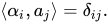
If A is an m × m matrix, then A induces an endomorphism of W with respect to this basis and the transpose AT induces a transformation of W∗ with

for all w in W and w∗ in W∗. It follows that the endomorphism ρA of V, equal to A on W, −AT on W∗ and zero on U (if n is odd), is skew,

for all u, v in V, and hence (see classical group) an element of so(n, C) ⊂ End(V).
Using the diagonal matrices in this construction defines a Cartan subalgebra h of so(n, C): the rank of so(n, C) is m, and the diagonal n × n matrices determine an m-dimensional abelian subalgebra.
Let ε1, ... εm be the basis of h∗ such that, for a diagonal matrix A, εk(ρA) is the kth diagonal entry of A. Clearly this is a basis for h∗. Since the bilinear form identifies so(n, C) with , explicitly,


it is now easy to construct the root system associated to h. The root spaces (simultaneous eigenspaces for the action of h) are spanned by the following elements:
- with root (simultaneous eigenvalue)
- (which is in h if i = j) with root
- with root
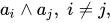




and, if n is odd, and u is a nonzero element of U,
- with root
- with root


Thus, with respect to the basis ε1, ... εm, the roots are the vectors in h∗ that are permutations of

together with the permutations of

if n = 2m + 1 is odd.
A system of positive roots is given by εi + εj (i ≠ j), εi − εj (i < j) and (for n odd) εi. The corresponding simple roots are

The positive roots are nonnegative integer linear combinations of the simple roots.
Spin representations and their weights
[edit]One construction of the spin representations of so(n, C) uses the exterior algebra(s)
- and/or


There is an action of V on S such that for any element v = w + w∗ in W ⊕ W∗ and any ψ in S the action is given by:

where the second term is a contraction (interior multiplication) defined using the bilinear form, which pairs W and W∗. This action respects the Clifford relations v2 = Q(v)1, and so induces a homomorphism from the Clifford algebra ClnC of V to End(S). A similar action can be defined on S′, so that both S and S′ are Clifford modules.
The Lie algebra so(n, C) is isomorphic to the complexified Lie algebra spinnC in ClnC via the mapping induced by the covering Spin(n) → SO(n)[5]
![{\displaystyle v\wedge w\mapsto {\tfrac {1}{4}}[v,w].}](https://wikimedia.org/api/rest_v1/media/math/render/svg/5e8cc46f0f390bf990cc36f33ee03d56f3275860)
It follows that both S and S′ are representations of so(n, C). They are actually equivalent representations, so we focus on S.
The explicit description shows that the elements αi ∧ ai of the Cartan subalgebra h act on S by

A basis for S is given by elements of the form

for 0 ≤ k ≤ m and i1 < ... < ik. These clearly span weight spaces for the action of h: αi ∧ ai has eigenvalue −1/2 on the given basis vector if i = ij for some j, and has eigenvalue 1/2 otherwise.
It follows that the weights of S are all possible combinations of

and each weight space is one-dimensional. Elements of S are called Dirac spinors.
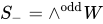
When n is even, S is not an irreducible representation: and are invariant subspaces. The weights divide into those with an even number of minus signs, and those with an odd number of minus signs. Both S+ and S− are irreducible representations of dimension 2m−1 whose elements are called Weyl spinors. They are also known as chiral spin representations or half-spin representations. With respect to the positive root system above, the highest weights of S+ and S− are

- and
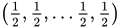
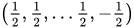
respectively. The Clifford action identifies ClnC with End(S) and the even subalgebra is identified with the endomorphisms preserving S+ and S−. The other Clifford module S′ is isomorphic to S in this case.
When n is odd, S is an irreducible representation of so(n,C) of dimension 2m: the Clifford action of a unit vector u ∈ U is given by
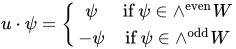
and so elements of so(n,C) of the form u∧w or u∧w∗ do not preserve the even and odd parts of the exterior algebra of W. The highest weight of S is
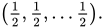
The Clifford action is not faithful on S: ClnC can be identified with End(S) ⊕ End(S′), where u acts with the opposite sign on S′. More precisely, the two representations are related by the parity involution α of ClnC (also known as the principal automorphism), which is the identity on the even subalgebra, and minus the identity on the odd part of ClnC. In other words, there is a linear isomorphism from S to S′, which identifies the action of A in ClnC on S with the action of α(A) on S′.
Bilinear forms
[edit]if λ is a weight of S, so is −λ. It follows that S is isomorphic to the dual representation S∗.
When n = 2m + 1 is odd, the isomorphism B: S → S∗ is unique up to scale by Schur's lemma, since S is irreducible, and it defines a nondegenerate invariant bilinear form β on S via

Here invariance means that

for all ξ in so(n,C) and φ, ψ in S — in other words the action of ξ is skew with respect to β. In fact, more is true: S∗ is a representation of the opposite Clifford algebra, and therefore, since ClnC only has two nontrivial simple modules S and S′, related by the parity involution α, there is an antiautomorphism τ of ClnC such that

for any A in ClnC. In fact τ is reversion (the antiautomorphism induced by the identity on V) for m even, and conjugation (the antiautomorphism induced by minus the identity on V) for m odd. These two antiautomorphisms are related by parity involution α, which is the automorphism induced by minus the identity on V. Both satisfy τ(ξ) = −ξ for ξ in so(n,C).
When n = 2m, the situation depends more sensitively upon the parity of m. For m even, a weight λ has an even number of minus signs if and only if −λ does; it follows that there are separate isomorphisms B±: S± → S±∗ of each half-spin representation with its dual, each determined uniquely up to scale. These may be combined into an isomorphism B: S → S∗. For m odd, λ is a weight of S+ if and only if −λ is a weight of S−; thus there is an isomorphism from S+ to S−∗, again unique up to scale, and its transpose provides an isomorphism from S− to S+∗. These may again be combined into an isomorphism B: S → S∗.
For both m even and m odd, the freedom in the choice of B may be restricted to an overall scale by insisting that the bilinear form β corresponding to B satisfies (1), where τ is a fixed antiautomorphism (either reversion or conjugation).
Symmetry and the tensor square
[edit]The symmetry properties of β: S ⊗ S → C can be determined using Clifford algebras or representation theory. In fact much more can be said: the tensor square S ⊗ S must decompose into a direct sum of k-forms on V for various k, because its weights are all elements in h∗ whose components belong to {−1,0,1}. Now equivariant linear maps S ⊗ S → ∧kV∗ correspond bijectively to invariant maps ∧kV ⊗ S ⊗ S → C and nonzero such maps can be constructed via the inclusion of ∧kV into the Clifford algebra. Furthermore, if β(φ,ψ) = ε β(ψ,φ) and τ has sign εk on ∧kV then

for A in ∧kV.
If n = 2m+1 is odd then it follows from Schur's Lemma that
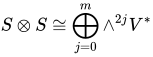
(both sides have dimension 22m and the representations on the right are inequivalent). Because the symmetries are governed by an involution τ that is either conjugation or reversion, the symmetry of the ∧2jV∗ component alternates with j. Elementary combinatorics gives

and the sign determines which representations occur in S2S and which occur in ∧2S.[6] In particular
- and


for v ∈ V (which is isomorphic to ∧2mV), confirming that τ is reversion for m even, and conjugation for m odd.
If n = 2m is even, then the analysis is more involved, but the result is a more refined decomposition: S2S±, ∧2S± and S+ ⊗ S− can each be decomposed as a direct sum of k-forms (where for k = m there is a further decomposition into selfdual and antiselfdual m-forms).
The main outcome is a realisation of so(n,C) as a subalgebra of a classical Lie algebra on S, depending upon n modulo 8, according to the following table:
| n mod 8 | 0 | 1 | 2 | 3 | 4 | 5 | 6 | 7 |
|---|---|---|---|---|---|---|---|---|
| Spinor algebra |




For n ≤ 6, these embeddings are isomorphisms (onto sl rather than gl for n = 6):





Real representations
[edit]The complex spin representations of so(n,C) yield real representations S of so(p,q) by restricting the action to the real subalgebras. However, there are additional "reality" structures that are invariant under the action of the real Lie algebras. These come in three types.
- There is an invariant complex antilinear map r: S → S with r2 = idS. The fixed point set of r is then a real vector subspace SR of S with SR ⊗ C = S. This is called a real structure.
- There is an invariant complex antilinear map j: S → S with j2 = −idS. It follows that the triple i, j and k:=ij make S into a quaternionic vector space SH. This is called a quaternionic structure.
- There is an invariant complex antilinear map b: S → S∗ that is invertible. This defines a pseudohermitian bilinear form on S and is called a hermitian structure.
The type of structure invariant under so(p,q) depends only on the signature p − q modulo 8, and is given by the following table.
| p−q mod 8 | 0 | 1 | 2 | 3 | 4 | 5 | 6 | 7 |
|---|---|---|---|---|---|---|---|---|
| Structure | R + R | R | C | H | H + H | H | C | R |
Here R, C and H denote real, hermitian and quaternionic structures respectively, and R + R and H + H indicate that the half-spin representations both admit real or quaternionic structures respectively.
Description and tables
[edit]To complete the description of real representation, we must describe how these structures interact with the invariant bilinear forms. Since n = p + q ≅ p − q mod 2, there are two cases: the dimension and signature are both even, and the dimension and signature are both odd.
The odd case is simpler, there is only one complex spin representation S, and hermitian structures do not occur. Apart from the trivial case n = 1, S is always even-dimensional, say dim S = 2N. The real forms of so(2N,C) are so(K,L) with K + L = 2N and so∗(N,H), while the real forms of sp(2N,C) are sp(2N,R) and sp(K,L) with K + L = N. The presence of a Clifford action of V on S forces K = L in both cases unless pq = 0, in which case KL=0, which is denoted simply so(2N) or sp(N). Hence the odd spin representations may be summarized in the following table.
| n mod 8 | 1, 7 | 3, 5 | |
|---|---|---|---|
| p−q mod 8 | so(2N,C) | sp(2N,C) | |
| 1, 7 | R | so(N,N) or so(2N) | sp(2N,R) |
| 3, 5 | H | so∗(N,H) | sp(N/2,N/2)† or sp(N) |
(†) N is even for n > 3 and for n = 3, this is sp(1).
The even-dimensional case is similar. For n > 2, the complex half-spin representations are even-dimensional. We have additionally to deal with hermitian structures and the real forms of sl(2N, C), which are sl(2N, R), su(K, L) with K + L = 2N, and sl(N, H). The resulting even spin representations are summarized as follows.
| n mod 8 | 0 | 2, 6 | 4 | |
|---|---|---|---|---|
| p-q mod 8 | so(2N,C)+so(2N,C) | sl(2N,C) | sp(2N,C)+sp(2N,C) | |
| 0 | R+R | so(N,N)+so(N,N)∗ | sl(2N,R) | sp(2N,R)+sp(2N,R) |
| 2, 6 | C | so(2N,C) | su(N,N) | sp(2N,C) |
| 4 | H+H | so∗(N,H)+so∗(N,H) | sl(N,H) | sp(N/2,N/2)+sp(N/2,N/2)† |
(*) For pq = 0, we have instead so(2N) + so(2N)
(†) N is even for n > 4 and for pq = 0 (which includes n = 4 with N = 1), we have instead sp(N) + sp(N)
The low-dimensional isomorphisms in the complex case have the following real forms.
| Euclidean signature | Minkowskian signature | Other signatures | |


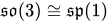




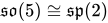


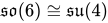



The only special isomorphisms of real Lie algebras missing from this table are and


Notes
[edit]- 1 2 Lawson & Michelsohn 1989, Chapter I.
- 1 2 Deligne 1999.
- ↑ Fulton & Harris 1991, Chapter 20.
- ↑ Lawson & Michelsohn 1989 Chapter I.6, p.41. If we follow the convention of Fulton & Harris 1991 Chapter 20, p.303, then a factor 2 appears and the following formulas have to be changed accordingly
- ↑ since if is the covering, then , so and since is a scalar, we get
- ↑ This sign can also be determined from the observation that if φ is a highest weight vector for S then φ⊗φ is a highest weight vector for ∧mV ≅ ∧m+1V, so this summand must occur in S2S.



![{\displaystyle d\alpha (1/4[v,w])=\varphi _{v\wedge w}}](https://wikimedia.org/api/rest_v1/media/math/render/svg/b0aaf4aaf578f9e6acba7c0511e8991741eae01d)
References
[edit]- Brauer, Richard; Weyl, Hermann (1935), "Spinors in n dimensions", American Journal of Mathematics, 57 (2), American Journal of Mathematics, Vol. 57, No. 2: 425–449, doi:10.2307/2371218, JSTOR 2371218.
- Cartan, Élie (1966), The theory of spinors, Paris, Hermann (reprinted 1981, Dover Publications), ISBN 978-0-486-64070-9.
- Chevalley, Claude (1954), The algebraic theory of spinors and Clifford algebras, Columbia University Press (reprinted 1996, Springer), ISBN 978-3-540-57063-9
{{citation}}: ISBN / Date incompatibility (help). - Deligne, Pierre (1999), "Notes on spinors", in P. Deligne; P. Etingof; D. S. Freed; L. C. Jeffrey; D. Kazhdan; J. W. Morgan; D. R. Morrison; E. Witten (eds.), Quantum Fields and Strings: A Course for Mathematicians, Providence: American Mathematical Society, pp. 99–135. See also the programme website for a preliminary version.
- Fulton, William; Harris, Joe (1991), Representation theory. A first course, Graduate Texts in Mathematics, Readings in Mathematics, vol. 129, New York: Springer-Verlag, ISBN 0-387-97495-4, MR 1153249.
- Harvey, F. Reese (1990), Spinors and Calibrations, Academic Press, ISBN 978-0-12-329650-4.
- Lawson, H. Blaine; Michelsohn, Marie-Louise (1989), Spin Geometry, Princeton University Press, ISBN 0-691-08542-0.
- Weyl, Hermann (1946), The Classical Groups: Their Invariants and Representations (2nd ed.), Princeton University Press (reprinted 1997), ISBN 978-0-691-05756-9
{{citation}}: ISBN / Date incompatibility (help).