9×39mm
| 9×39mm | ||||||||||||||||
|---|---|---|---|---|---|---|---|---|---|---|---|---|---|---|---|---|
.jpg) 9×39 mm SPP (7N9) cartridges with blue-tip armor-piercing bullets | ||||||||||||||||
| Type | Rifle cartridge | |||||||||||||||
| Place of origin | Soviet Union (Now Russia) | |||||||||||||||
| Service history | ||||||||||||||||
| Wars | Chechnya, Georgia, Iraq, Ukraine | |||||||||||||||
| Production history | ||||||||||||||||
| Designer | N.V.Zabelin, L.S.Dvoryaninova, Y.Z.Frolov, E.S.Kornilovova | |||||||||||||||
| Designed | finished in mid 1980s | |||||||||||||||
| Specifications | ||||||||||||||||
| Parent case | 7.62×39mm | |||||||||||||||
| Case type | Rimless, bottleneck | |||||||||||||||
| Bullet diameter | 9.27 mm (0.365 in) | |||||||||||||||
| Land diameter | 9.00 mm (0.354 in) | |||||||||||||||
| Neck diameter | 9.72 mm (0.383 in) | |||||||||||||||
| Shoulder diameter | 10.70 mm (0.421 in) | |||||||||||||||
| Base diameter | 11.33 mm (0.446 in) | |||||||||||||||
| Rim diameter | 11.33 mm (0.446 in) | |||||||||||||||
| Rim thickness | 1.50 mm (0.059 in) | |||||||||||||||
| Case length | 38.70 mm (1.524 in) | |||||||||||||||
| Overall length | 56.00 mm (2.205 in) | |||||||||||||||
| Maximum pressure | 3550 bar (355 MPa, 51,488 psi) | |||||||||||||||
| Ballistic performance | ||||||||||||||||
| ||||||||||||||||
| Test barrel length: 270 mm (10.5 in) Source: C.I.P. List of TDCC - Tab I - Rimless cartridges [2] | ||||||||||||||||
The 9×39 mm is a Soviet rifle cartridge.[3] The cartridge yields increased performance in shorter barrels and effective subsonic performance. It was designed as an exclusively subsonic round.
History and design
[edit]The 9×39 is based on the Soviet 7.62×39mm case but with the neck expanded to fit a 9.27 mm bullet. The intent was to create a stealthy cartridge for the "Vintorez" and "Val" projects which required more power, range, and penetration than 7.62×39 US or 7,62×28 rounds tested at the time.
The round is originally designed to have an optimistic effective lethal range of 300 to 400 meters and a maximum penetration of up to 10 mm of steel at 100 m. Like the 5.45×39mm cartridge, the 9×39mm SP-5 features an air pocket in the tip, which increases its tendency to yaw or "keyhole" upon impact, thus increasing soft tissue damage in human targets. The armor-piercing SP-6 cartridge is more effective against light armor, vehicles, or light barrier targets.[citation needed]
Commercial Wolf and Tula brand Ammunition that was being imported into the United States was subsequently banned on September 7, 2021 by then president Joe Biden as part of sanctions against Russia for poisoning of Alexei Navalny.[4]
Since many users in the U.S. had adopted the 9×39 round prior to the import ban, they are now forced to reload their own ammunition. However, multiple companies worldwide produce .365" and .366" bullets suitable for reloading 9×39 cases, including Hornady, Barnes, Nosler, Prvi Partizan, Lapua, and others.[5]
Roswell Manufacturing has developed what they are calling the 9x39US, which has slightly different specifications from the original 9×39 according to C.I.P. standards.[5]
Variants
[edit] | This section needs more citations. (September 2021) |
| Cartridge | SP-5(7N8) | SP-5UZ | SP-6(7N9) | SP-6UCh | PAB-9 | SPP | BP(7N12) |
|---|---|---|---|---|---|---|---|
| Type | Sniper | Test (increased charge) | Armor-piercing | Training | Armor-piercing | Sniper (increased penetration) | Armor-piercing |
| Bullet weight [g] | Up to 16.8 | About 16 | Up to 17.3 | ||||
| Muzzle velocity [m/s] | 280–320 | 280–290 | 280–305 | 280–320 | 280–310 | ||
| Muzzle energy [J] | 658–860 | 678–886 | |||||
| Maximum penetration | Up to 8 mm of steel | Up to 8 mm of steel[6] |
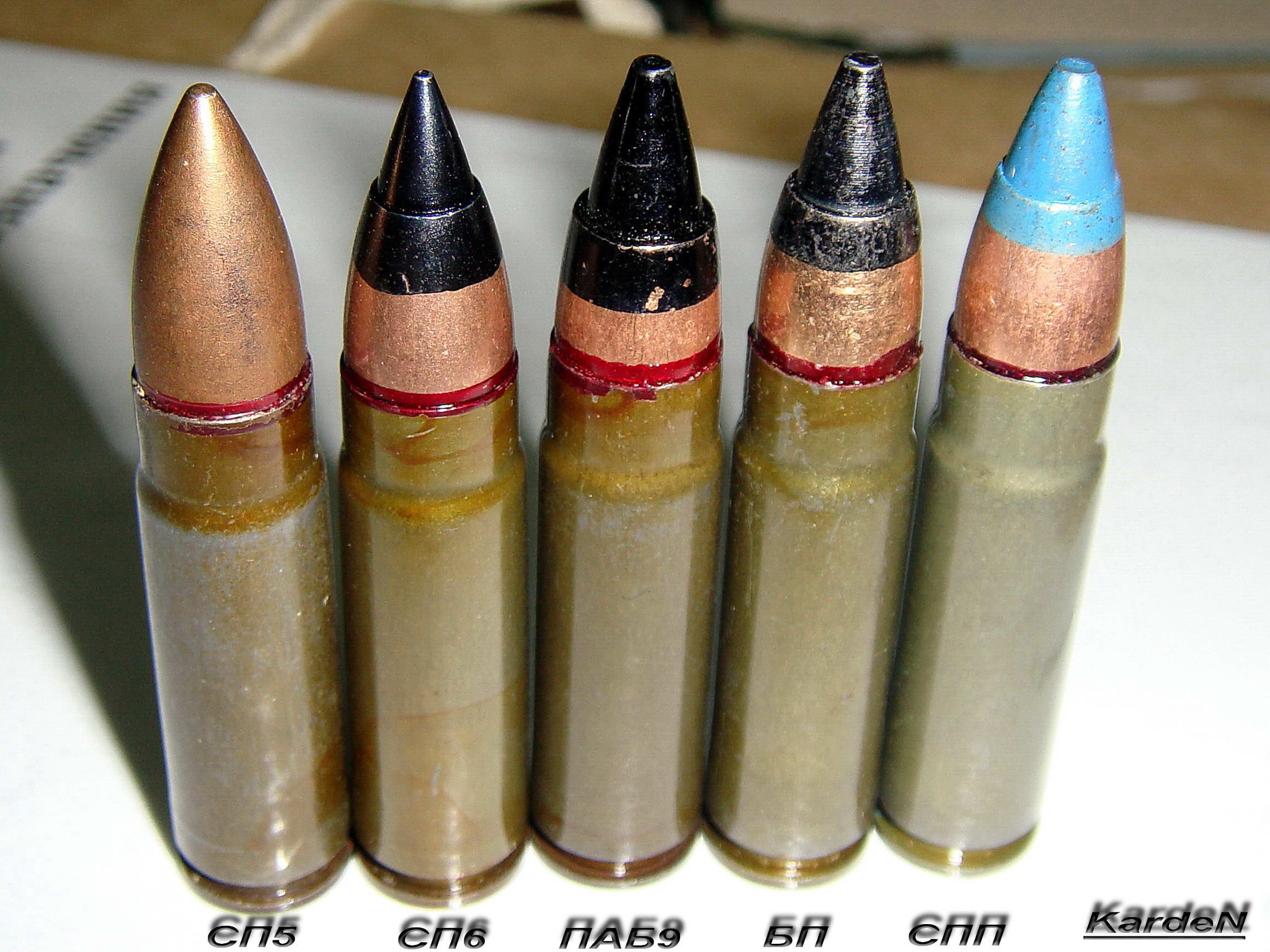
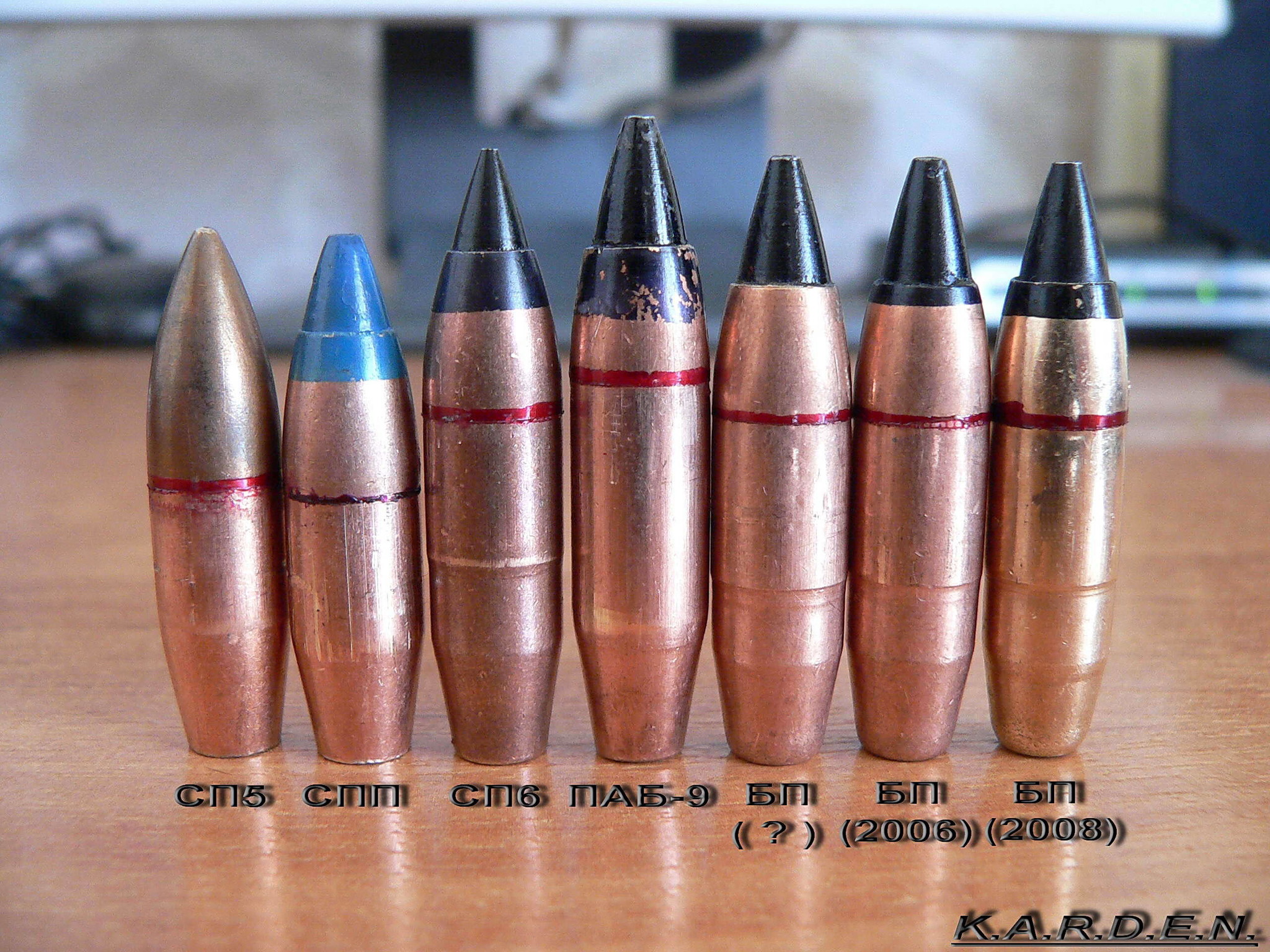
SP-5 (7N8) – The SP-5 (СП-5) (SP: Spetsialnyj Patron; "special cartridge") was developed by N. V. Zabelin, L. S. Dvoryaninova. It consists of conventional FMJ bullet with a mild steel and lead core. The primary goal of this version was to achieve accuracy.[1]
SP-5UZ – The SP-5UZ (СП5-УЗ) is an SP-5 variant with an increased charge intended for a factory-specific strength testing of the weapons.
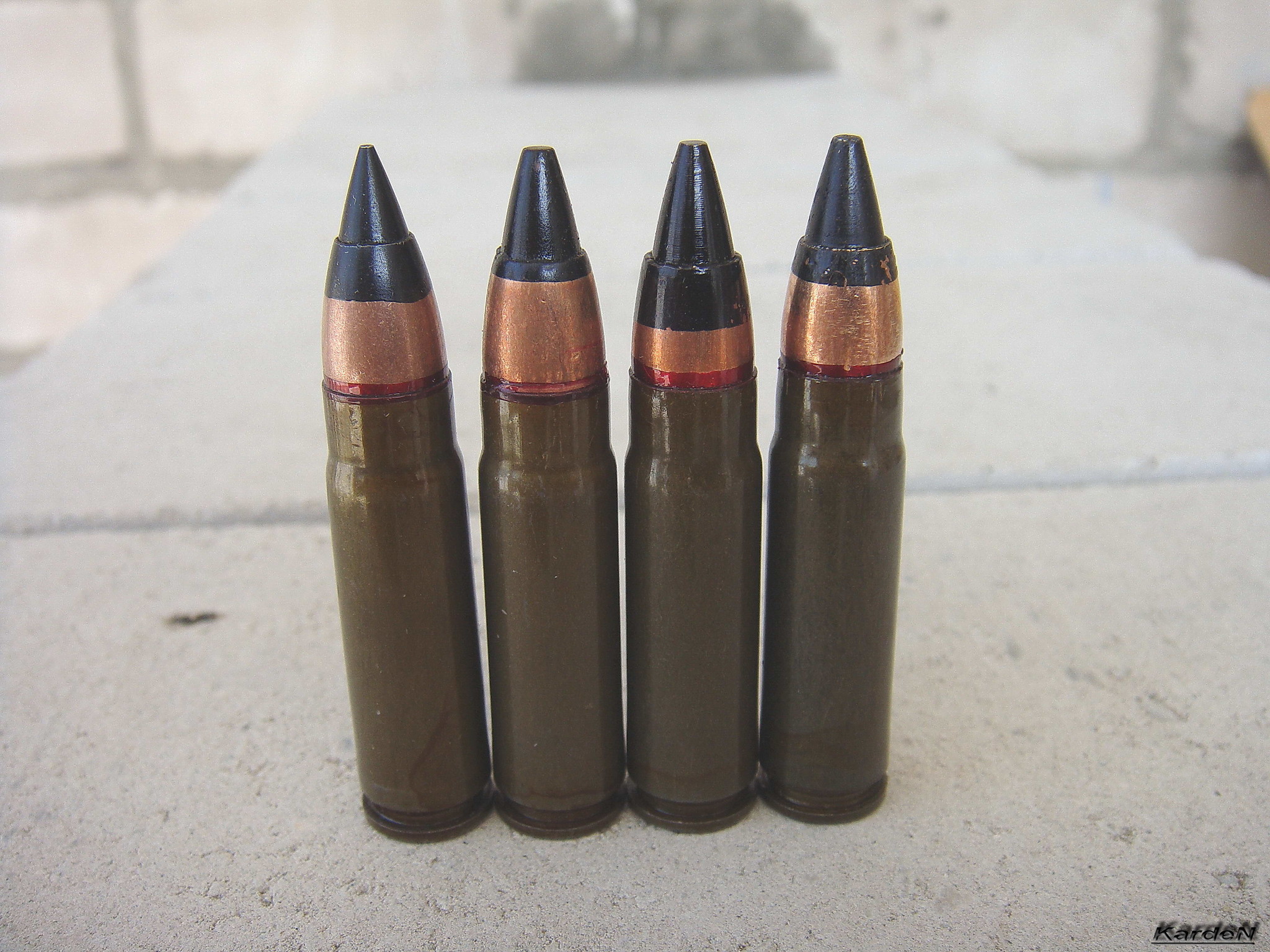
SP-6 (7N9) – The SP-6 (СП-6) was developed by Y. Z. Frolov and E. S. Kornilovova. It has a hardened steel armor-piercing core, designed to defeat body armor, which was being issued in the 1980s (such as PASGT). It can penetrate 2 mm (0.079 in) of steel at 500 meters or 6 mm (0.24 in) of steel, 2.8 mm (0.11 in) of titanium or 30 layers of Kevlar at 200 meters. At 100 meters it can penetrate 8 mm (0.31 in) of steel or GOST 3 rated body armor, while retaining enough power to inflict damage to a soft target behind it.[6][7][1]
SP-6UCh – The SP-6Uch (СП-6Уч) is an SP-6 variant intended for training.
PAB-9 (7N12) – The SP-6's bullet is expensive to manufacture, so an attempt was made to make a lower-cost version of the cartridge. The PAB-9 (ПАБ-9) used a stamped rather than machined steel core. It was not accepted due to higher wear it caused to barrels. As of 2011, its usage by Russian troops is prohibited.
SPP – The SPP (СПП) (SPP: Snaiperskiy, Povishennaya Probivaemost; "sniper – increased penetration") is a sniper round with increased penetration.
BP – The BP (БП) (BP: Broneboinaya Pulya; "armor-piercing bullet") is an armor-piercing round. Three modernizations of PAB-9 were created under the designation of BP to remedy its unusable performance.
There is at least one civilian load of this cartridge based on the SP-6 design. It is used by civilian 9×39mm firearms such as the (touted) civilian variant of RSh-9, MTs-570.[8]
Weapons
[edit]See also
[edit]References
[edit]- 1 2 3 V. Korabin, V. Krasnikov (2002). "ВСС «Винторез» и АС «Вал»". Стрелковое оружие России. 1: 27.
- ↑ "9 x 39" (PDF). 2018-05-16. Retrieved 2026-08-21.
- ↑ Николаев, Андриан. "Патроны для стрелкового оружия" [Ammunition for firearms]. Militaryparitet.com (in Russian). Archived from the original on May 2, 2007. Retrieved 2013-12-08.
- ↑ "Fact Sheet: United States Imposes Additional Costs on Russia for the Poisoning of Aleksei Navalny". United States Department of State. Retrieved 2024-11-03.
- 1 2 COMMISSION INTERNATIONALE PERMANENTE POUR L'EPREUVE DES ARMES A FEU PORTATIVES. "9x39 C.I.P. data sheet" (PDF). CIP - Homologation.
- 1 2 "Специальные патроны СП-5, СП-6 и ПАБ-9" [Special bullets SP-5, SP-6 and PAB-9.]. artillerist.ru (in Russian). 2008-04-02. Archived from the original on October 16, 2012. Retrieved 2015-03-24.
- ↑ F., Nathaniel (2017-11-03). ".300 Blackout vs. 9×39mm: Russia's Subsonic Brute". The Firearms Blog. Retrieved 2020-12-12.
- ↑ "Револьверный карабин МЦ-569 и МЦ-570 (Россия)". Modern Firearms (in Russian). 3 September 2021.
Bibliography
[edit]- Jane's Infantry Weapons 1997–98 (23rd ed.). Coulsdon, UK: Jane's Information Group. 1997. p. 458. ISBN 0-7106-1548-5.
External links
[edit]- photo of cartridges
- photo of cartridges
- photo of bullets
- Modern Firearms – Special purpose small arms ammunition of USSR and Russia
- 9×39mm special cartridges

Cartridges derived from the 7.62×39mm or its derivatives | |||||
|---|---|---|---|---|---|
| First generation derivatives |  | ||||
| Second generation derivatives |
| ||||
| Third generation derivatives |
| ||||