


Arnold tongue


In mathematics, particularly in dynamical systems, Arnold tongues (named after Vladimir Arnold)[1][2] are a pictorial phenomenon that occur when visualizing how the rotation number of a dynamical system, or other related invariant property thereof, changes according to two or more of its parameters. The regions of constant rotation number have been observed, for some dynamical systems, to form geometric shapes that resemble tongues, in which case they are called Arnold tongues.[3]
Sometimes the frequency of oscillation depends on, or is constrained (i.e., phase-locked or mode-locked, in some contexts) based on some quantity, and it is often of interest to study this relation.
One of the simplest physical models that exhibits mode-locking consists of two rotating disks connected by a weak spring. One disk is allowed to spin freely, and the other is driven by a motor. Mode locking occurs when the freely-spinning disk turns at a frequency that is a rational multiple of that of the driven rotator.
The simplest mathematical model that exhibits mode-locking is the circle map, which attempts to capture the motion of the spinning disks at discrete time intervals.
Arnold tongues are observed in a large variety of natural phenomena that involve oscillating quantities, such as concentration of enzymes and substrates in biological processes[4] and cardiac electric waves.
Overview
[edit]Arnold tongues appear most frequently when studying the interaction between oscillators, particularly in the case where one oscillator drives another. That is, one oscillator depends on the other but not the other way around, so they do not mutually influence each other as happens in Kuramoto models, for example. This is a particular case of driven oscillators, with a driving force that has a periodic behaviour.
Example applications
[edit]As a practical example, heart cells (the external oscillator) produce periodic electric signals to stimulate heart contractions (the driven oscillator); here, it could be useful to determine the relation between the frequency of the oscillators, possibly to design better artificial pacemakers.
The outset of a tumor triggers in the area a series of substance (mainly proteins) oscillations that interact with each other. Simulations show that these interactions cause Arnold tongues to appear, that is, the frequency of some oscillations constrain the others, and this can be used to control tumor growth.[3]
Other examples where Arnold tongues can be found include the inharmonicity of musical instruments, orbital resonance and tidal locking of orbiting moons, mode-locking in fiber optics and phase-locked loops and other electronic oscillators, as well as in cardiac rhythms, heart arrhythmias and cell cycle.[5]
For applications to cardiac rhythms, see Glass, L. et al. (1983) and McGuinness, M. et al. (2004). For applications to synchronisation of a resonant tunneling diode oscillators, see .[6]
The circle map family
[edit]The circle map family is a family of dynamical systems in which Arnold tongues appear. They are much simpler than real biological dynamical systems, as well as many others, but despite their simplicity, they exhibit many of the same phenomena that appears in the more complicated dynamical systems. Consequently, they are usually used in studies of the Arnold tongue.[7]
Consider a driven oscillator and a driving oscillator. We use the driving oscillator as an external "master clock", and use its period as the unit of time. Now, suppose the driven oscillator is driven at amplitude 0, that is, suppose that it is oscillating in an unforced manner. Then the driven oscillator oscillates at its unforced cycle time . In other words, its unforced phase velocity is per time . In particular, this means that if the driven and the driving oscillators have the same period, then .


Next, we arbitrarily fix two points in the two oscillators' cycles, and call these two points their respective 0-phase points. This then allows us to describe the phase of the system at any point using two numbers modulo 1. For example, means the system is in a state in which the driven oscillator is advanced in phase by 0.1 cycles, while the driving oscillator is advanced in phase by 0.5 cycles. Equivalently, the driven oscillator is retarded in phase by 0.9 cycles, while the driving oscillator is retarded in phase by 0.5 cycles. This is why we state that we are taking modulo 1.


Though, to be more accurate, we should say that , where is the circle with circumference 1. We write because it is notationally convenient to operate with real numbers.


Now, if we take a periodic strobing snapshot of the driven oscillator every time the driving oscillator reaches its origin, then we obtain a discrete series of phases . If there is no driving, i.e. the driving oscillator is completely disconnected from the driven oscillator, then we have More generally, if there is some driving effect, then in our strobing snapshot series, the driving effect shows up as phase delay/advance. The amount of delay/advance depends purely on , because of periodicity. That is, if for any two , then we must have , because the physical system does not change its driving effect strength over time.


Thus, we obtain the form of our circle map:where is a function of type . Each choice of determines a particular circle map. The set of all possible choices of is the circle map family.



Arnold's circle map
[edit]The particular circle map originally studied by Arnold,[8] and which continues to prove useful even nowadays, is:

where is called coupling strength, and should be interpreted modulo . This map displays very diverse behavior depending on the parameters and .


For example, if both are small, and , then the map has two fixed points, one stable and one unstable. The attractor basin of the stable fixed point is the whole circle, minus the unstable fixed point.


Chirikov standard map
[edit]The Chirikov standard map is related to the circle map, having similar recurrence relations, which may be written as
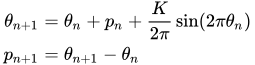
with both iterates taken modulo 1. In essence, the standard map introduces a momentum pn which is allowed to dynamically vary, rather than being forced fixed, as it is in the circle map. The standard map is studied in physics by means of the kicked rotor Hamiltonian.
Mode locking
[edit]The mode locking diagram
[edit]


For small to intermediate values of K (that is, in the range of K = 0 to about K = 1), and certain values of Ω, the map exhibits a phenomenon called mode locking or phase locking. In a phase-locked region, the values θn advance essentially as a rational multiple of n, although they may do so chaotically on the small scale.
Conversely, in the complement of the phase-locked region, the θn series never settles into a rational orbit, thus we call it the ergodic set.
The limiting behavior in the mode-locked regions is given by the rotation number
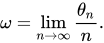
which is also sometimes referred to as the map winding number, or the asymptotic phase velocity.
The phase-locked regions, or Arnold tongues, are illustrated in yellow in the figure to the right. Each such V-shaped region touches down to a rational value Ω = p/q in the limit of K → 0. The values of (K,Ω) in one of these regions will all result in a motion such that the rotation number ω = p/q. For example, all values of (K,Ω) in the large V-shaped region in the bottom-center of the figure correspond to a rotation number of ω = 1/2. One reason the term "locking" is used is that the individual values θn can be perturbed by rather large random disturbances (up to the width of the tongue, for a given value of K), without disturbing the limiting rotation number. That is, the sequence stays "locked on" to the signal, despite the addition of significant noise to the series θn. This ability to "lock on" in the presence of noise is central to the utility of the phase-locked loop electronic circuit.[citation needed]
Properties of the mode locking diagram
[edit]By the symmetry of the circle map family, the Arnold tongue diagram is mirror-symmetric across the lines , , and . Consequently, it is standard to only plot the vertical half-strip bounded by the 3 lines.


There is a mode-locked region for every rational number p/q.
For every reduced rational number p/q, the width of its mode-locked region grows as . For example:

- The shape of the mode-locked region above 0/1 is a triangle with straight edges at the lowest order.
- The shape of the mode-locked region above 1/2 is a triangle with two curved edges, each being a parabola at the lowest order.
- The shape of the mode-locked region above 1/5 and 2/5 are both triangles with two curved edges. The width between the curved edges grows as .

In other words, the largest tongues, ordered by size, occur at the Farey fractions.
For the mode-locked region above 0/1 is exactly solvable. It is a triangle with sides . The other mode-locked regions do not have closed-form solutions for their shapes, but for small values of , we can take a series expansion to obtain their shapes near . For example, the mode-locked region above 1/2, to the lowest order, consists of two parabolas of formula .


The mode locking diagram behaves very differently in the and regions.


For any and any , the circle map is smooth and strictly increasing, so for any , the map is a strictly increasing diffeomorphism. Thus, starting at any , we obtain the same asymptotic phase velocity. In particular, this means that the dynamics can mode-lock to at most one mode. Graphically, this means the Arnold tongues do not overlap in this region.



For any the circle map is not monotonic. Thus, for certain values of , the dynamics can mode-lock to two or more modes, depending on the choice of . Graphically, this means the Arnold tongues may overlap in this region. For the circle map, in this region, no more than two stable mode locking regions can overlap. That is, at most two Arnold tongues can overlap at any point in this region.
In the region, the circle map maps the rationals, a set of measure zero at K = 0, to a set of non-zero measure for K ≠ 0.

Fixing a , and taking a cross-section through the diagram, we obtain a one-dimensional fractal with the same scaling behavior as the fat Cantor set. Consequently, its fractal dimension is 1.

Fixing K and taking a cross-section through the diagram, so that ω is plotted as a function of Ω. This gives a "Devil's staircase", a shape that is the same as the Cantor function in terms of its scaling behavior.
It is unknown if there is an upper bound to how many Arnold tongues can overlap for a generic map.[citation needed]
 |
|
Routes to chaos
[edit]


![{\displaystyle [-0.5,0.5]}](https://wikimedia.org/api/rest_v1/media/math/render/svg/2f82e0cb567f3dc7df3709b7077b346272589753)
![{\displaystyle [0,1]}](https://wikimedia.org/api/rest_v1/media/math/render/svg/738f7d23bb2d9642bab520020873cccbef49768d)
As previously described, the behavior of the map is very different for and . The point produces a phase transition.

For , the ergodic set (the complement of the Arnold tongues) is also a fractal of fractal dimension 1. But at , the ergodic set becomes a fractal of dimension ~0.87.[10]
If we fix and vary , the bifurcation diagram around this paragraph is obtained, where we can observe periodic orbits, period-doubling bifurcations as well as possible chaotic behavior.

The circle map also exhibits subharmonic routes to chaos, that is, period doubling of the form 3, 6, 12, 24,....
Other properties of the Arnold's circle map
[edit]Consider the general family of circle endomorphisms:
where, for the standard circle map, we have that . Sometimes it will also be convenient to represent the circle map in terms of a mapping :



We now proceed to listing some interesting properties of these circle endomorphisms.
P1. is monotonically increasing for , so for these values of the iterates only move forward in the circle, never backwards. To see this, note that the derivative of is:



which is positive as long as .
P2. When expanding the recurrence relation, one obtains a formula for :

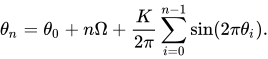
P3. Suppose that , so they are periodic fixed points of period . Since the sine oscillates at frequency 1 Hz, the number of oscillations of the sine per cycle of will be , thus characterizing a phase-locking of .[11]



P4. For any , it is true that , which in turn means that . Because of this, for many purposes it does not matter if the iterates are taken modulus or not.



P5 (translational symmetry).[12][11] Suppose that for a given there is a phase-locking in the system. Then, for with integer , there would be a phase-locking. This also means that if is a periodic orbit for parameter , then it is also a periodic orbit for any .


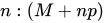


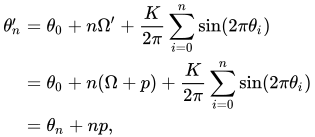


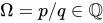
P6. For there will be phase-locking whenever is a rational. Moreover, let , then the phase-locking is .


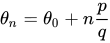
and equality modulus will hold only when is an integer, and the first that satisfies this is . Consequently:


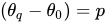
meaning a phase-locking.
For irrational (which leads to an irrational rotation), it would be necessary to have for integers and , but then and is rational, which contradicts the initial hypothesis.


Deriving the circle map
[edit]

Another way to view the circle map is as follows. Consider a function that decreases linearly with slope . Once it reaches zero, its value is reset to a certain oscillating value, described by a function . We are now interested in the sequence of times at which y(t) reaches zero.



This model tells us that at time it is valid that . From this point, will then decrease linearly until , where the function is zero, thus yielding:




![{\displaystyle {\begin{aligned}0&=y(t_{n-1})-a\cdot (t_{n}-t_{n-1})\\[0.5em]0&=\left[c+b\sin(2\pi t_{n-1})\right]-at_{n}+at_{n-1}\\[0.5em]t_{n}&={\frac {1}{a}}\left[c+b\sin(2\pi t_{n-1})\right]+t_{n-1}\\[0.5em]t_{n}&=t_{n-1}+{\frac {c}{a}}+{\frac {b}{a}}\sin(2\pi t_{n-1})\end{aligned}}}](https://wikimedia.org/api/rest_v1/media/math/render/svg/a91812190f89b36afeeeb427a247dd2af4a66573)
and by choosing and we obtain the circle map discussed previously:



Glass, L. (2001) argues that this simple model is applicable to some biological systems, such as regulation of substance concentration in cells or blood, with above representing the concentration of a certain substance.
In this model, a phase-locking of would mean that is reset exactly times every periods of the sinusoidal . The rotation number, in turn, would be the quotient .[11]


See also
[edit]Notes
[edit]- ↑ Arnol'd, V.I. (1961). "Small denominators. I. Mapping the circle onto itself". Izvestiya Rossiiskoi Akademii Nauk. Seriya Matematicheskaya. 25 (1): 21–86. Section 12 in page 78 has a figure showing Arnold tongues.
- ↑ Translation to english of Arnold's paper: S. Adjan; V. I. Arnol'd; S. P. Demuškin; Ju. S. Gurevič; S. S. Kemhadze; N. I. Klimov; Ju. V. Linnik; A. V. Malyšev; P. S. Novikov; D. A. Suprunenko; V. A. Tartakovskiĭ; V. Tašbaev. Eleven Papers on Number Theory, Algebra and Functions of a Complex Variable. Vol. 46. American Mathematical Society Translations Series 2.
- 1 2 Jensen, M.H.; Krishna, S. (2012). "Inducing phase-locking and chaos in cellular oscillators by modulating the driving stimuli". FEBS Letters. 586 (11): 1664–1668. arXiv:1112.6093. doi:10.1016/j.febslet.2012.04.044. PMID 22673576. S2CID 2959093.
- ↑ Gérard, C.; Goldbeter, A. (2012). "The cell cycle is a limit cycle". Mathematical Modelling of Natural Phenomena. 7 (6): 126–166. doi:10.1051/mmnp/20127607.
- ↑ Nakao, M.; Enkhkhudulmur, T.E.; Katayama, N.; Karashima, A. (2014). Entrainability of cell cycle oscillator models with exponential growth of cell mass. Conference of Engineering in Medicine and Biology Society. IEEE. pp. 6826–6829.
- ↑ Romeira, B.; Figueiredo, J.M.; Ironside, C.N.; Slight, T. (2009). "Chaotic dynamics in resonant tunneling optoelectronic voltage controlled oscillators". IEEE Photonics Technology Letters. 21 (24): 1819–1821. Bibcode:2009IPTL...21.1819R. doi:10.1109/LPT.2009.2034129. S2CID 41327316.
- ↑ Glass, L. (2001). "Synchronization and rhythmic processes in physiology". Nature. 410 (6825): 277–284. Bibcode:2001Natur.410..277G. doi:10.1038/35065745. PMID 11258383. S2CID 4379463.
- ↑ He studied it using cosine instead of sine; see page 78 of Arnol'd, V.I. (1961).
- ↑ Weisstein, Eric. "Map Winding Number". MathWorld. Retrieved 20 June 2016.
- ↑ Jensen, Mogens Høgh; Bak, Per; Bohr, Tomas (1 October 1984). "Transition to chaos by interaction of resonances in dissipative systems. I. Circle maps". Physical Review A. 30 (4). American Physical Society: 1960–1969. doi:10.1103/PhysRevA.30.1960.
- 1 2 3 Glass, L.; Perez, R. (1982). "Fine structure of phase locking". Physical Review Letters. 48 (26): 1772. Bibcode:1982PhRvL..48.1772G. doi:10.1103/PhysRevLett.48.1772.
- ↑ Guevara, M.R.; Glass, L. (1982). "Phase locking, period doubling bifurcations and chaos in a mathematical model of a periodically driven oscillator: A theory for the entrainment of biological oscillators and the generation of cardiac dysrhythmias". Journal of Mathematical Biology. 14 (1): 1–23. CiteSeerX 10.1.1.476.8649. doi:10.1007/BF02154750. PMID 7077182. S2CID 2273911.
{{cite journal}}: Cite uses deprecated parameter|citeseerx=(help)
References
[edit]- Weisstein, Eric W. "Circle Map". MathWorld.
- Boyland, P.L. (1986). "Bifurcations of circle maps: Arnol'd tongues, bistability and rotation intervals". Communications in Mathematical Physics. 106 (3): 353–381. Bibcode:1986CMaPh.106..353B. doi:10.1007/BF01207252. S2CID 121088353.
- Gilmore, R.; Lefranc, M. (2002). The Topology of Chaos: Alice in Stretch and Squeezeland. John Wiley & Sons. ISBN 0-471-40816--6. - Provides a brief review of basic facts in section 2.12.
- Glass, L.; Guevara, M.R.; Shrier, A.; Perez, R. (1983). "Bifurcation and chaos in a periodically stimulated cardiac oscillator". Physica D: Nonlinear Phenomena. 7 (1–3): 89–101. Bibcode:1983PhyD....7...89G. doi:10.1016/0167-2789(83)90119-7. - Performs a detailed analysis of heart cardiac rhythms in the context of the circle map.
- McGuinness, M.; Hong, Y.; Galletly, D.; Larsen, P. (2004). "Arnold tongues in human cardiorespiratory systems". Chaos. 14 (1): 1–6. Bibcode:2004Chaos..14....1M. doi:10.1063/1.1620990. PMID 15003038.
External links
[edit]- Circle map with interactive Java applet

