


Gelfond's constant
 | This article needs more citations. (October 2022) |
In mathematics, the exponential of pi eπ,[1] also called Gelfond's constant,[2] is the real number e raised to the power π (i.e., the value of the exponential function at π).
Its decimal expansion is given by
Like both e and π, this constant is both irrational and transcendental. This follows from the Gelfond–Schneider theorem, which establishes ab to be transcendental, given that a is algebraic and not equal to zero or one and b is algebraic but not rational. We have where i is the imaginary unit. Since −i is algebraic but not rational, eπ is transcendental. The numbers π, eπ, and the lemniscate constant are also known to be algebraically independent over the rational numbers, as demonstrated by Yuri Nesterenko.[3] It is not known whether eπ is a Liouville number.[4] The constant was mentioned in Hilbert's seventh problem alongside the Gelfond–Schneider constant 2√2, and the name "Gelfond's constant" stems from Soviet mathematician Alexander Gelfond.[5]

Occurrences
[edit]The constant eπ appears in relation to the volumes of hyperspheres.


The volume of an n-sphere with radius R is given by where Γ is the gamma function. Considering only unit spheres (R = 1) yields


Any even-dimensional 2n-sphere now gives Summing up all even-dimensional unit sphere volumes and utilizing the series expansion of the exponential function gives[6]


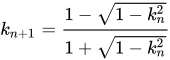
Also, if one defines k0 = 1/√2 and for n > 0, then the sequence converges rapidly to eπ.[7]

In physics
[edit]The Q factor is a measure of how underdamped an oscillating system is; at large values, it is approximately equal to the number of oscillation cycles it takes for the amplitude of the oscillator to decrease by a factor of eπ, or the energy by a factor of e2π.[8][9]
A black hole bends light coming from behind it, producing an infinite series of lensed images corresponding to the number of times light wraps around the photon sphere. For a non-rotating black hole, the ratio of distances between successive images is asymptotically equal to e−2π.[10][11]
Blumhofer and Hutter (1997) describe a toy model of a quantum field theory with a Gribov ambiguity-like mechanism that produces multiple generations of fermions, analogous to the real generations in the Standard Model. In the typical case, the mass ratio between successive generations is approximately eπ.[12]
Similar or related constants
[edit]Ramanujan's constant
[edit]The number eπ√163 is known as Ramanujan's constant. Its decimal expansion is given by
which turns out to be very close to the integer 6403203 + 744. This is an application of Heegner numbers, where 163 is the Heegner number in question. This number was discovered in 1859 by the mathematician Charles Hermite.[13] In a 1975 April Fool article in Scientific American magazine,[14] "Mathematical Games" columnist Martin Gardner made the hoax claim that the number was in fact an integer, and that the Indian mathematical genius Srinivasa Ramanujan had predicted it—hence its name. Ramanujan's constant is also a transcendental number.
The coincidental closeness, to within one trillionth of the number 6403203 + 744 is explained by complex multiplication and the q-expansion of the j-invariant, specifically: and where the error term which explains why eπ√163 is 0.00000000000075 below 6403203 + 744.


For more detail on this proof, consult the article on Heegner numbers.
The number eπ − π
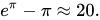
[edit]The number eπ − π is also very close to an integer, its decimal expansion being given by
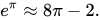
The explanation for this seemingly remarkable coincidence was given by A. Doman in September 2023 and is a result of a sum related to Jacobi theta functions as follows: The first term dominates, since the sum of the terms for total The sum can therefore be truncated to where solving for gives Rewriting the approximation for and using the approximation for gives Thus, rearranging terms gives Ironically, the crude approximation for yields an additional order of magnitude of precision.[15]








The number πe
[edit]The decimal expansion of πe is given by

It is not known whether or not this number is transcendental. Note that, by Gelfond–Schneider theorem, we can only infer definitively whether or not ab is transcendental if a and b are algebraic (a and b are both considered complex numbers).
In the case of eπ, we are only able to prove this number transcendental due to properties of complex exponential forms and the above equivalency given to transform it into (−1)−i, allowing the application of Gelfond–Schneider theorem.
πe has no such equivalence, and hence, as both π and e are transcendental, we cannot use the Gelfond–Schneider theorem to draw conclusions about the transcendence of πe. However the currently unproven Schanuel's conjecture would imply its transcendence.[16]
The number ii
[edit]Using the principal value of the complex logarithm, The decimal expansion of is given by


Its transcendence follows directly from the transcendence of eπ and directly from the Gelfond–Schneider theorem.
See also
[edit]- Transcendental number
- Transcendental number theory, the study of questions related to transcendental numbers
- Euler's identity
- Gelfond–Schneider constant
References
[edit]- ↑ "A039661 - OEIS". oeis.org. Retrieved 2024-10-27.
- ↑ Weisstein, Eric W. "Gelfond's Constant". Wolfram MathWorld. Retrieved 2024-10-27.
- ↑ Nesterenko, Y. (1996). "Modular Functions and Transcendence Problems". Comptes Rendus de l'Académie des Sciences, Série I. 322 (10): 909–914. Zbl 0859.11047.
- ↑ Waldschmidt, Michel (2004-01-24). "Open Diophantine Problems". arXiv:math/0312440.
- ↑ Tijdeman, Robert (1976). "On the Gel'fond–Baker method and its applications". In Felix E. Browder (ed.). Mathematical Developments Arising from Hilbert Problems. Proceedings of Symposia in Pure Mathematics. Vol. XXVIII.1. American Mathematical Society. pp. 241–268. ISBN 0-8218-1428-1. Zbl 0341.10026.
- ↑ "Sums of volumes of unit spheres". www.johndcook.com. 2019-05-26. Retrieved 2024-10-27.
- ↑ Borwein, J.; Bailey, D. (2004). Mathematics by Experiment: Plausible Reasoning in the 21st Century. Wellesley, MA: A K Peters. p. 137. ISBN 1-56881-211-6. Zbl 1083.00001.
- ↑ Anant., Agarwal (2005). Foundations of analog & digital electronic circuits. Lang, Jeffrey (Jeffrey H.). Amsterdam: Elsevier. p. 647. ISBN 9781558607354. OCLC 60245509.
- ↑ Benjamin Crowell (2006). "Light and Matter". Archived from the original on 2011-05-19., Ch. 18
- ↑ Sneppen, Albert (December 2021). "Divergent reflections around the photon sphere of a black hole". Scientific Reports. 11 (1) 14247. Cosmic Dawn Center. Bibcode:2021NatSR..1114247S. doi:10.1038/s41598-021-93595-w. PMC 8270963. PMID 34244573.
- ↑ Sutter, Paul (22 July 2021). "Black holes warp the universe into a grotesque hall of mirrors". livescience.com.
- ↑ Blumhofer, A.; Hutter, M. (1997). "Family structure from periodic solutions of an improved gap equation". Nuclear Physics B. 484 (1): 80–96. Bibcode:1997NuPhB.484...80B. doi:10.1016/S0550-3213(96)00644-X. (Erratum: doi:10.1016/S0550-3213(97)00228-9)
- ↑ Barrow, John D (2002). The Constants of Nature. London: Jonathan Cape. p. 72. ISBN 0-224-06135-6.
- ↑ Gardner, Martin (April 1975). "Mathematical Games". Scientific American. 232 (4). Scientific American, Inc: 127. Bibcode:1975SciAm.232e.102G. doi:10.1038/scientificamerican0575-102.
- ↑ Eric Weisstein, "Almost Integer" at MathWorld.
- ↑ Waldschmidt, Michel (2021). "Schanuel's Conjecture: algebraic independence of transcendental numbers" (PDF).
Further reading
[edit]- Alan Baker and Gisbert Wüstholz, Logarithmic Forms and Diophantine Geometry, New Mathematical Monographs 9, Cambridge University Press, 2007, ISBN 978-0-521-88268-2