


Nuclear operator
 | This article needs more citations. (June 2020) |
In mathematics, nuclear operators are an important class of linear operators introduced by Alexander Grothendieck in his doctoral dissertation[1]. Nuclear operators are intimately tied to the projective tensor product of two topological vector spaces (TVSs).[2]
Preliminaries and notation
[edit]Throughout let X,Y, and Z be topological vector spaces (TVSs) and L : X → Y be a linear operator (no assumption of continuity is made unless otherwise stated).
- The projective tensor product of two locally convex TVSs X and Y is denoted by and the completion of this space will be denoted by .
- L : X → Y is a topological homomorphism or homomorphism, if it is linear, continuous, and is an open map, where , the image of L, has the subspace topology induced by Y.
- If S is a subspace of X then both the quotient map X → X/S and the canonical injection S → X are homomorphisms.
- The set of continuous linear maps X → Z (resp. continuous bilinear maps ) will be denoted by L(X, Z) (resp. B(X, Y; Z)) where if Z is the underlying scalar field then we may instead write L(X) (resp. B(X, Y)).
- Any linear map can be canonically decomposed as follows: where defines a bijection called the canonical bijection associated with L.
- X* or will denote the continuous dual space of X.
- To increase the clarity of the exposition, we use the common convention of writing elements of with a prime following the symbol (e.g. denotes an element of and not, say, a derivative and the variables x and need not be related in any way).
- will denote the algebraic dual space of X (which is the vector space of all linear functionals on X, whether continuous or not).
- A linear map L : H → H from a Hilbert space into itself is called positive if for every . In this case, there is a unique positive map r : H → H, called the square-root of L, such that .[3]
- If is any continuous linear map between Hilbert spaces, then is always positive. Now let R : H → H denote its positive square-root, which is called the absolute value of L. Define first on by setting for and extending continuously to , and then define U on by setting for and extend this map linearly to all of . The map is a surjective isometry and .
- A linear map is called compact or completely continuous if there is a neighborhood U of the origin in X such that is precompact in Y.[4]













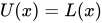






In a Hilbert space, positive compact linear operators, say L : H → H have a simple spectral decomposition discovered at the beginning of the 20th century by Fredholm and F. Riesz:[5]
There is a sequence of positive numbers, decreasing and either finite or else converging to 0, and a sequence of nonzero finite dimensional subspaces of H (i = 1, 2, ) with the following properties: (1) the subspaces are pairwise orthogonal; (2) for every i and every , ; and (3) the orthogonal of the subspace spanned by is equal to the kernel of L.[5]



Notation for topologies
[edit]- σ(X, X′) denotes the coarsest topology on X making every map in X′ continuous and or denotes X endowed with this topology.
- σ(X′, X) denotes weak-* topology on X* and or denotes X′ endowed with this topology.
- Note that every induces a map defined by . σ(X′, X) is the coarsest topology on X′ making all such maps continuous.
- b(X, X′) denotes the topology of bounded convergence on X and or denotes X endowed with this topology.
- b(X′, X) denotes the topology of bounded convergence on X′ or the strong dual topology on X′ and or denotes X′ endowed with this topology.
- As usual, if X* is considered as a topological vector space but it has not been made clear what topology it is endowed with, then the topology will be assumed to be b(X′, X).


A canonical tensor product as a subspace of the dual of Bi(X, Y)
[edit]Let X and Y be vector spaces (no topology is needed yet) and let Bi(X, Y) be the space of all bilinear maps defined on and going into the underlying scalar field.

For every , let be the canonical linear form on Bi(X, Y) defined by for every u ∈ Bi(X, Y). This induces a canonical map defined by , where denotes the algebraic dual of Bi(X, Y). If we denote the span of the range of 𝜒 by X ⊗ Y then it can be shown that X ⊗ Y together with 𝜒 forms a tensor product of X and Y (where x ⊗ y := 𝜒(x, y)). This gives us a canonical tensor product of X and Y.






If Z is any other vector space then the mapping Li(X ⊗ Y; Z) → Bi(X, Y; Z) given by u ↦ u ∘ 𝜒 is an isomorphism of vector spaces. In particular, this allows us to identify the algebraic dual of X ⊗ Y with the space of bilinear forms on X × Y.[6] Moreover, if X and Y are locally convex topological vector spaces (TVSs) and if X ⊗ Y is given the π-topology then for every locally convex TVS Z, this map restricts to a vector space isomorphism from the space of continuous linear mappings onto the space of continuous bilinear mappings.[7] In particular, the continuous dual of X ⊗ Y can be canonically identified with the space B(X, Y) of continuous bilinear forms on X × Y; furthermore, under this identification the equicontinuous subsets of B(X, Y) are the same as the equicontinuous subsets of .[7]


Nuclear operators between Banach spaces
[edit]There is a canonical vector space embedding defined by sending to the map


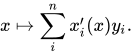
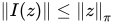
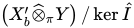
Assuming that X and Y are Banach spaces, then the map has norm (to see that the norm is , note that so that ). Thus it has a continuous extension to a map , where it is known that this map is not necessarily injective.[8] The range of this map is denoted by and its elements are called nuclear operators.[9] is TVS-isomorphic to and the norm on this quotient space, when transferred to elements of via the induced map , is called the trace-norm and is denoted by . Explicitly,[clarification needed explicitly or especially?] if is a nuclear operator then .










Characterization
[edit]Suppose that X and Y are Banach spaces and that is a continuous linear operator.

- The following are equivalent:
- is nuclear.
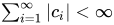
- There exists a sequence in the closed unit ball of , a sequence in the closed unit ball of , and a complex sequence such that and is equal to the mapping:[10] for all . Furthermore, the trace-norm is equal to the infimum of the numbers over the set of all representations of as such a series.[10]
- If Y is reflexive then is a nuclear if and only if is nuclear, in which case . [11]







Properties
[edit]Let X and Y be Banach spaces and let be a continuous linear operator.
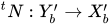
- If is a nuclear map then its transpose is a continuous nuclear map (when the dual spaces carry their strong dual topologies) and .[12]

Nuclear operators between Hilbert spaces
[edit]Nuclear automorphisms of a Hilbert space are called trace class operators.
Let X and Y be Hilbert spaces and let N : X → Y be a continuous linear map. Suppose that where R : X → X is the square-root of and U : X → Y is such that is a surjective isometry. Then N is a nuclear map if and only if R is a nuclear map; hence, to study nuclear maps between Hilbert spaces it suffices to restrict one's attention to positive self-adjoint operators R.[13]



Characterizations
[edit]Let X and Y be Hilbert spaces and let N : X → Y be a continuous linear map whose absolute value is R : X → X. The following are equivalent:
- N : X → Y is nuclear.
- R : X → X is nuclear.[14]
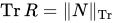
- R : X → X is compact and is finite, in which case .[14]
- Here, is the trace of R and it is defined as follows: Since R is a continuous compact positive operator, there exists a (possibly finite) sequence of positive numbers with corresponding non-trivial finite-dimensional and mutually orthogonal vector spaces such that the orthogonal (in H) of is equal to (and hence also to ) and for all k, for all ; the trace is defined as .
- is nuclear, in which case . [11]
- There are two orthogonal sequences in X and in Y, and a sequence in such that for all , .[14]
- N : X → Y is an integral map.[15]











Nuclear operators between locally convex spaces
[edit]Suppose that U is a convex balanced closed neighborhood of the origin in X and B is a convex balanced bounded Banach disk in Y with both X and Y locally convex spaces. Let and let be the canonical projection. One can define the auxiliary Banach space with the canonical map whose image, , is dense in as well as the auxiliary space normed by and with a canonical map being the (continuous) canonical injection. Given any continuous linear map one obtains through composition the continuous linear map ; thus we have an injection and we henceforth use this map to identify as a subspace of .[9]



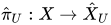




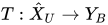

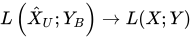


Definition: Let X and Y be Hausdorff locally convex spaces. The union of all as U ranges over all closed convex balanced neighborhoods of the origin in X and B ranges over all bounded Banach disks in Y, is denoted by and its elements are call nuclear mappings of X into Y.[9]
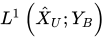
When X and Y are Banach spaces, then this new definition of nuclear mapping is consistent with the original one given for the special case where X and Y are Banach spaces.
Sufficient conditions for nuclearity
[edit]- Let W, X, Y, and Z be Hausdorff locally convex spaces, a nuclear map, and and be continuous linear maps. Then , , and are nuclear and if in addition W, X, Y, and Z are all Banach spaces then .[16][17]
- If is a nuclear map between two Hausdorff locally convex spaces, then its transpose is a continuous nuclear map (when the dual spaces carry their strong dual topologies).[4]
- If in addition X and Y are Banach spaces, then .[11]
- If is a nuclear map between two Hausdorff locally convex spaces and if is a completion of X, then the unique continuous extension of N is nuclear.[17]








Characterizations
[edit]Let X and Y be Hausdorff locally convex spaces and let be a continuous linear operator.
- The following are equivalent:
- is nuclear.
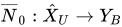
- (Definition) There exists a convex balanced neighborhood U of the origin in X and a bounded Banach disk B in Y such that and the induced map is nuclear, where is the unique continuous extension of , which is the unique map satisfying where is the natural inclusion and is the canonical projection.[8]
- There exist Banach spaces and and continuous linear maps , , and such that is nuclear and .[10]
- There exists an equicontinuous sequence in , a bounded Banach disk , a sequence in B, and a complex sequence such that and is equal to the mapping:[10] for all .
- If X is barreled and Y is quasi-complete, then N is nuclear if and only if N has a representation of the form with bounded in , bounded in Y and .[10]












Properties
[edit]The following is a type of Hahn-Banach theorem for extending nuclear maps:
- If is a TVS-embedding and is a nuclear map then there exists a nuclear map such that . Furthermore, when X and Y are Banach spaces and E is an isometry then for any , can be picked so that .[18]
- Suppose that is a TVS-embedding whose image is closed in Z and let be the canonical projection. Suppose all that every compact disk in is the image under of a bounded Banach disk in Z (this is true, for instance, if X and Z are both Fréchet spaces, or if Z is the strong dual of a Fréchet space and is weakly closed in Z). Then for every nuclear map there exists a nuclear map such that .
- Furthermore, when X and Z are Banach spaces and E is an isometry then for any , can be picked so that .[18]










Let X and Y be Hausdorff locally convex spaces and let be a continuous linear operator.

See also
[edit]- Auxiliary normed spaces
- Covariance operator – Operator in probability theory
- Initial topology – Coarsest topology making certain functions continuous
- Inductive tensor product
- Injective tensor product
- Locally convex topological vector space – Space with topology generated by convex sets
- Nuclear operators between Banach spaces
- Nuclear space – Generalization of finite-dimensional Euclidean spaces different from Hilbert spaces
- Projective tensor product
- Tensor product of Hilbert spaces – Tensor product space endowed with a special inner product
- Topological tensor product – Tensor product constructions for topological vector spaces
- Trace class – Compact operator for which a finite trace can be defined
- Topological vector space – Vector space with a notion of nearness
References
[edit]- ↑ "Nuclear operator - Encyclopedia of Mathematics". encyclopediaofmath.org. Retrieved 2026-08-24.
- ↑ "Produits Tensoriels Topologiques et Espaces Nucléaires". pubs.ams.org. Retrieved 2026-08-24.
- ↑ Trèves 2006, p. 488.
- 1 2 3 Trèves 2006, p. 483.
- 1 2 Trèves 2006, p. 490.
- ↑ Schaefer & Wolff 1999, p. 92.
- 1 2 Schaefer & Wolff 1999, p. 93.
- 1 2 3 Schaefer & Wolff 1999, p. 98.
- 1 2 3 Trèves 2006, pp. 478–479.
- 1 2 3 4 5 Trèves 2006, pp. 481–483.
- 1 2 3 Trèves 2006, p. 484.
- ↑ Trèves 2006, pp. 483–484.
- ↑ Trèves 2006, pp. 488–492.
- 1 2 3 Trèves 2006, pp. 492–494.
- ↑ Trèves 2006, pp. 502–508.
- ↑ Trèves 2006, pp. 479–481.
- 1 2 Schaefer & Wolff 1999, p. 100.
- 1 2 Trèves 2006, p. 485.
Bibliography
[edit]- Diestel, Joe (2008). The metric theory of tensor products : Grothendieck's résumé revisited. Providence, R.I: American Mathematical Society. ISBN 978-0-8218-4440-3. OCLC 185095773.
- Dubinsky, Ed (1979). The structure of nuclear Fréchet spaces. Berlin New York: Springer-Verlag. ISBN 3-540-09504-7. OCLC 5126156.
- Grothendieck, Alexander (1966). Produits tensoriels topologiques et espaces nucléaires (in French). Providence: American Mathematical Society. ISBN 0-8218-1216-5. OCLC 1315788.
- Husain, Taqdir (1978). Barrelledness in topological and ordered vector spaces. Berlin New York: Springer-Verlag. ISBN 3-540-09096-7. OCLC 4493665.
- Khaleelulla, S. M. (1982). Counterexamples in Topological Vector Spaces. Lecture Notes in Mathematics. Vol. 936. Berlin, Heidelberg, New York: Springer-Verlag. ISBN 978-3-540-11565-6. OCLC 8588370.
- Narici, Lawrence; Beckenstein, Edward (2011). Topological Vector Spaces. Pure and applied mathematics (Second ed.). Boca Raton, FL: CRC Press. ISBN 978-1584888666. OCLC 144216834.
- Nlend, H (1977). Bornologies and functional analysis : introductory course on the theory of duality topology-bornology and its use in functional analysis. Amsterdam New York New York: North-Holland Pub. Co. Sole distributors for the U.S.A. and Canada, Elsevier-North Holland. ISBN 0-7204-0712-5. OCLC 2798822.
- Nlend, H (1981). Nuclear and conuclear spaces : introductory courses on nuclear and conuclear spaces in the light of the duality. Amsterdam New York New York, N.Y: North-Holland Pub. Co. Sole distributors for the U.S.A. and Canada, Elsevier North-Holland. ISBN 0-444-86207-2. OCLC 7553061.
- Pietsch, Albrecht (1972). Nuclear locally convex spaces. Berlin, New York: Springer-Verlag. ISBN 0-387-05644-0. OCLC 539541.
- Robertson, A. P. (1973). Topological vector spaces. Cambridge England: University Press. ISBN 0-521-29882-2. OCLC 589250.
- Ryan, Raymond (2002). Introduction to tensor products of Banach spaces. London New York: Springer. ISBN 1-85233-437-1. OCLC 48092184.
- Schaefer, Helmut H.; Wolff, Manfred P. (1999). Topological Vector Spaces. GTM. Vol. 8 (Second ed.). New York, NY: Springer New York Imprint Springer. ISBN 978-1-4612-7155-0. OCLC 840278135.
- Trèves, François (2006) [1967]. Topological Vector Spaces, Distributions and Kernels. Mineola, N.Y.: Dover Publications. ISBN 978-0-486-45352-1. OCLC 853623322.
- Wong (1979). Schwartz spaces, nuclear spaces, and tensor products. Berlin New York: Springer-Verlag. ISBN 3-540-09513-6. OCLC 5126158.
External links
[edit]| Spaces |
| ||||
|---|---|---|---|---|---|
| Theorems | |||||
| Operators | |||||
| Algebras | |||||
| Open problems | |||||
| Applications | |||||
| Advanced topics | |||||
