
India, officially the Republic of India,[j][20] is a country in South Asia. It is the seventh-largest country in the world by area and the most populous country. Bounded by the Indian Ocean on the south, the Arabian Sea on the southwest, and the Bay of Bengal on the southeast, it shares land borders with Pakistan to the west;[k] China, Nepal, and Bhutan to the north; and Bangladesh and Myanmar to the east. In the Indian Ocean, India is in the vicinity of Sri Lanka and the Maldives; its Andaman and Nicobar Islands share a maritime border with Thailand, Myanmar, and Indonesia.
Republic of India Bhārat Gaṇarājya | |
|---|---|
| Motto: Satyameva Jayate (Sanskrit) "Truth Alone Triumphs"[1] | |
| Anthem: Jana Gana Mana (Hindi)[a][2][3] "Thou Art the Ruler of the Minds of All People"[4][2] | |
| National song: Vande Mataram (Sanskrit)[c] "I Bow to Thee, Mother"[b][1][2] | |
.svg) Territory controlled by India shown in dark green; territory claimed but not controlled shown in light green | |
| Capital | New Delhi 28°36′50″N 77°12′30″E / 28.61389°N 77.20833°E |
| Largest city by city proper population | Mumbai |
| Largest city by metropolitan area population | Delhi |
| Official languages | |
| Recognised regional languages |
|
| Native languages | 424 languages[g] |
| Religion (2011)[11] |
|
| Demonym(s) | |
| Government | Federal parliamentary republic |
| Droupadi Murmu | |
| Jagdeep Dhankhar | |
| Narendra Modi | |
| Legislature | Parliament |
| Rajya Sabha | |
| Lok Sabha | |
| Independence from the United Kingdom | |
• Dominion | 15 August 1947 |
• Republic | 26 January 1950 |
| Area | |
• Total | 3,287,263 km2 (1,269,219 sq mi)[2][h] (7th) |
• Water (%) | 9.6 |
| Population | |
• 2023 estimate |  1,428,627,663[13] (1st) 1,428,627,663[13] (1st) |
• 2011 census | 1,210,854,977[14][15] (2nd) |
• Density | 427.3/km2 (1,106.7/sq mi) (30th) |
| GDP (PPP) | 2024 estimate |
• Total |  $16.020 trillion[16] (3rd) $16.020 trillion[16] (3rd) |
• Per capita | $11,112[16] (122nd) |
| GDP (nominal) | 2024 estimate |
• Total | $3.889 trillion[16] (5th) |
• Per capita | $2,698[16] (141st) |
| Gini (2021) |  32.8[17] 32.8[17]medium inequality |
| HDI (2022) | 0.644[18] medium (134th) |
| Currency | Indian rupee (₹) (INR) |
| Time zone | UTC+05:30 (IST) |
| DST is not observed. | |
| Date format |
|
| Drives on | left[19] |
| Calling code | +91 |
| ISO 3166 code | IN |
| Internet TLD | .in (others) |


Modern humans arrived on the Indian subcontinent from Africa no later than 55,000 years ago.[22][23][24] Their long occupation, initially in varying forms of isolation as hunter-gatherers, has made the region highly diverse, second only to Africa in human genetic diversity.[25] Settled life emerged on the subcontinent in the western margins of the Indus river basin 9,000 years ago, evolving gradually into the Indus Valley Civilisation of the third millennium BCE.[26] By at least 1200 BCE, an archaic form of Sanskrit, an Indo-European language, had diffused into India from the northwest.[27][28] Its evidence today is found in the hymns of the Rigveda. Preserved by an oral tradition that was resolutely vigilant, the Rigveda records the dawning of Hinduism in India.[29] The Dravidian languages of India were supplanted in the northern and western regions.[30] By 400 BCE, stratification and exclusion by caste had emerged within Hinduism,[31] and Buddhism and Jainism had arisen, proclaiming social orders unlinked to heredity.[32] Early political consolidations gave rise to the loose-knit Maurya and Gupta Empires based in the Ganges Basin.[33] Their collective era was suffused with wide-ranging creativity,[34] but also marked by the declining status of women,[35] and the incorporation of untouchability into an organised system of belief.[l][36] In South India, the Middle kingdoms exported Dravidian-languages scripts and religious cultures to the kingdoms of Southeast Asia.[37]
In the early mediaeval era, Christianity, Islam, Judaism, and Zoroastrianism became established on India's southern and western coasts.[38] Muslim armies from Central Asia intermittently overran India's northern plains,[39] eventually founding the Delhi Sultanate and drawing northern India into the cosmopolitan networks of mediaeval Islam.[40] In the 15th century, the Vijayanagara Empire created a long-lasting composite Hindu culture in south India.[41] In the Punjab, Sikhism emerged, rejecting institutionalised religion.[42] The Mughal Empire, in 1526, ushered in two centuries of relative peace,[43] leaving a legacy of luminous architecture.[m][44] Gradually expanding rule of the British East India Company followed, turning India into a colonial economy but also consolidating its sovereignty.[45] British Crown rule began in 1858. The rights promised to Indians were granted slowly,[46][47] but technological changes were introduced, and modern ideas of education and public life took root.[48] A pioneering and influential nationalist movement emerged, which was noted for nonviolent resistance and became the major factor in ending British rule.[49][50] In 1947, the British Indian Empire was partitioned into two independent dominions,[51][52][53][54] a Hindu-majority dominion of India and a Muslim-majority dominion of Pakistan, amid large-scale loss of life and an unprecedented migration.[55]
India has been a federal republic since 1950, governed through a democratic parliamentary system, and has been the world's most populous democracy since the time of its independence in 1947.[56][57][58] It is a pluralistic, multilingual and multi-ethnic society. India's nominal per capita income increased from US$64 annually in 1951 to US$2,601 in 2022, and its literacy rate from 16.6% to 74%. During the same time, its population grew from 361 million to almost 1.4 billion,[59] and India became the most populous country in 2023.[60][61] From being a comparatively destitute country in 1951,[62] India has become a fast-growing major economy and a hub for information technology services, with an expanding middle class.[63] India has a space programme with several planned or completed extraterrestrial missions. Indian movies, music, and spiritual teachings play an increasing role in global culture.[64] India has substantially reduced its rate of poverty, though at the cost of increasing economic inequality.[65] India is a nuclear-weapon state, which ranks high in military expenditure. It has disputes over Kashmir with its neighbours, Pakistan and China, unresolved since the mid-20th century.[66] Among the socio-economic challenges India faces are gender inequality, child malnutrition,[67] and rising levels of air pollution.[68] India's land is megadiverse, with four biodiversity hotspots.[69] Its forest cover comprises 21.7% of its area.[70] India's wildlife, which has traditionally been viewed with tolerance in India's culture,[71] is supported among these forests, and elsewhere, in protected habitats.
Etymology
According to the Oxford English Dictionary (third edition 2009), the name "India" is derived from the Classical Latin India, a reference to South Asia and an uncertain region to its east. In turn the name "India" derived successively from Hellenistic Greek India ( Ἰνδία), ancient Greek Indos ( Ἰνδός), Old Persian Hindush (an eastern province of the Achaemenid Empire), and ultimately its cognate, the Sanskrit Sindhu, or "river", specifically the Indus River and, by implication, its well-settled southern basin.[72][73] The ancient Greeks referred to the Indians as Indoi (Ἰνδοί), which translates as "The people of the Indus".[74]
The term Bharat (Bhārat; pronounced [ˈbʱaːɾət] ), mentioned in both Indian epic poetry and the Constitution of India,[75][76] is used in its variations by many Indian languages. A modern rendering of the historical name Bharatavarsha, which applied originally to North India,[77][78] Bharat gained increased currency from the mid-19th century as a native name for India.[75][79]
Hindustan ([ɦɪndʊˈstaːn] ) is a Middle Persian name for India that became popular by the 13th century,[80] and was used widely since the era of the Mughal Empire. The meaning of Hindustan has varied, referring to a region encompassing the northern Indian subcontinent (present-day northern India and Pakistan) or to India in its near entirety.[75][79][81]
History
Ancient India

By 55,000 years ago, the first modern humans, or Homo sapiens, had arrived on the Indian subcontinent from Africa, where they had earlier evolved.[22][23][24] The earliest known modern human remains in South Asia date to about 30,000 years ago.[22] After 6500 BCE, evidence for domestication of food crops and animals, construction of permanent structures, and storage of agricultural surplus appeared in Mehrgarh and other sites in Balochistan, Pakistan.[83] These gradually developed into the Indus Valley Civilisation,[84][83] the first urban culture in South Asia,[85] which flourished during 2500–1900 BCE in Pakistan and western India.[86] Centred around cities such as Mohenjo-daro, Harappa, Dholavira, and Kalibangan, and relying on varied forms of subsistence, the civilisation engaged robustly in crafts production and wide-ranging trade.[85]
During the period 2000–500 BCE, many regions of the subcontinent transitioned from the Chalcolithic cultures to the Iron Age ones.[87] The Vedas, the oldest scriptures associated with Hinduism,[88] were composed during this period,[89] and historians have analysed these to posit a Vedic culture in the Punjab region and the upper Gangetic Plain.[87] Most historians also consider this period to have encompassed several waves of Indo-Aryan migration into the subcontinent from the north-west.[88] The caste system, which created a hierarchy of priests, warriors, and free peasants, but which excluded indigenous peoples by labelling their occupations impure, arose during this period.[90] On the Deccan Plateau, archaeological evidence from this period suggests the existence of a chiefdom stage of political organisation.[87] In South India, a progression to sedentary life is indicated by the large number of megalithic monuments dating from this period,[91] as well as by nearby traces of agriculture, irrigation tanks, and craft traditions.[91]

In the late Vedic period, around the 6th century BCE, the small states and chiefdoms of the Ganges Plain and the north-western regions had consolidated into 16 major oligarchies and monarchies that were known as the mahajanapadas.[92][93] The emerging urbanisation gave rise to non-Vedic religious movements, two of which became independent religions. Jainism came into prominence during the life of its exemplar, Mahavira.[94] Buddhism, based on the teachings of Gautama Buddha, attracted followers from all social classes excepting the middle class; chronicling the life of the Buddha was central to the beginnings of recorded history in India.[95][96][97] In an age of increasing urban wealth, both religions held up renunciation as an ideal,[98] and both established long-lasting monastic traditions. Politically, by the 3rd century BCE, the kingdom of Magadha had annexed or reduced other states to emerge as the Maurya Empire.[99] The empire was once thought to have controlled most of the subcontinent except the far south, but its core regions are now thought to have been separated by large autonomous areas.[100][101] The Mauryan kings are known as much for their empire-building and determined management of public life as for Ashoka's renunciation of militarism and far-flung advocacy of the Buddhist dhamma.[102][103]
The Sangam literature of the Tamil language reveals that, between 200 BCE and 200 CE, the southern peninsula was ruled by the Cheras, the Cholas, and the Pandyas, dynasties that traded extensively with the Roman Empire and with West and Southeast Asia.[104][105] In North India, Hinduism asserted patriarchal control within the family, leading to increased subordination of women.[106][99] By the 4th and 5th centuries, the Gupta Empire had created a complex system of administration and taxation in the greater Ganges Plain; this system became a model for later Indian kingdoms.[107][108] Under the Guptas, a renewed Hinduism based on devotion, rather than the management of ritual, began to assert itself.[109] This renewal was reflected in a flowering of sculpture and architecture, which found patrons among an urban elite.[108] Classical Sanskrit literature flowered as well, and Indian science, astronomy, medicine, and mathematics made significant advances.[108]
Medieval India


The Indian early medieval age, from 600 to 1200 CE, is defined by regional kingdoms and cultural diversity.[110] When Harsha of Kannauj, who ruled much of the Indo-Gangetic Plain from 606 to 647 CE, attempted to expand southwards, he was defeated by the Chalukya ruler of the Deccan.[111] When his successor attempted to expand eastwards, he was defeated by the Pala king of Bengal.[111] When the Chalukyas attempted to expand southwards, they were defeated by the Pallavas from farther south, who in turn were opposed by the Pandyas and the Cholas from still farther south.[111] No ruler of this period was able to create an empire and consistently control lands much beyond their core region.[110] During this time, pastoral peoples, whose land had been cleared to make way for the growing agricultural economy, were accommodated within caste society, as were new non-traditional ruling classes.[112] The caste system consequently began to show regional differences.[112]
In the 6th and 7th centuries, the first devotional hymns were created in the Tamil language.[113] They were imitated all over India and led to both the resurgence of Hinduism and the development of all modern languages of the subcontinent.[113] Indian royalty, big and small, and the temples they patronised drew citizens in great numbers to the capital cities, which became economic hubs as well.[114] Temple towns of various sizes began to appear everywhere as India underwent another urbanisation.[114] By the 8th and 9th centuries, the effects were felt in Southeast Asia, as South Indian culture and political systems were exported to lands that became part of modern-day Myanmar, Thailand, Laos, Brunei, Cambodia, Vietnam, Philippines, Malaysia, and Indonesia.[115] Indian merchants, scholars, and sometimes armies were involved in this transmission; Southeast Asians took the initiative as well, with many sojourning in Indian seminaries and translating Buddhist and Hindu texts into their languages.[115]
After the 10th century, Muslim Central Asian nomadic clans, using swift-horse cavalry and raising vast armies united by ethnicity and religion, repeatedly overran South Asia's north-western plains, leading eventually to the establishment of the Islamic Delhi Sultanate in 1206.[116] The sultanate was to control much of North India and to make many forays into South India. Although at first disruptive for the Indian elites, the sultanate largely left its vast non-Muslim subject population to its own laws and customs.[117][118] By repeatedly repulsing Mongol raiders in the 13th century, the sultanate saved India from the devastation visited on West and Central Asia, setting the scene for centuries of migration of fleeing soldiers, learned men, mystics, traders, artists, and artisans from that region into the subcontinent, thereby creating a syncretic Indo-Islamic culture in the north.[119][120] The sultanate's raiding and weakening of the regional kingdoms of South India paved the way for the indigenous Vijayanagara Empire.[121] Embracing a strong Shaivite tradition and building upon the military technology of the sultanate, the empire came to control much of peninsular India,[122] and was to influence South Indian society for long afterwards.[121]
Early modern India
In the early 16th century, northern India, then under mainly Muslim rulers,[123] fell again to the superior mobility and firepower of a new generation of Central Asian warriors.[124] The resulting Mughal Empire did not stamp out the local societies it came to rule. Instead, it balanced and pacified them through new administrative practices[125][126] and diverse and inclusive ruling elites,[127] leading to more systematic, centralised, and uniform rule.[128] Eschewing tribal bonds and Islamic identity, especially under Akbar, the Mughals united their far-flung realms through loyalty, expressed through a Persianised culture, to an emperor who had near-divine status.[127] The Mughal state's economic policies, deriving most revenues from agriculture[129] and mandating that taxes be paid in the well-regulated silver currency,[130] caused peasants and artisans to enter larger markets.[128] The relative peace maintained by the empire during much of the 17th century was a factor in India's economic expansion,[128] resulting in greater patronage of painting, literary forms, textiles, and architecture.[131] Newly coherent social groups in northern and western India, such as the Marathas, the Rajputs, and the Sikhs, gained military and governing ambitions during Mughal rule, which, through collaboration or adversity, gave them both recognition and military experience.[132] Expanding commerce during Mughal rule gave rise to new Indian commercial and political elites along the coasts of southern and eastern India.[132] As the empire disintegrated, many among these elites were able to seek and control their own affairs.[133]


By the early 18th century, with the lines between commercial and political dominance being increasingly blurred, a number of European trading companies, including the English East India Company, had established coastal outposts.[134][135] The East India Company's control of the seas, greater resources, and more advanced military training and technology led it to increasingly assert its military strength and caused it to become attractive to a portion of the Indian elite; these factors were crucial in allowing the company to gain control over the Bengal region by 1765 and sideline the other European companies.[136][134][137][138] Its further access to the riches of Bengal and the subsequent increased strength and size of its army enabled it to annex or subdue most of India by the 1820s.[139] India was then no longer exporting manufactured goods as it long had, but was instead supplying the British Empire with raw materials. Many historians consider this to be the onset of India's colonial period.[134] By this time, with its economic power severely curtailed by the British parliament and having effectively been made an arm of British administration, the East India Company began more consciously to enter non-economic arenas, including education, social reform, and culture.[140]
Modern India
Historians consider India's modern age to have begun sometime between 1848 and 1885. The appointment in 1848 of Lord Dalhousie as Governor General of the East India Company set the stage for changes essential to a modern state. These included the consolidation and demarcation of sovereignty, the surveillance of the population, and the education of citizens. Technological changes—among them, railways, canals, and the telegraph—were introduced not long after their introduction in Europe.[141][142][143][144] However, disaffection with the company also grew during this time and set off the Indian Rebellion of 1857. Fed by diverse resentments and perceptions, including invasive British-style social reforms, harsh land taxes, and summary treatment of some rich landowners and princes, the rebellion rocked many regions of northern and central India and shook the foundations of Company rule.[145][146] Although the rebellion was suppressed by 1858, it led to the dissolution of the East India Company and the direct administration of India by the British government. Proclaiming a unitary state and a gradual but limited British-style parliamentary system, the new rulers also protected princes and landed gentry as a feudal safeguard against future unrest.[147][148] In the decades following, public life gradually emerged all over India, leading eventually to the founding of the Indian National Congress in 1885.[149][150][151][152]
The rush of technology and the commercialisation of agriculture in the second half of the 19th century was marked by economic setbacks, and many small farmers became dependent on the whims of far-away markets.[153] There was an increase in the number of large-scale famines,[154] and, despite the risks of infrastructure development borne by Indian taxpayers, little industrial employment was generated for Indians.[155] There were also salutary effects: commercial cropping, especially in the newly canalled Punjab, led to increased food production for internal consumption.[156] The railway network provided critical famine relief,[157] notably reduced the cost of moving goods,[157] and helped nascent Indian-owned industry.[156]


After World War I, in which approximately one million Indians served,[158] a new period began. It was marked by British reforms but also repressive legislation, by more strident Indian calls for self-rule, and by the beginnings of a nonviolent movement of non-co-operation, of which Mahatma Gandhi would become the leader and enduring symbol.[159] During the 1930s, slow legislative reform was enacted by the British; the Indian National Congress won victories in the resulting elections.[160] The next decade was beset with crises: Indian participation in World War II, the Congress's final push for non-co-operation, and an upsurge of Muslim nationalism. All were capped by the advent of independence in 1947, but tempered by the partition of India into two states: India and Pakistan.[161]
Vital to India's self-image as an independent nation was its constitution, completed in 1950, which put in place a secular and democratic republic.[162] Per the London Declaration, India retained its membership of the Commonwealth, becoming the first republic within it.[163] Economic liberalisation, which began in the 1980s and the collaboration with Soviet Union for technical know-how,[164] has created a large urban middle class, transformed India into one of the world's fastest-growing economies,[165] and increased its geopolitical clout. Yet, India is also shaped by seemingly unyielding poverty, both rural and urban;[166] by religious and caste-related violence;[167] by Maoist-inspired Naxalite insurgencies;[168] and by separatism in Jammu and Kashmir and in Northeast India.[169] It has unresolved territorial disputes with China[170] and with Pakistan.[170] India's sustained democratic freedoms are unique among the world's newer nations; however, in spite of its recent economic successes, freedom from want for its disadvantaged population remains a goal yet to be achieved.[171]
Geography
India accounts for the bulk of the Indian subcontinent, lying atop the Indian tectonic plate, a part of the Indo-Australian Plate.[172] India's defining geological processes began 75 million years ago when the Indian Plate, then part of the southern supercontinent Gondwana, began a north-eastward drift caused by seafloor spreading to its south-west, and later, south and south-east.[172] Simultaneously, the vast Tethyan oceanic crust, to its northeast, began to subduct under the Eurasian Plate.[172] These dual processes, driven by convection in the Earth's mantle, both created the Indian Ocean and caused the Indian continental crust eventually to under-thrust Eurasia and to uplift the Himalayas.[172] Immediately south of the emerging Himalayas, plate movement created a vast crescent-shaped trough that rapidly filled with river-borne sediment[173] and now constitutes the Indo-Gangetic Plain.[174] The original Indian plate makes its first appearance above the sediment in the ancient Aravalli range, which extends from the Delhi Ridge in a southwesterly direction. To the west lies the Thar Desert, the eastern spread of which is checked by the Aravallis.[175][176][177]


The remaining Indian Plate survives as peninsular India, the oldest and geologically most stable part of India. It extends as far north as the Satpura and Vindhya ranges in central India. These parallel chains run from the Arabian Sea coast in Gujarat in the west to the coal-rich Chota Nagpur Plateau in Jharkhand in the east.[179] To the south, the remaining peninsular landmass, the Deccan Plateau, is flanked on the west and east by coastal ranges known as the Western and Eastern Ghats;[180] the plateau contains the country's oldest rock formations, some over one billion years old. Constituted in such fashion, India lies to the north of the equator between 6° 44′ and 35° 30′ north latitude[n] and 68° 7′ and 97° 25′ east longitude.[181]
India's coastline measures 7,517 kilometres (4,700 mi) in length; of this distance, 5,423 kilometres (3,400 mi) belong to peninsular India and 2,094 kilometres (1,300 mi) to the Andaman, Nicobar, and Lakshadweep island chains.[182] According to the Indian naval hydrographic charts, the mainland coastline consists of the following: 43% sandy beaches; 11% rocky shores, including cliffs; and 46% mudflats or marshy shores.[182]
Major Himalayan-origin rivers that substantially flow through India include the Ganges and the Brahmaputra, both of which drain into the Bay of Bengal.[183] Important tributaries of the Ganges include the Yamuna and the Kosi; the latter's extremely low gradient, caused by long-term silt deposition, leads to severe floods and course changes.[184][185] Major peninsular rivers, whose steeper gradients prevent their waters from flooding, include the Godavari, the Mahanadi, the Kaveri, and the Krishna, which also drain into the Bay of Bengal;[186] and the Narmada and the Tapti, which drain into the Arabian Sea.[187] Coastal features include the marshy Rann of Kutch of western India and the alluvial Sundarbans delta of eastern India; the latter is shared with Bangladesh.[188] India has two archipelagos: the Lakshadweep, coral atolls off India's south-western coast; and the Andaman and Nicobar Islands, a volcanic chain in the Andaman Sea.[189]
Indian climate is strongly influenced by the Himalayas and the Thar Desert, both of which drive the economically and culturally pivotal summer and winter monsoons.[190] The Himalayas prevent cold Central Asian katabatic winds from blowing in, keeping the bulk of the Indian subcontinent warmer than most locations at similar latitudes.[191][192] The Thar Desert plays a crucial role in attracting the moisture-laden south-west summer monsoon winds that, between June and October, provide the majority of India's rainfall.[190] Four major climatic groupings predominate in India: tropical wet, tropical dry, subtropical humid, and montane.[193]
Temperatures in India have risen by 0.7 °C (1.3 °F) between 1901 and 2018.[194] Climate change in India is often thought to be the cause. The retreat of Himalayan glaciers has adversely affected the flow rate of the major Himalayan rivers, including the Ganges and the Brahmaputra.[195] According to some current projections, the number and severity of droughts in India will have markedly increased by the end of the present century.[196]
Biodiversity
India is a megadiverse country, a term employed for 17 countries that display high biological diversity and contain many species exclusively indigenous, or endemic, to them.[197] India is the habitat for 8.6% of all mammals, 13.7% of bird species, 7.9% of reptile species, 6% of amphibian species, 12.2% of fish species, and 6.0% of all flowering plant species.[198][199] Fully a third of Indian plant species are endemic.[200] India also contains four of the world's 34 biodiversity hotspots,[69] or regions that display significant habitat loss in the presence of high endemism.[o][201]
According to official statistics, India's forest cover is 713,789 km2 (275,595 sq mi), which is 21.71% of the country's total land area.[70] It can be subdivided further into broad categories of canopy density, or the proportion of the area of a forest covered by its tree canopy.[202] Very dense forest, whose canopy density is greater than 70%, occupies 3.02% of India's land area.[202][203] It predominates in the tropical moist forest of the Andaman Islands, the Western Ghats, and Northeast India. Moderately dense forest, whose canopy density is between 40% and 70%, occupies 9.39% of India's land area.[202][203] It predominates in the temperate coniferous forest of the Himalayas, the moist deciduous sal forest of eastern India, and the dry deciduous teak forest of central and southern India.[204] Open forest, whose canopy density is between 10% and 40%, occupies 9.26% of India's land area.[202][203] India has two natural zones of thorn forest, one in the Deccan Plateau, immediately east of the Western Ghats, and the other in the western part of the Indo-Gangetic plain, now turned into rich agricultural land by irrigation, its features no longer visible.[205]
Among the Indian subcontinent's notable indigenous trees are the astringent Azadirachta indica, or neem, which is widely used in rural Indian herbal medicine,[206] and the luxuriant Ficus religiosa, or peepul,[207] which is displayed on the ancient seals of Mohenjo-daro,[208] and under which the Buddha is recorded in the Pali canon to have sought enlightenment.[209]
Many Indian species have descended from those of Gondwana, the southern supercontinent from which India separated more than 100 million years ago.[210] India's subsequent collision with Eurasia set off a mass exchange of species. However, volcanism and climatic changes later caused the extinction of many endemic Indian forms.[211] Still later, mammals entered India from Asia through two zoogeographic passes flanking the Himalayas.[212] This had the effect of lowering endemism among India's mammals, which stands at 12.6%, contrasting with 45.8% among reptiles and 55.8% among amphibians.[199] Among endemics are the vulnerable[213] hooded leaf monkey[214] and the threatened[215] Beddome's toad[215][216] of the Western Ghats.
India contains 172 IUCN-designated threatened animal species, or 2.9% of endangered forms.[217] These include the endangered Bengal tiger and the Ganges river dolphin. Critically endangered species include the gharial, a crocodilian; the great Indian bustard; and the Indian white-rumped vulture, which has become nearly extinct by having ingested the carrion of diclofenac-treated cattle.[218] Before they were extensively used for agriculture and cleared for human settlement, the thorn forests of Punjab were mingled at intervals with open grasslands that were grazed by large herds of blackbuck preyed on by the Asiatic cheetah; the blackbuck, no longer extant in Punjab, is now severely endangered in India, and the cheetah is extinct.[219] The pervasive and ecologically devastating human encroachment of recent decades has critically endangered Indian wildlife. In response, the system of national parks and protected areas, first established in 1935, was expanded substantially. In 1972, India enacted the Wildlife Protection Act[220] and Project Tiger to safeguard crucial wilderness; the Forest Conservation Act was enacted in 1980 and amendments added in 1988.[221] India hosts more than five hundred wildlife sanctuaries and eighteen biosphere reserves,[222] four of which are part of the World Network of Biosphere Reserves; seventy-five wetlands are registered under the Ramsar Convention.[223]
-
![India has the majority of the world's wild tigers, approximately 3,170 in 2022.[224]](//upload.wikimedia.org/wikipedia/commons/thumb/d/da/Panthera_tigris_tigris_Tidoba_20150306.jpg/270px-Panthera_tigris_tigris_Tidoba_20150306.jpg)
-
![A chital (Axis axis) stag in the Nagarhole National Park in a region covered by a moderately dense[p] forest.](//upload.wikimedia.org/wikipedia/commons/thumb/3/36/Axis_axis_%28Nagarhole%2C_2010%29.jpg/270px-Axis_axis_%28Nagarhole%2C_2010%29.jpg) A chital (Axis axis) stag in the Nagarhole National Park in a region covered by a moderately dense[p] forest.
A chital (Axis axis) stag in the Nagarhole National Park in a region covered by a moderately dense[p] forest. -
 Three of the last Asiatic cheetahs in India were shot dead in 1948 in Surguja district, Madhya Pradesh, Central India by Maharajah Ramanuj Pratap Singh Deo. The young male cheetahs, all from the same litter, were sitting together when they were shot at night.
![India has the majority of the world's wild tigers, approximately 3,170 in 2022.[224]](/wiki/File:Panthera_tigris_tigris_Tidoba_20150306.jpg)
![A chital (Axis axis) stag in the Nagarhole National Park in a region covered by a moderately dense[p] forest.](/wiki/File:Axis_axis_(Nagarhole,_2010).jpg)

Politics and government
Politics

A parliamentary republic with a multi-party system,[226] India has six recognised national parties, including the Indian National Congress (INC) and the Bharatiya Janata Party (BJP), and more than 50 regional parties.[227] The Congress is considered center in Indian political culture,[228] and the BJP right-wing.[229][230][231] For most of the period between 1950—when India first became a republic—and the late 1980s, the Congress held a majority in the Parliament. Since then, however, it has increasingly shared the political stage with the BJP,[232] as well as with powerful regional parties which have often forced the creation of multi-party coalition governments at the center. [233]
In the Republic of India's first three general elections, in 1951, 1957, and 1962, the Pandit Jawaharlal Nehru-led Congress won easy victories. On Nehru's death in 1964, Lal Bahadur Shastri briefly became prime minister; he was succeeded, after his own unexpected death in 1966, by Nehru's daughter Indira Gandhi, who went on to lead the Congress to election victories in 1967 and 1971. Following public discontent with the state of emergency she declared in 1975, the Congress was voted out of power in 1977; the then-new Janata Party, which had opposed the emergency, was voted in. Its government lasted just over two years. There were two prime ministers during this period; Morarji Desai and Charan Singh. Voted back into power in 1980, the Congress saw a change in leadership in 1984, when Indira Gandhi was assassinated; she was succeeded by her son Rajiv Gandhi, who won an easy victory in the general elections later that year. The Congress was voted out again in 1989 when a National Front coalition, led by the newly formed Janata Dal in alliance with the Left Front, won the elections; that government too proved relatively short-lived, lasting just under two years. There were two prime ministers during this period; V.P. Singh and Chandra Shekhar.[234] Elections were held again in 1991; no party won an absolute majority. The Congress, as the largest single party, was able to form a minority government led by P. V. Narasimha Rao.[235]

A two-year period of political turmoil followed the general election of 1996. Several short-lived alliances shared power at the centre. The BJP formed a government briefly in 1996; it was followed by two comparatively long-lasting United Front coalitions, which depended on external support. There were two prime ministers during this period; H.D. Deve Gowda and I.K. Gujral. In 1998, the BJP was able to form a successful coalition, the National Democratic Alliance (NDA). Led by Atal Bihari Vajpayee, the NDA became the first non-Congress, coalition government to complete a five-year term.[236] Again in the 2004 Indian general elections, no party won an absolute majority, but the Congress emerged as the largest single party, forming another successful coalition: the United Progressive Alliance (UPA). It had the support of left-leaning parties and MPs who opposed the BJP. The UPA returned to power in the 2009 general election with increased numbers, and it no longer required external support from India's communist parties.[237] That year, Manmohan Singh became the first prime minister since Jawaharlal Nehru in 1957 and 1962 to be re-elected to a consecutive five-year term.[238] In the 2014 general election, the BJP became the first political party since 1984 to win a majority and govern without the support of other parties.[239] In the 2019 general election, the BJP was victorious again with majority. In the 2024 general election, the BJP failed to achieve majority and the BJP-led NDA coalition formed the government. Narendra Modi, a former chief minister of Gujarat, is serving as the 14th Prime Minister of India in his third term since May 26, 2014.[240]
Government

India is a federation with a parliamentary system governed under the Constitution of India—the country's supreme legal document. It is a constitutional republic.
Federalism in India defines the power distribution between the union and the states. The Constitution of India, which came into effect on 26 January 1950,[242] originally stated India to be a "sovereign, democratic republic;" this characterisation was amended in 1971 to "a sovereign, socialist, secular, democratic republic".[243] India's form of government, traditionally described as "quasi-federal" with a strong centre and weak states,[244] has grown increasingly federal since the late 1990s as a result of political, economic, and social changes.[245][246]
| Emblem | Sarnath Lion Capital |
|---|---|
| Anthem | Jana Gana Mana |
| Song | "Vande Mataram" |
| Language | None[247][248][249] |
| Currency | ₹ (Indian rupee) |
| Calendar | Shaka |
| Bird | Indian peafowl |
| Flower | Lotus |
| Fruit | Mango |
| Mammal | |
| Tree | Banyan |
| River | Ganges |
The Government of India comprises three branches:[250]
- Executive: The President of India is the ceremonial head of state,[251] who is elected indirectly for a five-year term by an electoral college comprising members of national and state legislatures.[252][253] The Prime Minister of India is the head of government and exercises most executive power.[254] Appointed by the president,[255] the prime minister is by convention supported by the party or political alliance having a majority of seats in the lower house of parliament.[254] The executive of the Indian government consists of the president, the vice-president, and the Union Council of Ministers—with the cabinet being its executive committee—headed by the prime minister. Any minister holding a portfolio must be a member of one of the houses of parliament.[251] In the Indian parliamentary system, the executive is subordinate to the legislature; the prime minister and their council are directly responsible to the lower house of the parliament. Civil servants act as permanent executives and all decisions of the executive are implemented by them.[256]
- Legislature: The legislature of India is the bicameral parliament. Operating under a Westminster-style parliamentary system, it comprises an upper house called the Rajya Sabha (Council of States) and a lower house called the Lok Sabha (House of the People).[257] The Rajya Sabha is a permanent body of 245 members who serve staggered six-year terms with elections every 2 years.[258] Most are elected indirectly by the state and union territorial legislatures in numbers proportional to their state's share of the national population.[255] All but two of the Lok Sabha's 545 members are elected directly by popular vote; they represent single-member constituencies for five-year terms.[259] Two seats of parliament, reserved for Anglo-Indians in the article 331, have been scrapped.[260][261]
- Judiciary: India has a three-tier unitary independent judiciary[262] comprising the supreme court, headed by the Chief Justice of India, 25 high courts, and a large number of trial courts.[262] The supreme court has original jurisdiction over cases involving fundamental rights and over disputes between states and the centre and has appellate jurisdiction over the high courts.[263] It has the power to both strike down union or state laws which contravene the constitution[264] and invalidate any government action it deems unconstitutional.[265]
Administrative divisions
India is a federal union comprising 28 states and 8 union territories.[12] All states, as well as the union territories of Jammu and Kashmir, Puducherry and the National Capital Territory of Delhi, have elected legislatures and governments following the Westminster system of governance. The remaining five union territories are directly ruled by the central government through appointed administrators. In 1956, under the States Reorganisation Act, states were reorganised on a linguistic basis.[266] There are over a quarter of a million local government bodies at city, town, block, district and village levels.[267]
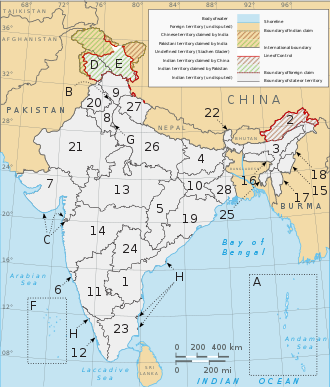
States
Union territories
Foreign, economic and strategic relations

In the 1950s, India strongly supported decolonisation in Africa and Asia and played a leading role in the Non-Aligned Movement.[269] After initially cordial relations with neighbouring China, India went to war with China in 1962 and was widely thought to have been humiliated.[270] This was followed by another military conflict in 1967 in which India successfully repelled Chinese attack.[271] India has had tense relations with neighbouring Pakistan; the two nations have gone to war four times: in 1947, 1965, 1971, and 1999. Three of these wars were fought over the disputed territory of Kashmir, while the third, the 1971 war, followed from India's support for the independence of Bangladesh.[272] In the late 1980s, the Indian military twice intervened abroad at the invitation of the host country: a peace-keeping operation in Sri Lanka between 1987 and 1990; and an armed intervention to prevent a 1988 coup d'état attempt in the Maldives. After the 1965 war with Pakistan, India began to pursue close military and economic ties with the Soviet Union; by the late 1960s, the Soviet Union was its largest arms supplier.[273]
Aside from its ongoing special relationship with Russia,[274] India has wide-ranging defence relations with Israel and France. In recent years, it has played key roles in the South Asian Association for Regional Cooperation and the World Trade Organization. The nation has provided 100,000 military and police personnel to serve in 35 UN peacekeeping operations across four continents. It participates in the East Asia Summit, the G8+5, and other multilateral forums.[275] India has close economic ties with countries in South America,[276] Asia, and Africa; it pursues a "Look East" policy that seeks to strengthen partnerships with the ASEAN nations, Japan, and South Korea that revolve around many issues, but especially those involving economic investment and regional security.[277][278]

China's nuclear test of 1964, as well as its repeated threats to intervene in support of Pakistan in the 1965 war, convinced India to develop nuclear weapons.[280] India conducted its first nuclear weapons test in 1974 and carried out additional underground testing in 1998. Despite criticism and military sanctions, India has signed neither the Comprehensive Nuclear-Test-Ban Treaty nor the Nuclear Non-Proliferation Treaty, considering both to be flawed and discriminatory.[281] India maintains a "no first use" nuclear policy and is developing a nuclear triad capability as a part of its "Minimum Credible Deterrence" doctrine.[282][283] It is developing a ballistic missile defence shield and, a fifth-generation fighter jet.[284][285] Other indigenous military projects involve the design and implementation of Vikrant-class aircraft carriers and Arihant-class nuclear submarines.[286]
Since the end of the Cold War, India has increased its economic, strategic, and military co-operation with the United States and the European Union.[287] In 2008, a civilian nuclear agreement was signed between India and the United States. Although India possessed nuclear weapons at the time and was not a party to the Nuclear Non-Proliferation Treaty, it received waivers from the International Atomic Energy Agency and the Nuclear Suppliers Group, ending earlier restrictions on India's nuclear technology and commerce. As a consequence, India became the sixth de facto nuclear weapons state.[288] India subsequently signed co-operation agreements involving civilian nuclear energy with Russia,[289] France,[290] the United Kingdom,[291] and Canada.[292]

The President of India is the supreme commander of the nation's armed forces; with 1.45 million active troops, they compose the world's second-largest military. It comprises the Indian Army, the Indian Navy, the Indian Air Force, and the Indian Coast Guard.[293] The official Indian defence budget for 2011 was US$36.03 billion, or 1.83% of GDP.[294] Defence expenditure was pegged at US$70.12 billion for fiscal year 2022–23 and, increased 9.8% than previous fiscal year.[295][296] India is the world's second-largest arms importer; between 2016 and 2020, it accounted for 9.5% of the total global arms imports.[297] Much of the military expenditure was focused on defence against Pakistan and countering growing Chinese influence in the Indian Ocean.[298] In May 2017, the Indian Space Research Organisation launched the South Asia Satellite, a gift from India to its neighbouring SAARC countries.[299] In October 2018, India signed a US$5.43 billion (over ₹400 billion) agreement with Russia to procure four S-400 Triumf surface-to-air missile defence systems, Russia's most advanced long-range missile defence system.[300]
Economy


.jpg)
According to the International Monetary Fund (IMF), the Indian economy in 2024 was nominally worth $3.94 trillion; it was the fifth-largest economy by market exchange rates and is, at around $15.0 trillion, the third-largest by purchasing power parity (PPP).[16] With its average annual GDP growth rate of 5.8% over the past two decades, and reaching 6.1% during 2011–2012,[304] India is one of the world's fastest-growing economies.[305] However, due to its low GDP per capita—which ranks 136th in the world in nominal per capita income and 125th in per capita income adjusted for purchasing power parity (PPP)—the vast majority of Indians fall into the low-income group.[306][307] Until 1991, all Indian governments followed protectionist policies that were influenced by socialist economics. Widespread state intervention and regulation largely walled the economy off from the outside world. An acute balance of payments crisis in 1991 forced the nation to liberalise its economy;[308] since then, it has moved increasingly towards a free-market system[309][310] by emphasising both foreign trade and direct investment inflows.[311] India has been a member of World Trade Organization since 1 January 1995.[312]
The 522-million-worker Indian labour force is the world's second largest, as of 2017[update].[293] The service sector makes up 55.6% of GDP, the industrial sector 26.3% and the agricultural sector 18.1%. India's foreign exchange remittances of US$100 billion in 2022,[313] highest in the world, were contributed to its economy by 32 million Indians working in foreign countries.[314] Major agricultural products include rice, wheat, oilseed, cotton, jute, tea, sugarcane, and potatoes.[12] Major industries include textiles, telecommunications, chemicals, pharmaceuticals, biotechnology, food processing, steel, transport equipment, cement, mining, petroleum, machinery, and software.[12] In 2006, the share of external trade in India's GDP stood at 24%, up from 6% in 1985.[309] In 2008, India's share of world trade was 1.7%;[315] In 2021, India was the world's ninth-largest importer and the sixteenth-largest exporter.[316] Major exports include petroleum products, textile goods, jewellery, software, engineering goods, chemicals, and manufactured leather goods.[12] Major imports include crude oil, machinery, gems, fertiliser, and chemicals.[12] Between 2001 and 2011, the contribution of petrochemical and engineering goods to total exports grew from 14% to 42%.[317] India was the world's second-largest textile exporter after China in the 2013 calendar year.[318]
Averaging an economic growth rate of 7.5% for several years prior to 2007,[309] India has more than doubled its hourly wage rates during the first decade of the 21st century.[319] Some 431 million Indians have left poverty since 1985; India's middle classes are projected to number around 580 million by 2030.[320] Though ranking 68th in global competitiveness,[321] as of 2010[update], India ranks 17th in financial market sophistication, 24th in the banking sector, 44th in business sophistication, and 39th in innovation, ahead of several advanced economies.[322] With seven of the world's top 15 information technology outsourcing companies based in India, as of 2009[update], the country is viewed as the second-most favourable outsourcing destination after the United States.[323] India is ranked 39th in the Global Innovation Index in 2024.[324]As of 2023[update], India's consumer market was the world's fifth largest.[325]
Driven by growth, India's nominal GDP per capita increased steadily from US$308 in 1991, when economic liberalisation began, to US$1,380 in 2010, to an estimated US$2,731 in 2024. It is expected to grow to US$3,264 by 2026.[16] However, it has remained lower than those of other Asian developing countries such as Indonesia, Malaysia, Philippines, Sri Lanka, and Thailand, and is expected to remain so in the near future.

According to a 2011 PricewaterhouseCoopers (PwC) report, India's GDP at purchasing power parity could overtake that of the United States by 2045.[327] During the next four decades, Indian GDP is expected to grow at an annualised average of 8%, making it potentially the world's fastest-growing major economy until 2050.[327] The report highlights key growth factors: a young and rapidly growing working-age population; growth in the manufacturing sector because of rising education and engineering skill levels; and sustained growth of the consumer market driven by a rapidly growing middle-class.[327] The World Bank cautions that, for India to achieve its economic potential, it must continue to focus on public sector reform, transport infrastructure, agricultural and rural development, removal of labour regulations, education, energy security, and public health and nutrition.[328]
According to the Worldwide Cost of Living Report 2017 released by the Economist Intelligence Unit (EIU) which was created by comparing more than 400 individual prices across 160 products and services, four of the cheapest cities were in India: Bangalore (3rd), Mumbai (5th), Chennai (5th) and New Delhi (8th).[329]
Industries

India's telecommunication industry is the second-largest in the world with over 1.2 billion subscribers. It contributes 6.5% to India's GDP.[330] After the third quarter of 2017, India surpassed the US to become the second-largest smartphone market in the world after China.[331]
The Indian automotive industry, the world's second-fastest growing, increased domestic sales by 26% during 2009–2010,[332] and exports by 36% during 2008–2009.[333] In 2022, India became the world's third-largest vehicle market after China and the United States, surpassing Japan.[334] At the end of 2011, the Indian IT industry employed 2.8 million professionals, generated revenues close to US$100 billion equalling 7.5% of Indian GDP, and contributed 26% of India's merchandise exports.[335]
The pharmaceutical industry in India emerged as a global player. As of 2021, with 3000 pharmaceutical companies and 10,500 manufacturing units India is the world's third-largest pharmaceutical producer, largest producer of generic medicines and supply up to 50–60% of global vaccines demand, these all contribute up to US$24.44 billions in exports and India's local pharmaceutical market is estimated up to US$42 billion.[336][337] India is among the top 12 biotech destinations in the world.[338][339] The Indian biotech industry grew by 15.1% in 2012–2013, increasing its revenues from ₹204.4 billion (Indian rupees) to ₹235.24 billion (US$3.94 billion at June 2013 exchange rates).[340]
Energy
India's capacity to generate electrical power is 300 gigawatts, of which 42 gigawatts is renewable.[341] The country's usage of coal is a major cause of greenhouse gas emissions by India but its renewable energy is competing strongly.[342] India emits about 7% of global greenhouse gas emissions. This equates to about 2.5 tons of carbon dioxide per person per year, which is half the world average.[343][344] Increasing access to electricity and clean cooking with liquefied petroleum gas have been priorities for energy in India.[345]
Socio-economic challenges
.jpg)
Despite economic growth during recent decades, India continues to face socio-economic challenges. In 2006, India contained the largest number of people living below the World Bank's international poverty line of US$1.25 per day.[347] The proportion decreased from 60% in 1981 to 42% in 2005.[348] Under the World Bank's later revised poverty line, it was 21% in 2011.[q][350] 30.7% of India's children under the age of five are underweight.[351] According to a Food and Agriculture Organization report in 2015, 15% of the population is undernourished.[352][353] The Midday Meal Scheme attempts to lower these rates.[354]
A 2018 Walk Free Foundation report estimated that nearly 8 million people in India were living in different forms of modern slavery, such as bonded labour, child labour, human trafficking, and forced begging, among others.[355] According to the 2011 census, there were 10.1 million child labourers in the country, a decline of 2.6 million from 12.6 million in 2001.[356]
Since 1991, economic inequality between India's states has consistently grown: the per-capita net state domestic product of the richest states in 2007 was 3.2 times that of the poorest.[357] Corruption in India is perceived to have decreased. According to the Corruption Perceptions Index, India ranked 78th out of 180 countries in 2018 with a score of 41 out of 100, an improvement from 85th in 2014.[358][359]
Demographics, languages and religion

With an estimated 1,428,627,663 residents in 2023, India is the world's most populous country.[13] 1,210,193,422 residents were reported in the 2011 provisional census report.[360] Its population grew by 17.64% from 2001 to 2011,[361] compared to 21.54% growth in the previous decade (1991–2001).[361] The human sex ratio, according to the 2011 census, is 940 females per 1,000 males.[360] The median age was 28.7 as of 2020[update].[293] The first post-colonial census, conducted in 1951, counted 361 million people.[362] Medical advances made in the last 50 years as well as increased agricultural productivity brought about by the "Green Revolution" have caused India's population to grow rapidly.[363]
The life expectancy in India is at 70 years—71.5 years for women, 68.7 years for men.[293] There are around 93 physicians per 100,000 people.[364] Migration from rural to urban areas has been an important dynamic in India's recent history. The number of people living in urban areas grew by 31.2% between 1991 and 2001.[365] Yet, in 2001, over 70% still lived in rural areas.[366][367] The level of urbanisation increased further from 27.81% in the 2001 Census to 31.16% in the 2011 Census. The slowing down of the overall population growth rate was due to the sharp decline in the growth rate in rural areas since 1991.[368] According to the 2011 census, there are 53 million-plus urban agglomerations in India; among them Mumbai, Delhi, Kolkata, Chennai, Bangalore, Hyderabad and Ahmedabad, in decreasing order by population.[369] The literacy rate in 2011 was 74.04%: 65.46% among females and 82.14% among males.[370] The rural-urban literacy gap, which was 21.2 percentage points in 2001, dropped to 16.1 percentage points in 2011. The improvement in the rural literacy rate is twice that of urban areas.[368] Kerala is the most literate state with 93.91% literacy; while Bihar the least with 63.82%.[370]

Among speakers of the Indian languages, 74% speak Indo-Aryan languages, the easternmost branch of the Indo-European languages; 24% speak Dravidian languages, indigenous to South Asia and spoken widely before the spread of Indo-Aryan languages and 2% speak Austroasiatic languages or the Sino-Tibetan languages. India has no national language.[371] Hindi, with the largest number of speakers, is the official language of the government.[372][373] English is used extensively in business and administration and has the status of a "subsidiary official language";[6] it is important in education, especially as a medium of higher education. Each state and union territory has one or more official languages, and the constitution recognises in particular 22 "scheduled languages".
The 2011 census reported the religion in India with the largest number of followers was Hinduism (79.80% of the population), followed by Islam (14.23%); the remaining were Christianity (2.30%), Sikhism (1.72%), Buddhism (0.70%), Jainism (0.36%) and others[r] (0.9%).[11] India has the third-largest Muslim population—the largest for a non-Muslim majority country.[374][375]
Culture
_in_Amritsar,_India.jpg)
Indian cultural history spans more than 4,500 years.[376] During the Vedic period (c. 1700 BCE – c. 500 BCE), the foundations of Hindu philosophy, mythology, theology and literature were laid, and many beliefs and practices which still exist today, such as dhárma, kárma, yóga, and mokṣa, were established.[74] India is notable for its religious diversity, with Hinduism, Buddhism, Sikhism, Islam, Christianity, and Jainism among the nation's major religions.[377] The predominant religion, Hinduism, has been shaped by various historical schools of thought, including those of the Upanishads,[378] the Yoga Sutras, the Bhakti movement,[377] and by Buddhist philosophy.[379]
Visual art
India has a very ancient tradition of art, which has exchanged many influences with the rest of Eurasia, especially in the first millennium, when Buddhist art spread with Indian religions to Central, East and Southeast Asia, the last also greatly influenced by Hindu art.[380] Thousands of seals from the Indus Valley Civilization of the third millennium BCE have been found, usually carved with animals, but a few with human figures. The "Pashupati" seal, excavated in Mohenjo-daro, Pakistan, in 1928–29, is the best known.[381][382] After this there is a long period with virtually nothing surviving.[382][383] Almost all surviving ancient Indian art thereafter is in various forms of religious sculpture in durable materials, or coins. There was probably originally far more in wood, which is lost. In north India Mauryan art is the first imperial movement.[384][385][386] In the first millennium CE, Buddhist art spread with Indian religions to Central, East and Southeast Asia, the last also greatly influenced by Hindu art.[387] Over the following centuries a distinctly Indian style of sculpting the human figure developed, with less interest in articulating precise anatomy than ancient Greek sculpture but showing smoothly flowing forms expressing prana ("breath" or life-force).[388][389] This is often complicated by the need to give figures multiple arms or heads, or represent different genders on the left and right of figures, as with the Ardhanarishvara form of Shiva and Parvati.[390][391]
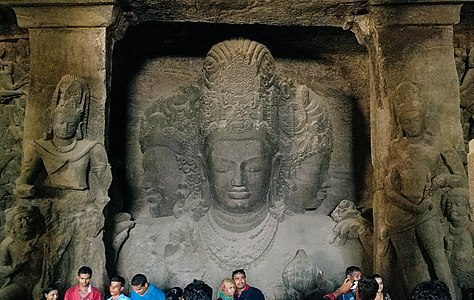
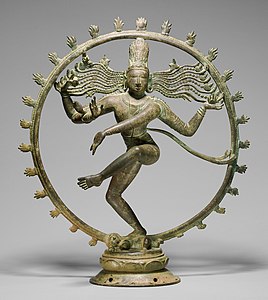
Most of the earliest large sculpture is Buddhist, either excavated from Buddhist stupas such as Sanchi, Sarnath and Amaravati,[392] or is rock cut reliefs at sites such as Ajanta, Karla and Ellora. Hindu and Jain sites appear rather later.[393][394] In spite of this complex mixture of religious traditions, generally, the prevailing artistic style at any time and place has been shared by the major religious groups, and sculptors probably usually served all communities.[395] Gupta art, at its peak c. 300 CE – c. 500 CE, is often regarded as a classical period whose influence lingered for many centuries after; it saw a new dominance of Hindu sculpture, as at the Elephanta Caves.[396][397] Across the north, this became rather stiff and formulaic after c. 800 CE, though rich with finely carved detail in the surrounds of statues.[398] But in the South, under the Pallava and Chola dynasties, sculpture in both stone and bronze had a sustained period of great achievement; the large bronzes with Shiva as Nataraja have become an iconic symbol of India.[399][400]
Ancient painting has only survived at a few sites, of which the crowded scenes of court life in the Ajanta Caves are by far the most important, but it was evidently highly developed, and is mentioned as a courtly accomplishment in Gupta times.[401][402] Painted manuscripts of religious texts survive from Eastern India about the 10th century onwards, most of the earliest being Buddhist and later Jain. No doubt the style of these was used in larger paintings.[403] The Persian-derived Deccan painting, starting just before the Mughal miniature, between them give the first large body of secular painting, with an emphasis on portraits, and the recording of princely pleasures and wars.[404][405] The style spread to Hindu courts, especially among the Rajputs, and developed a variety of styles, with the smaller courts often the most innovative, with figures such as Nihâl Chand and Nainsukh.[406][407] As a market developed among European residents, it was supplied by Company painting by Indian artists with considerable Western influence.[408][409] In the 19th century, cheap Kalighat paintings of gods and everyday life, done on paper, were urban folk art from Calcutta, which later saw the Bengal School of Art, reflecting the art colleges founded by the British, the first movement in modern Indian painting.[410][411]
-

-

-
-
-

-
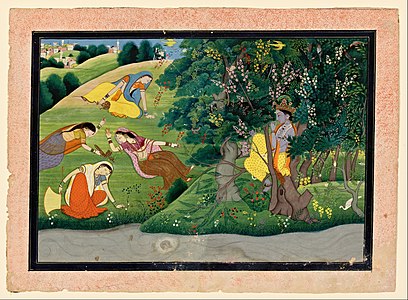 Krishna Fluting to the Milkmaids, Kangra painting, 1775–1785

.jpg)
_(cropped).jpg)
.jpg)


Architecture

Much of Indian architecture, including the Taj Mahal, other works of Indo-Islamic Mughal architecture, and South Indian architecture, blends ancient local traditions with imported styles.[412] Vernacular architecture is also regional in its flavours. Vastu shastra, literally "science of construction" or "architecture" and ascribed to Mamuni Mayan,[413] explores how the laws of nature affect human dwellings;[414] it employs precise geometry and directional alignments to reflect perceived cosmic constructs.[415] As applied in Hindu temple architecture, it is influenced by the Shilpa Shastras, a series of foundational texts whose basic mythological form is the Vastu-Purusha mandala, a square that embodied the "absolute".[416] The Taj Mahal, built in Agra between 1631 and 1648 by orders of Mughal emperor Shah Jahan in memory of his wife, has been described in the UNESCO World Heritage List as "the jewel of Muslim art in India and one of the universally admired masterpieces of the world's heritage".[417] Indo-Saracenic Revival architecture, developed by the British in the late 19th century, drew on Indo-Islamic architecture.[418]
Literature
The earliest literature in India, composed between 1500 BCE and 1200 CE, was in the Sanskrit language.[419] Major works of Sanskrit literature include the Rigveda (c. 1500 BCE – c. 1200 BCE), the epics: Mahābhārata (c. 400 BCE – c. 400 CE) and the Ramayana (c. 300 BCE and later); Abhijñānaśākuntalam (The Recognition of Śakuntalā, and other dramas of Kālidāsa (c. 5th century CE) and Mahākāvya poetry.[420][421][422] In Tamil literature, the Sangam literature (c. 600 BCE – c. 300 BCE) consisting of 2,381 poems, composed by 473 poets, is the earliest work.[423][424][425][426] From the 14th to the 18th centuries, India's literary traditions went through a period of drastic change because of the emergence of devotional poets like Kabīr, Tulsīdās, and Guru Nānak. This period was characterised by a varied and wide spectrum of thought and expression; as a consequence, medieval Indian literary works differed significantly from classical traditions.[427] In the 19th century, Indian writers took a new interest in social questions and psychological descriptions. In the 20th century, Indian literature was influenced by the works of the Bengali poet, author and philosopher Rabindranath Tagore,[428] who was a recipient of the Nobel Prize in Literature.
Performing arts and media

Indian music ranges over various traditions and regional styles. Classical music encompasses two genres and their various folk offshoots: the northern Hindustani and the southern Carnatic schools.[429] Regionalised popular forms include filmi and folk music; the syncretic tradition of the bauls is a well-known form of the latter. Indian dance also features diverse folk and classical forms. Among the better-known folk dances are: bhangra of Punjab, bihu of Assam, Jhumair and chhau of Jharkhand, Odisha and West Bengal, garba and dandiya of Gujarat, ghoomar of Rajasthan, and lavani of Maharashtra. Eight dance forms, many with narrative forms and mythological elements, have been accorded classical dance status by India's National Academy of Music, Dance, and Drama. These are: bharatanatyam of the state of Tamil Nadu, kathak of Uttar Pradesh, kathakali and mohiniyattam of Kerala, kuchipudi of Andhra Pradesh, manipuri of Manipur, odissi of Odisha, and the sattriya of Assam.[430]
Theatre in India melds music, dance, and improvised or written dialogue.[431] Often based on Hindu mythology, but also borrowing from medieval romances or social and political events, Indian theatre includes: the bhavai of Gujarat, the jatra of West Bengal, the nautanki and ramlila of North India, tamasha of Maharashtra, burrakatha of Andhra Pradesh and Telangana, terukkuttu of Tamil Nadu, and the yakshagana of Karnataka.[432] India has a theatre training institute the National School of Drama (NSD) that is situated at New Delhi. It is an autonomous organisation under the Ministry of culture, Government of India.[433] The Indian film industry produces the world's most-watched cinema.[434] Established regional cinematic traditions exist in the Assamese, Bengali, Bhojpuri, Hindi, Kannada, Malayalam, Punjabi, Gujarati, Marathi, Odia, Tamil, and Telugu languages.[435] The Hindi language film industry (Bollywood) is the largest sector representing 43% of box office revenue, followed by the South Indian Telugu and Tamil film industries which represent 36% combined.[436]
Television broadcasting began in India in 1959 as a state-run medium of communication and expanded slowly for more than two decades.[437][438] The state monopoly on television broadcast ended in the 1990s. Since then, satellite channels have increasingly shaped the popular culture of Indian society.[439] Today, television is the most penetrative media in India; industry estimates indicate that as of 2012[update] there are over 554 million TV consumers, 462 million with satellite or cable connections compared to other forms of mass media such as the press (350 million), radio (156 million) or internet (37 million).[440]
Society

Traditional Indian society is sometimes defined by social hierarchy. The Indian caste system embodies much of the social stratification and many of the social restrictions found on the Indian subcontinent. Social classes are defined by thousands of endogamous hereditary groups, often termed as jātis, or "castes".[441] India abolished untouchability in 1950 with the adoption of the constitution and has since enacted other anti-discriminatory laws and social welfare initiatives.
Family values are important in the Indian tradition, and multi-generational patrilineal joint families have been the norm in India, though nuclear families are becoming common in urban areas.[442] An overwhelming majority of Indians, with their consent, have their marriages arranged by their parents or other family elders.[443] Marriage is thought to be for life,[443] and the divorce rate is extremely low,[444] with less than one in a thousand marriages ending in divorce.[445] Child marriages are common, especially in rural areas; many women wed before reaching 18, which is their legal marriageable age.[446] Female infanticide in India, and lately female foeticide, have created skewed gender ratios; the number of missing women in the country quadrupled from 15 million to 63 million in the 50-year period ending in 2014, faster than the population growth during the same period, and constituting 20 percent of India's female electorate.[447] According to an Indian government study, an additional 21 million girls are unwanted and do not receive adequate care.[448] Despite a government ban on sex-selective foeticide, the practice remains commonplace in India, the result of a preference for boys in a patriarchal society.[449] The payment of dowry, although illegal, remains widespread across class lines.[450] Deaths resulting from dowry, mostly from bride burning, are on the rise, despite stringent anti-dowry laws.[451]
Many Indian festivals are religious in origin. The best known include Diwali, Ganesh Chaturthi, Thai Pongal, Holi, Durga Puja, Eid ul-Fitr, Bakr-Id, Christmas, and Vaisakhi.[452][453]
Education
.jpg)
In the 2011 census, about 73% of the population was literate, with 81% for men and 65% for women. This compares to 1981 when the respective rates were 41%, 53% and 29%. In 1951 the rates were 18%, 27% and 9%. In 1921 the rates 7%, 12% and 2%. In 1891 they were 5%, 9% and 1%,[454][455] According to Latika Chaudhary, in 1911 there were under three primary schools for every ten villages. Statistically, more caste and religious diversity reduced private spending. Primary schools taught literacy, so local diversity limited its growth.[456]
The education system of India is the world's second-largest.[457] India has over 900 universities, 40,000 colleges[458] and 1.5 million schools.[459] In India's higher education system, a significant number of seats are reserved under affirmative action policies for the historically disadvantaged. In recent decades India's improved education system is often cited as one of the main contributors to its economic development.[460][461]
Clothing

_Cropped.jpg)
From ancient times until the advent of the modern, the most widely worn traditional dress in India was draped.[462] For women it took the form of a sari, a single piece of cloth many yards long.[462] The sari was traditionally wrapped around the lower body and the shoulder.[462] In its modern form, it is combined with an underskirt, or Indian petticoat, and tucked in the waist band for more secure fastening. It is also commonly worn with an Indian blouse, or choli, which serves as the primary upper-body garment, the sari's end—passing over the shoulder—serving to cover the midriff and obscure the upper body's contours.[462] For men, a similar but shorter length of cloth, the dhoti, has served as a lower-body garment.[463]

The use of stitched clothes became widespread after Muslim rule was established at first by the Delhi sultanate (c. 1300 CE) and then continued by the Mughal Empire (c. 1525 CE).[464] Among the garments introduced during this time and still commonly worn are: the shalwars and pyjamas, both styles of trousers, and the tunics kurta and kameez.[464] In southern India, the traditional draped garments were to see much longer continuous use.[464]
Salwars are atypically wide at the waist but narrow to a cuffed bottom. They are held up by a drawstring, which causes them to become pleated around the waist.[465] The pants can be wide and baggy, or they can be cut quite narrow, on the bias, in which case they are called churidars. When they are ordinarily wide at the waist and their bottoms are hemmed but not cuffed, they are called pyjamas. The kameez is a long shirt or tunic,[466] its side seams left open below the waistline.[467] The kurta is traditionally collarless and made of cotton or silk; it is worn plain or with embroidered decoration, such as chikan; and typically falls to either just above or just below the wearer's knees.[468]
In the last 50 years, fashions have changed a great deal in India. Increasingly, in urban northern India, the sari is no longer the apparel of everyday wear, though they remain popular on formal occasions.[469] The traditional shalwar kameez is rarely worn by younger urban women, who favour churidars or jeans.[469] In white-collar office settings, ubiquitous air conditioning allows men to wear sports jackets year-round.[469] For weddings and formal occasions, men in the middle- and upper classes often wear bandgala, or short Nehru jackets, with pants, with the groom and his groomsmen sporting sherwanis and churidars.[469] The dhoti, once the universal garment of Hindu males, the wearing of which in the homespun and handwoven khadi allowed Gandhi to bring Indian nationalism to the millions,[470] is seldom seen in the cities.[469]
Cuisine

_Rotated.jpg)
The foundation of a typical Indian meal is a cereal cooked in a plain fashion and complemented with flavourful savoury dishes.[471] The cooked cereal could be steamed rice; chapati, a thin unleavened bread made from wheat flour, or occasionally cornmeal, and griddle-cooked dry;[472] the idli, a steamed breakfast cake, or dosa, a griddled pancake, both leavened and made from a batter of rice- and gram meal.[473] The savoury dishes might include lentils, pulses and vegetables commonly spiced with ginger and garlic, but also with a combination of spices that may include coriander, cumin, turmeric, cinnamon, cardamon and others as informed by culinary conventions.[471] They might also include poultry, fish, or meat dishes. In some instances, the ingredients might be mixed during the process of cooking.[474]
A platter, or thali, used for eating usually has a central place reserved for the cooked cereal, and peripheral ones for the flavourful accompaniments, which are often served in small bowls. The cereal and its accompaniments are eaten simultaneously rather than a piecemeal manner. This is accomplished by mixing—for example of rice and lentils—or folding, wrapping, scooping or dipping—such as chapati and cooked vegetables or lentils.[471]
India has distinctive vegetarian cuisines, each a feature of the geographical and cultural histories of its adherents.[476] The appearance of ahimsa, or the avoidance of violence toward all forms of life in many religious orders early in Indian history, especially Upanishadic Hinduism, Buddhism and Jainism, is thought to have contributed to the predominance of vegetarianism among a large segment of India's Hindu population, especially in southern India, Gujarat, the Hindi-speaking belt of north-central India, as well as among Jains.[476] Although meat is eaten widely in India, the proportional consumption of meat in the overall diet is low.[477] Unlike China, which has increased its per capita meat consumption substantially in its years of increased economic growth, in India the strong dietary traditions have contributed to dairy, rather than meat, becoming the preferred form of animal protein consumption.[478]
The most significant import of cooking techniques into India during the last millennium occurred during the Mughal Empire. Dishes such as the pilaf,[479] developed in the Abbasid caliphate,[480] and cooking techniques such as the marinating of meat in yogurt, spread into northern India from regions to its northwest.[481] To the simple yogurt marinade of Persia, onions, garlic, almonds, and spices began to be added in India.[481] Rice was partially cooked and layered alternately with the sauteed meat, the pot sealed tightly, and slow cooked according to another Persian cooking technique, to produce what has today become the Indian biryani,[481] a feature of festive dining in many parts of India.[482] In the food served in Indian restaurants worldwide the diversity of Indian food has been partially concealed by the dominance of Punjabi cuisine. The popularity of tandoori chicken—cooked in the tandoor oven, which had traditionally been used for baking bread in the rural Punjab and the Delhi region, especially among Muslims, but which is originally from Central Asia—dates to the 1950s, and was caused in large part by an entrepreneurial response among people from the Punjab who had been displaced by the 1947 partition of India.[476]
Sports and recreation

Several traditional indigenous sports—such as kabaddi, kho kho, pehlwani, gilli-danda, hopscotch and martial arts such as Kalarippayattu and marma adi—remain popular. Chess is commonly held to have originated in India as chaturaṅga;[484] in recent years, there has been a rise in the number of Indian grandmasters.[485] Viswanathan Anand became the Chess World Champion in 2007 and held the status until 2013. He also won the Chess World Cup in 2000 and 2002. In 2023, R Praggnanandhaa finished as runner-up in the tournament.[486] Parcheesi is derived from Pachisi, another traditional Indian pastime, which in early modern times was played on a giant marble court by Mughal emperor Akbar the Great.[487]
Cricket is the most popular sport in India.[488] The major domestic league is the Indian Premier League. Professional leagues in other sports include the Indian Super League (football) and the Pro Kabaddi league.[489][490][491]

India has won two Cricket World Cups, the 1983 edition and the 2011 edition. India became the inaugural ICC Men's T20 World Cup Champions in 2007, and won it again in 2024. India has also won the Champions Trophy twice, in 2002 and 2013. The only edition of the World Championship of Cricket was won by India in 1985.
India also has eight field hockey gold medals in the summer olympics.[492] The improved results garnered by the Indian Davis Cup team and other tennis players in the early 2010s have made tennis increasingly popular in the country.[493] India has a comparatively strong presence in shooting sports, and has won several medals at the Olympics, the World Shooting Championships, and the Commonwealth Games.[494][495] Other sports in which Indians have succeeded internationally include badminton[496] (Saina Nehwal and P. V. Sindhu are two of the top-ranked female badminton players in the world), boxing,[497] and wrestling.[498] Football is popular in West Bengal, Goa, Tamil Nadu, Kerala, and the north-eastern states.India has traditionally been the dominant country at the South Asian Games. An example of this dominance is the basketball competition where the Indian team won four out of five tournaments to date.[499][500]
India has hosted or co-hosted several international sporting events: the 1951 and 1982 Asian Games; the 1987, 1996, 2011 and 2023 ICC Men's Cricket World Cup tournaments (and is also scheduled to host it in 2031); the 1978, 1997 and 2013 ICC Women's Cricket World Cup tournaments (and is also scheduled to host it in 2025); the 1987, 1985 and 2016 South Asian Games; the 1990–91 Men's Asia Cup; the 2002 Chess World Cup; the 2003 Afro-Asian Games; the 2006 ICC Cricket Champion's Trophy (and is also scheduled to host it in 2029); the 2006 Women's Asia Cup; the 2009 World Badminton Championships; the 2010 Hockey World Cup; the 2010 Commonwealth Games; the 2016 ICC Men's Cricket T20 World Cup (and is also scheduled to host it in 2026); the 2016 ICC Women's Cricket T20 World Cup and the 2017 FIFA U-17 World Cup. Major international sporting events held annually in India include the Maharashtra Open, the Mumbai Marathon, the Delhi Half Marathon, and the Indian Masters. The first Formula 1 Indian Grand Prix featured in late 2011 but has been discontinued from the F1 season calendar since 2014.[501]
See also


.svg)
Notes
- ^ Originally written in Sanskritised Bengali and adopted as the national anthem in its Hindi translation
- ^ "[...] Jana Gana Mana is the National Anthem of India, subject to such alterations in the words as the Government may authorise as occasion arises; and the song Vande Mataram, which has played a historic part in the struggle for Indian freedom, shall be honoured equally with Jana Gana Mana and shall have equal status with it."[5]
- ^ Written in a mixture of Sanskrit and Sanskritised Bengali
- ^ According to Part XVII of the Constitution of India, Hindi in the Devanagari script is the official language of the Union, along with English as an additional official language.[1][6][7] States and union territories can have a different official language of their own other than Hindi or English.
- ^ Not all the state-level official languages are in the eighth schedule and not all the scheduled languages are state-level official languages. For example, the Sindhi language is an 8th scheduled but not a state-level official language.
- ^ Kashmiri and Dogri language are the official languages of Jammu and Kashmir which is currently a union territory and no longer the former state.
- ^
- According to Ethnologue, there are 424 living indigenous languages in India, in contrast to 11 extinct indigenous languages. In addition, there are also 29 living non-indigenous languages.[10]
- Different sources give widely differing figures, primarily based on how the terms "language" and "dialect" are defined and grouped.
- ^ "The country's exact size is subject to debate because some borders are disputed. The Indian government lists the total area as 3,287,260 km2 (1,269,220 sq mi) and the total land area as 3,060,500 km2 (1,181,700 sq mi); the United Nations lists the total area as 3,287,263 km2 (1,269,219 sq mi) and total land area as 2,973,190 km2 (1,147,960 sq mi)."[12]
- ^ See Date and time notation in India.
- ^ ISO: Bhārat Gaṇarājya
- ^ The Government of India also regards Afghanistan as a bordering country, as it considers all of Kashmir to be part of India. However, this is disputed, and the region bordering Afghanistan is administered by Pakistan.[21]
- ^ "A Chinese pilgrim also recorded evidence of the caste system as he could observe it. According to this evidence the treatment meted out to untouchables such as the Chandalas was very similar to that which they experienced in later periods. This would contradict assertions that this rigid form of the caste system emerged in India only as a reaction to the Islamic conquest."[36]
- ^ "Shah Jahan eventually sent her body 800 km (500 mi) to Agra for burial in the Rauza-i Munauwara ("Illuminated Tomb") – a personal tribute and a stone manifestation of his imperial power. This tomb has been celebrated globally as the Taj Mahal."[44]
- ^ The northernmost point under Indian control is the disputed Siachen Glacier in Jammu and Kashmir; however, the Government of India regards the entire region of the former princely state of Jammu and Kashmir, including the Gilgit-Baltistan administered by Pakistan, to be its territory. It therefore assigns the latitude 37° 6′ to its northernmost point.
- ^ A biodiversity hotspot is a biogeographical region which has more than 1,500 vascular plant species, but less than 30% of its primary habitat.[201]
- ^ A forest cover is moderately dense if between 40% and 70% of its area is covered by its tree canopy.
- ^ In 2015, the World Bank raised its international poverty line to $1.90 per day.[349]
- ^ Besides specific religions, the last two categories in the 2011 Census were "Other religions and persuasions" (0.65%) and "Religion not stated" (0.23%).
References
- ^ a b c d National Informatics Centre 2005.
- ^ a b c d "National Symbols | National Portal of India". India.gov.in. Archived from the original on 4 February 2017. Retrieved 1 March 2017.
The National Anthem of India Jana Gana Mana, composed originally in Bengali by Rabindranath Tagore, was adopted in its Hindi version by the Constituent Assembly as the National Anthem of India on 24 January 1950.
- ^ "National anthem of India: a brief on 'Jana Gana Mana'". News18. 14 August 2012. Archived from the original on 17 April 2019. Retrieved 7 June 2019.
- ^ Wolpert 2003, p. 1.
- ^ Constituent Assembly of India 1950.
- ^ a b Ministry of Home Affairs 1960.
- ^ "Profile | National Portal of India". India.gov.in. Archived from the original on 30 August 2013. Retrieved 23 August 2013.
- ^ "Constitutional Provisions – Official Language Related Part-17 of the Constitution of India". Department of Official Language via Government of India. Archived from the original on 18 April 2021. Retrieved 18 April 2021.
- ^ "50th Report of the Commissioner for Linguistic Minorities in India (July 2012 to June 2013)" (PDF). Commissioner for Linguistic Minorities, Ministry of Minority Affairs, Government of India. Archived from the original (PDF) on 8 July 2016. Retrieved 26 December 2014.
- ^ Eberhard, David M.; Simons, Gary F.; Fennig, Charles D. (2024). "India". Ethnologue: Languages of the World (27 ed.).
- ^ a b "C −1 Population by religious community – 2011". Office of the Registrar General & Census Commissioner. Archived from the original on 25 August 2015. Retrieved 25 August 2015.
- ^ a b c d e f Library of Congress 2004.
- ^ a b "World Population Prospects". Population Division – United Nations. Retrieved 2 July 2023.
- ^ "Population Enumeration Data (Final Population)". 2011 Census Data. Office of the Registrar General & Census Commissioner, India. Archived from the original on 22 May 2016. Retrieved 17 June 2016.
- ^ "A – 2 Decadal Variation in Population Since 1901" (PDF). 2011 Census Data. Office of the Registrar General & Census Commissioner, India. Archived from the original (PDF) on 30 April 2016. Retrieved 17 June 2016.
- ^ a b c d e f "World Economic Outlook Database, October 2024 Edition. (India)". www.imf.org. International Monetary Fund. 22 October 2024. Retrieved 22 October 2024.
- ^ "Gini index (World Bank estimate) – India". World Bank.
- ^ "Human Development Report 2023/24" (PDF). United Nations Development Programme. 13 March 2024. Retrieved 13 March 2024.
- ^ "List of all left- & right-driving countries around the world". worldstandards.eu. 13 May 2020. Retrieved 10 June 2020.
- ^
- The Essential Desk Reference, Oxford University Press, 2002, p. 76, ISBN 978-0-19-512873-4 "Official name: Republic of India.";
- John Da Graça (2017), Heads of State and Government, London: Macmillan, p. 421, ISBN 978-1-349-65771-1 "Official name: Republic of India; Bharat Ganarajya (Hindi)";
- Graham Rhind (2017), Global Sourcebook of Address Data Management: A Guide to Address Formats and Data in 194 Countries, Taylor & Francis, p. 302, ISBN 978-1-351-93326-1 "Official name: Republic of India; Bharat.";
- Bradnock, Robert W. (2015), The Routledge Atlas of South Asian Affairs, Routledge, p. 108, ISBN 978-1-317-40511-5 "Official name: English: Republic of India; Hindi:Bharat Ganarajya";
- Penguin Compact Atlas of the World, Penguin, 2012, p. 140, ISBN 978-0-7566-9859-1 "Official name: Republic of India";
- Merriam-Webster's Geographical Dictionary (3rd ed.), Merriam-Webster, 1997, pp. 515–516, ISBN 978-0-87779-546-9 "Officially, Republic of India";
- Complete Atlas of the World: The Definitive View of the Earth (3rd ed.), DK Publishing, 2016, p. 54, ISBN 978-1-4654-5528-4 "Official name: Republic of India";
- Worldwide Government Directory with Intergovernmental Organizations 2013, CQ Press, 2013, p. 726, ISBN 978-1-4522-9937-2
- ^ "Ministry of Home Affairs (Department of Border Management)" (PDF). Archived from the original (PDF) on 17 March 2015. Retrieved 1 September 2008.
- ^ a b c Petraglia & Allchin 2007, p. 10, "Y-Chromosome and Mt-DNA data support the colonization of South Asia by modern humans originating in Africa. ... Coalescence dates for most non-European populations average to between 73 and 55 ka."
- ^ a b Dyson 2018, p. 1, "Modern human beings—Homo sapiens—originated in Africa. Then, intermittently, sometime between 60,000 and 80,000 years ago, tiny groups of them began to enter the north-west of the Indian subcontinent. It seems likely that initially they came by way of the coast. ... it is virtually certain that there were Homo sapiens in the subcontinent 55,000 years ago, even though the earliest fossils that have been found of them date to only about 30,000 years before the present."
- ^ a b Fisher 2018, p. 23, "Scholars estimate that the first successful expansion of the Homo sapiens range beyond Africa and across the Arabian Peninsula occurred from as early as 80,000 years ago to as late as 40,000 years ago, although there may have been prior unsuccessful emigrations. Some of their descendants extended the human range ever further in each generation, spreading into each habitable land they encountered. One human channel was along the warm and productive coastal lands of the Persian Gulf and northern Indian Ocean. Eventually, various bands entered India between 75,000 years ago and 35,000 years ago."
- ^ Dyson 2018, p. 28
- ^ (a) Dyson 2018, pp. 4–5;
(b) Fisher 2018, p. 33 - ^ Lowe 2015, pp. 1–2, "It consists of 1,028 hymns (sūktas), highly crafted poetic compositions originally intended for recital during rituals and for the invocation of and communication with the Indo-Aryan gods. Modern scholarly opinion largely agrees that these hymns were composed between around 1500 BCE and 1200 BCE, during the eastward migration of the Indo-Aryan tribes from the mountains of what is today northern Afghanistan across the Punjab into north India."
- ^ (a) Witzel 2003, pp. 68–70, "It is known from internal evidence that the Vedic texts were orally composed in northern India, at first in the Greater Punjab and later on also in more eastern areas, including northern Bihar, between ca. 1500 BCE and ca. 500–400 BCE. The oldest text, the Rgveda, must have been more or less contemporary with the Mitanni texts of northern Syria/Iraq (1450–1350 BCE); [...] The Vedic texts were orally composed and transmitted, without the use of script, in an unbroken line of transmission from teacher to student that was formalised early on. This ensured an impeccable textual transmission superior to the classical texts of other cultures; it is in fact something of a tape-recording of ca. 1500–500 BCE. Not just the actual words, but even the long-lost musical (tonal) accent (as in old Greek or in Japanese) has been preserved up to the present. [...] The RV text was composed before the introduction and massive use of iron, that is before ca. 1200–1000 BCE.";
(b) Doniger 2014, pp. xviii, 10, "A Chronology of Hinduism: ca. 1500–1000 BCE Rig Veda; ca. 1200–900 BCE Yajur Veda, Sama Veda and Atharva Veda [...] Hindu texts began with the Rig Veda ('Knowledge of Verses'), composed in northwest India around 1500 BCE; the first of the three Vedas, it is the earliest extant text composed in Sanskrit, the language of ancient India.";
(c) Ludden 2014, p. 19, "In Punjab, a dry region with grasslands watered by five rivers (hence 'panch' and 'ab') draining the western Himalayas, one prehistoric culture left no material remains, but some of its ritual texts were preserved orally over the millennia. The culture is called Aryan, and evidence in its texts indicates that it spread slowly south-east, following the course of the Yamuna and Ganga Rivers. Its elite called itself Arya (pure) and distinguished themselves sharply from others. Aryans led kin groups organized as nomadic horse-herding tribes. Their ritual texts are called Vedas, composed in Sanskrit. Vedic Sanskrit is recorded only in hymns that were part of Vedic rituals to Aryan gods. To be Aryan apparently meant to belong to the elite among pastoral tribes. Texts that record Aryan culture are not precisely datable, but they seem to begin around 1200 BCE with four collections of Vedic hymns (Rg, Sama, Yajur, and Artharva).";
(d) Dyson 2018, pp. 14–15, "Although the collapse of the Indus valley civilization is no longer believed to have been due to an 'Aryan invasion' it is widely thought that, at roughly the same time, or perhaps a few centuries later, new Indo-Aryan-speaking people and influences began to enter the subcontinent from the north-west. Detailed evidence is lacking. Nevertheless, a predecessor of the language that would eventually be called Sanskrit was probably introduced into the north-west sometime between 3,900 and 3,000 years ago. This language was related to one then spoken in eastern Iran; and both of these languages belonged to the Indo-European language family. [...] It seems likely that various small-scale migrations were involved in the gradual introduction of the predecessor language and associated cultural characteristics. However, there may not have been a tight relationship between movements of people on the one hand, and changes in language and culture on the other. Moreover, the process whereby a dynamic new force gradually arose—a people with a distinct ideology who eventually seem to have referred to themselves as 'Arya'—was certainly two-way. That is, it involved a blending of new features which came from outside with other features—probably including some surviving Harappan influences—that were already present. Anyhow, it would be quite a few centuries before Sanskrit was written down. And the hymns and stories of the Arya people—especially the Vedas and the later Mahabharata and Ramayana epics—are poor guides as to historical events. Of course, the emerging Arya were to have a huge impact on the history of the subcontinent. Nevertheless, little is known about their early presence.";
(e) Robb 2011, pp. 46–, "The expansion of Aryan culture is supposed to have begun around 1500 BCE. It should not be thought that this Aryan emergence (though it implies some migration) necessarily meant either a sudden invasion of new peoples, or a complete break with earlier traditions. It comprises a set of cultural ideas and practices, upheld by a Sanskrit-speaking elite, or Aryans. The features of this society are recorded in the Vedas." - ^ (a) Jamison, Stephanie; Brereton, Joel (2020), The Rigveda, Oxford University Press, pp. 2, 4, ISBN 978-0-19-063339-4,
The RgVeda is one of the four Vedas, which together constitute the oldest texts in Sanskrit and the earliest evidence for what will become Hinduism. (p. 2) Although Vedic religion is very different in many regards from what is known as Classical Hinduism, the seeds are there. Gods like Visnu and Siva (under the name Rudra), who will become so dominant later, are already present in the Rgveda, though in roles both lesser than and different from those they will later play, and the principal Rgvedic gods like Indra remain in later Hinduism, though in diminished capacity (p. 4).
;
(b) Flood, Gavin (2020), "Introduction", in Gavin Flood (ed.), The Oxford History of Hinduism: Hindu Practice: Hindu Practice, Oxford University Press, pp. 4–, ISBN 978-0-19-105322-1,I take the term 'Hinduism to meaningfully denote a range and history of practice characterised by a number of features, particularly reference to Vedic textual and sacrificial origins, belonging to endogamous social units (jati/varna), participating in practices that involve making an offering to a deity and receiving a blessing (puja), and a first-level cultural polytheism (although many Hindus adhere to a second-level monotheism in which many gods are regarded as emanations or manifestations of the one, supreme being).
;
(c) Michaels, Axel (2017). Patrick Olivelle, Donald R. Davis (ed.). The Oxford History of Hinduism: Hindu Law: A New History of Dharmaśāstra. Oxford: Oxford University Press. pp. 86–97. ISBN 978-0-19-100709-5.Almost all traditional Hindu families observe until today at least three samskaras (initiation, marriage, and death ritual). Most other rituals have lost their popularity, are combined with other rites of passage, or are drastically shortened. Although samskaras vary from region to region, from class (varna) to class, and from caste to caste, their core elements remain the same owing to the common source, the Veda, and a common priestly tradition preserved by the Brahmin priests. (p 86)
(d) Flood, Gavin D. (1996). An Introduction to Hinduism. Cambridge University Press. p. 35. ISBN 978-0-521-43878-0.It is this Sansrit, vedic, tradition which has maintained a continuity into modern times and which has provided the most important resource and inspiration for Hindu traditions and individuals. The Veda is the foundation for most later developments in what is known as Hinduism.
- ^ Dyson 2018, pp. 16, 25
- ^ Dyson 2018, p. 16
- ^ Fisher 2018, p. 59
- ^ (a) Dyson 2018, pp. 16–17;
(b) Fisher 2018, p. 67;
(c) Robb 2011, pp. 56–57;
(d) Ludden 2014, pp. 29–30. - ^ (a) Ludden 2014, pp. 28–29;
(b) Glenn Van Brummelen (2014), "Arithmetic", in Thomas F. Glick; Steven Livesey; Faith Wallis (eds.), Medieval Science, Technology, and Medicine: An Encyclopedia, Routledge, pp. 46–48, ISBN 978-1-135-45932-1 - ^ (a) Dyson 2018, p. 20;
(b) Stein 2010, p. 90;
(c) Ramusack, Barbara N. (1999), "Women in South Asia", in Barbara N. Ramusack; Sharon L. Sievers (eds.), Women in Asia: Restoring Women to History, Indiana University Press, pp. 27–29, ISBN 0-253-21267-7 - ^ a b Kulke & Rothermund 2004, p. 93.
- ^ Asher & Talbot 2006, p. 17
- ^ (a) Ludden 2014, p. 54;
(b) Asher & Talbot 2006, pp. 78–79;
(c) Fisher 2018, p. 76 - ^ (a) Ludden 2014, pp. 68–70;
(b) Asher & Talbot 2006, pp. 19, 24 - ^ (a) Dyson 2018, p. 48;
(b) Asher & Talbot 2006, p. 52 - ^ Asher & Talbot 2006, p. 74
- ^ Asher & Talbot 2006, p. 267
- ^ Asher & Talbot 2006, p. 152
- ^ a b Fisher 2018, p. 106
- ^ (a) Asher & Talbot 2006, p. 289
(b) Fisher 2018, p. 120 - ^ Taylor, Miles (2016), "The British royal family and the colonial empire from the Georgians to Prince George", in Aldrish, Robert; McCreery, Cindy (eds.), Crowns and Colonies: European Monarchies and Overseas Empires, Manchester University Press, pp. 38–39, ISBN 978-1-5261-0088-7
- ^ Peers 2013, p. 76.
- ^ Embree, Ainslie Thomas; Hay, Stephen N.; Bary, William Theodore De (1988), "Nationalism Takes Root: The Moderates", Sources of Indian Tradition: Modern India and Pakistan, Columbia University Press, p. 85, ISBN 978-0-231-06414-9
- ^ Marshall, P. J. (2001), The Cambridge Illustrated History of the British Empire, Cambridge University Press, p. 179, ISBN 978-0-521-00254-7,
The first modern nationalist movement to arise in the non-European empire, and one that became an inspiration for many others, was the Indian Congress.
- ^ Chiriyankandath, James (2016), Parties and Political Change in South Asia, Routledge, p. 2, ISBN 978-1-317-58620-3,
South Asian parties include several of the oldest in the post-colonial world, foremost among them the 129-year-old Indian National Congress that led India to independence in 1947
- ^ Fisher 2018, pp. 173–174: "The partition of South Asia that produced India and West and East Pakistan resulted from years of bitter negotiations and recriminations ... The departing British also decreed that the hundreds of princes, who ruled one-third of the subcontinent and a quarter of its population, became legally independent, their status to be settled later. Geographical location, personal and popular sentiment, and substantial pressure and incentives from the new governments led almost all princes eventually to merge their domains into either Pakistan or India. ... Each new government asserted its exclusive sovereignty within its borders, realigning all territories, animals, plants, minerals, and all other natural and human-made resources as either Pakistani or Indian property, to be used for its national development... Simultaneously, the central civil and military services and judiciary split roughly along religious 'communal' lines, even as they divided movable government assets according to a negotiated formula: 22.7 percent for Pakistan and 77.3 percent for India."
- ^ Chatterji, Joya; Washbrook, David (2013), "Introduction: Concepts and Questions", in Chatterji, Joya; Washbrook, David (eds.), Routledge Handbook of the South Asian Diaspora, London and New York: Routledge, ISBN 978-0-415-48010-9,
Joya Chatterji describes how the partition of the British Indian empire into the new nation states of India and Pakistan produced new diaspora on a vast, and hitherto unprecedented, scale, but hints that the sheer magnitude of refugee movements in South Asia after 1947 must be understood in the context of pre-existing migratory flows within the partitioned regions (see also Chatterji 2013). She also demonstrates that the new national states of India and Pakistan were quickly drawn into trying to stem this migration. As they put into place laws designed to restrict the return of partition emigrants, this produced new dilemmas for both new nations in their treatment of 'overseas Indians'; and many of them lost their right to return to their places of origin in the subcontinent, and also their claims to full citizenship in host countries.
- ^ Talbot, Ian; Singh, Gurharpal (2009), The Partition of India, Cambridge University Press, ISBN 978-0-521-85661-4, archived from the original on 13 December 2016, retrieved 15 November 2015,
When the British divided and quit India in August 1947, they not only partitioned the subcontinent with the emergence of the two nations of India and Pakistan but also the provinces of Punjab and Bengal. ... Indeed for many the Indian subcontinent's division in August 1947 is seen as a unique event which defies comparative historical and conceptual analysis
- ^ Khan, Yasmin (2017) [2007], The Great Partition: The Making of India and Pakistan (2nd ed.), New Haven and London: Yale University Press, p. 1, ISBN 978-0-300-23032-1,
South Asians learned that the British Indian empire would be partitioned on 3 June 1947. They heard about it on the radio, from relations and friends, by reading newspapers and, later, through government pamphlets. Among a population of almost four hundred million, where the vast majority live in the countryside, ploughing the land as landless peasants or sharecroppers, it is hardly surprising that many thousands, perhaps hundreds of thousands, did not hear the news for many weeks afterwards. For some, the butchery and forced relocation of the summer months of 1947 may have been the first that they knew about the creation of the two new states rising from the fragmentary and terminally weakened British empire in India
- ^ (a) Copland 2001, pp. 71–78;
(b) Metcalf & Metcalf 2006, p. 222. - ^ Metcalf & Metcalf 2012, p. 327: "Even though much remains to be done, especially in regard to eradicating poverty and securing effective structures of governance, India's achievements since independence in sustaining freedom and democracy have been singular among the world's new nations."
- ^ Stein, Burton (2012), Arnold, David (ed.), A History of India, The Blackwell History of the World Series (2 ed.), Wiley-Blackwell,
One of these is the idea of India as 'the world's largest democracy', but a democracy forged less by the creation of representative institutions and expanding electorate under British rule than by the endeavours of India's founding fathers – Gandhi, Nehru, Patel and Ambedkar – and the labours of the Constituent Assembly between 1946 and 1949, embodied in the Indian constitution of 1950. This democratic order, reinforced by the regular holding of nationwide elections and polling for the state assemblies, has, it can be argued, consistently underpinned a fundamentally democratic state structure – despite the anomaly of the Emergency and the apparent durability of the Gandhi-Nehru dynasty.
- ^ Fisher 2018, pp. 184–185: "Since 1947, India's internal disputes over its national identity, while periodically bitter and occasionally punctuated by violence, have been largely managed with remarkable and sustained commitment to national unity and democracy."
- ^ Dyson 2018, pp. 219, 262
- ^ Biswas, Soutik (1 May 2023). "Most populous nation: Should India rejoice or panic?". BBC News. British Broadcasting Corporation. Retrieved 3 May 2023.
- ^ World Population Prospects 2022: Summary of Results (PDF). New York: United Nations Department of Social and Economic Affairs. 2022. pp. i.
- ^ Fisher 2018, p. 8
- ^ Metcalf & Metcalf 2012, pp. 265–266
- ^ Metcalf & Metcalf 2012, p. 266
- ^ Dyson 2018, p. 216
- ^ (a) "Kashmir, region Indian subcontinent", Encyclopaedia Britannica, archived from the original on 13 August 2019, retrieved 15 August 2019,
Kashmir, region of the northwestern Indian subcontinent ... has been the subject of dispute between India and Pakistan since the partition of the Indian subcontinent in 1947.
;
(b) Pletcher, Kenneth, "Aksai Chin, Plateau Region, Asia", Encyclopaedia Britannica, archived from the original on 2 April 2019, retrieved 16 August 2019,Aksai Chin, Chinese (Pinyin) Aksayqin, portion of the Kashmir region, ... constitutes nearly all the territory of the Chinese-administered sector of Kashmir that is claimed by India
;
(c) Bosworth, C. E (2006). "Kashmir". Encyclopedia Americana: Jefferson to Latin. Scholastic Library Publishing. p. 328. ISBN 978-0-7172-0139-6.KASHMIR, kash'mer, the northernmost region of the Indian subcontinent, administered partly by India, partly by Pakistan, and partly by China. The region has been the subject of a bitter dispute between India and Pakistan since they became independent in 1947
- ^ Narayan, Jitendra; John, Denny; Ramadas, Nirupama (2018). "Malnutrition in India: status and government initiatives". Journal of Public Health Policy. 40 (1): 126–141. doi:10.1057/s41271-018-0149-5. ISSN 0197-5897. PMID 30353132. S2CID 53032234.
- ^ Balakrishnan, Kalpana; Dey, Sagnik; et al. (2019). "The impact of air pollution on deaths, disease burden, and life expectancy across the states of India: the Global Burden of Disease Study 2017". The Lancet Planetary Health. 3 (1): e26–e39. doi:10.1016/S2542-5196(18)30261-4. ISSN 2542-5196. PMC 6358127. PMID 30528905.
- ^ a b India, International Union for Conservation of Nature (IUCN), 2019, archived from the original on 1 November 2020, retrieved 21 May 2019
- ^ a b "India State of Forest Report, 2021". Forest Survey of India, National Informatics Centre. Retrieved 17 January 2022.
- ^ Karanth & Gopal 2005, p. 374.
- ^ "India (noun)", Oxford English Dictionary (3rd ed.), 2009 (subscription required)
- ^ Thieme 1970, pp. 447–450.
- ^ a b Kuiper 2010, p. 86.
- ^ a b c Clémentin-Ojha 2014.
- ^ The Constitution of India (PDF), Ministry of Law and Justice, 1 December 2007, archived from the original (PDF) on 9 September 2014, retrieved 3 March 2012,
Article 1(1): India, that is Bharat, shall be a Union of States.
- ^ Jha, Dwijendra Narayan (2014), Rethinking Hindu Identity, Routledge, p. 11, ISBN 978-1-317-49034-0
- ^ Singh 2017, p. 253.
- ^ a b Barrow 2003.
- ^ Paturi, Joseph; Patterson, Roger (2016). "Hinduism (with Hare Krishna)". In Hodge, Bodie; Patterson, Roger (eds.). World Religions & Cults Volume 2: Moralistic, Mythical and Mysticism Religions. United States: New Leaf Publishing Group. pp. 59–60. ISBN 978-0-89051-922-6.
The actual term Hindu first occurs as a Persian geographical term for the people who lived beyond the Indus River. The term Hindu originated as a geographical term and did not refer to a religion. Later, Hindu was taken by European languages from the Arabic term al-Hind, which referred to the people who lived across the Indus River. This Arabic term was itself taken from the Persian term Hindū, which refers to all Indians. By the 13th century, Hindustan emerged as a popular alternative name for India, meaning the "land of Hindus."
- ^ "Hindustan", Encyclopædia Britannica, retrieved 17 July 2011
- ^ Lowe, John J. (2017). Transitive Nouns and Adjectives: Evidence from Early Indo-Aryan. Oxford University Press. p. 58. ISBN 978-0-19-879357-1.
The term 'Epic Sanskrit' refers to the language of the two great Sanskrit epics, the Mahābhārata and the Rāmāyaṇa. ... It is likely, therefore, that the epic-like elements found in Vedic sources and the two epics that we have are not directly related, but that both drew on the same source, an oral tradition of storytelling that existed before, throughout, and after the Vedic period.
- ^ a b Coningham & Young 2015, pp. 104–105.
- ^ Kulke & Rothermund 2004, pp. 21–23.
- ^ a b Singh 2009, p. 181.
- ^ Possehl 2003, p. 2.
- ^ a b c Singh 2009, p. 255.
- ^ a b Singh 2009, pp. 186–187.
- ^ Witzel 2003, pp. 68–69.
- ^ Kulke & Rothermund 2004, pp. 41–43.
- ^ a b Singh 2009, pp. 250–251.
- ^ Singh 2009, pp. 260–265.
- ^ Kulke & Rothermund 2004, pp. 53–54.
- ^ Singh 2009, pp. 312–313.
- ^ Kulke & Rothermund 2004, pp. 54–56.
- ^ Stein 1998, p. 21.
- ^ Stein 1998, pp. 67–68.
- ^ Singh 2009, p. 300.
- ^ a b Singh 2009, p. 319.
- ^ Stein 1998, pp. 78–79.
- ^ Kulke & Rothermund 2004, p. 70.
- ^ Singh 2009, p. 367.
- ^ Kulke & Rothermund 2004, p. 63.
- ^ Stein 1998, pp. 89–90.
- ^ Singh 2009, pp. 408–415.
- ^ Stein 1998, pp. 92–95.
- ^ Kulke & Rothermund 2004, pp. 89–91.
- ^ a b c Singh 2009, p. 545.
- ^ Stein 1998, pp. 98–99.
- ^ a b Stein 1998, p. 132.
- ^ a b c Stein 1998, pp. 119–120.
- ^ a b Stein 1998, pp. 121–122.
- ^ a b Stein 1998, p. 123.
- ^ a b Stein 1998, p. 124.
- ^ a b Stein 1998, pp. 127–128.
- ^ Ludden 2002, p. 68.
- ^ Asher & Talbot 2008, p. 47.
- ^ Metcalf & Metcalf 2006, p. 6.
- ^ Ludden 2002, p. 67.
- ^ Asher & Talbot 2008, pp. 50–51.
- ^ a b Asher & Talbot 2008, p. 53.
- ^ Metcalf & Metcalf 2006, p. 12.
- ^ Robb 2001, p. 80.
- ^ Stein 1998, p. 164.
- ^ Asher & Talbot 2008, p. 115.
- ^ Robb 2001, pp. 90–91.
- ^ a b Metcalf & Metcalf 2006, p. 17.
- ^ a b c Asher & Talbot 2008, p. 152.
- ^ Asher & Talbot 2008, p. 158.
- ^ Stein 1998, p. 169.
- ^ Asher & Talbot 2008, p. 186.
- ^ a b Metcalf & Metcalf 2006, pp. 23–24.
- ^ Asher & Talbot 2008, p. 256.
- ^ a b c Asher & Talbot 2008, p. 286.
- ^ Metcalf & Metcalf 2006, pp. 44–49.
- ^ Robb 2001, pp. 98–100.
- ^ Ludden 2002, pp. 128–132.
- ^ Metcalf & Metcalf 2006, pp. 51–55.
- ^ Metcalf & Metcalf 2006, pp. 68–71.
- ^ Asher & Talbot 2008, p. 289.
- ^ Robb 2001, pp. 151–152.
- ^ Metcalf & Metcalf 2006, pp. 94–99.
- ^ Brown 1994, p. 83.
- ^ Peers 2006, p. 50.
- ^ Metcalf & Metcalf 2006, pp. 100–103.
- ^ Brown 1994, pp. 85–86.
- ^ Stein 1998, p. 239.
- ^ Metcalf & Metcalf 2006, pp. 103–108.
- ^ Robb 2001, p. 183.
- ^ Sarkar 1983, pp. 1–4.
- ^ Copland 2001, pp. ix–x.
- ^ Metcalf & Metcalf 2006, p. 123.
- ^ Stein 1998, p. 260.
- ^ Stein 2010, p. 245: An expansion of state functions in British and in princely India occurred as a result of the terrible famines of the later nineteenth century, ... A reluctant regime decided that state resources had to be deployed and that anti-famine measures were best managed through technical experts.
- ^ Stein 1998, p. 258.
- ^ a b Metcalf & Metcalf 2006, p. 126.
- ^ a b Metcalf & Metcalf 2006, p. 97.
- ^ Metcalf & Metcalf 2006, p. 163.
- ^ Metcalf & Metcalf 2006, p. 167.
- ^ Metcalf & Metcalf 2006, pp. 195–197.
- ^ Metcalf & Metcalf 2006, p. 203.
- ^ Metcalf & Metcalf 2006, p. 231.
- ^ "London Declaration, 1949". Commonwealth. Retrieved 11 October 2022.
- ^ "Role of Soviet Union in India's industrialisation: a comparative assessment with the West" (PDF). ijrar.com.
- ^ "Briefing Rooms: India", Economic Research Service, United States Department of Agriculture, 2009, archived from the original on 20 May 2011
- ^ Metcalf & Metcalf 2006, pp. 265–266.
- ^ Metcalf & Metcalf 2006, pp. 266–270.
- ^ Metcalf & Metcalf 2006, p. 253.
- ^ Metcalf & Metcalf 2006, p. 274.
- ^ a b Metcalf & Metcalf 2006, pp. 247–248.
- ^ Metcalf & Metcalf 2006, p. 304.
- ^ a b c d Ali & Aitchison 2005.
- ^ Dikshit & Schwartzberg 2023, p. 7.
- ^ Prakash et al. 2000.
- ^ Kaul 1970, p. 160, " The Aravalli range boldy defines the eastern limit of the arid and semi-arid zone. Probably the more humid conditions that prevail near the Aravallis prevented the extension of aridity towards the east and the Ganges Valley. It is noteworthy that, wherever there are gaps in this range, sand has advanced to the east of it."
- ^ Prasad 1974, p. 372, " The topography of the Indian Desert is dominated by the Aravalli Ranges on its eastern border, which consist largely of tightly folded and highly metamorphosed Archaean rocks."
- ^ Fisher 2018, p. 83, " East of the lower Indus lay the inhospitable Rann of Kutch and Thar Desert. East of the upper Indus lay the more promising but narrow corridor between the Himalayan foothills on the north and the Thar Desert and Aravalli Mountains on the south. At the strategic choke point, just before reaching the fertile, well-watered Gangetic plain, sat Delhi. On this site, where life giving streams running off the most northern spur of the rocky Aravalli ridge flowed into the Jumna river, and where the war-horse and war-elephant trade intersected, a series of dynasties built fortified capitals."
- ^ Mcgrail et al. 2003, p. 257.
- ^ Dikshit & Schwartzberg 2023, p. 8.
- ^ Dikshit & Schwartzberg 2023, pp. 9–10.
- ^ Ministry of Information and Broadcasting 2007, p. 1.
- ^ a b Kumar et al. 2006.
- ^ Dikshit & Schwartzberg 2023, p. 15.
- ^ Duff 1993, p. 353.
- ^ Basu & Xavier 2017, p. 78.
- ^ Dikshit & Schwartzberg 2023, p. 16.
- ^ Dikshit & Schwartzberg 2023, p. 17.
- ^ Dikshit & Schwartzberg 2023, p. 12.
- ^ Dikshit & Schwartzberg 2023, p. 13.
- ^ a b Chang 1967, pp. 391–394.
- ^ Posey 1994, p. 118.
- ^ Wolpert 2003, p. 4.
- ^ Heitzman & Worden 1996, p. 97.
- ^ Sharma, Vibha (15 June 2020). "Average temperature over India projected to rise by 4.4 degrees Celsius: Govt report on impact of climate change in country". The Tribune. Retrieved 30 November 2020.
- ^ Sethi, Nitin (3 February 2007). "Global warming: Mumbai to face the heat". The Times of India. Retrieved 11 March 2021.
- ^ Gupta, Vivek; Jain, Manoj Kumar (2018). "Investigation of multi-model spatiotemporal mesoscale drought projections over India under climate change scenario". Journal of Hydrology. 567: 489–509. Bibcode:2018JHyd..567..489G. doi:10.1016/j.jhydrol.2018.10.012. ISSN 0022-1694. S2CID 135053362.
- ^ Megadiverse Countries, Biodiversity A–Z, UN Environment World Conservation Monitoring Centre, retrieved 17 October 2021
- ^ "Animal Discoveries 2011: New Species and New Records" (PDF). Zoological Survey of India. 2012. Archived from the original (PDF) on 16 January 2013. Retrieved 20 July 2012.
- ^ a b Puri, S. K., "Biodiversity Profile of India", ces.iisc.ernet.in, archived from the original on 21 November 2011, retrieved 20 June 2007
- ^ Basak 1983, p. 24.
- ^ a b Venkataraman, Krishnamoorthy; Sivaperuman, Chandrakasan (2018), "Biodiversity Hotspots in India", in Sivaperuman, Chandrakasan; Venkataraman, Krishnamoorthy (eds.), Indian Hotspots: Vertebrate Faunal Diversity, Conservation and Management, Springer, p. 5, ISBN 978-981-10-6605-4
- ^ a b c d Jha, Raghbendra (2018), Facets of India's Economy and Her Society Volume II: Current State and Future Prospects, Springer, p. 198, ISBN 978-1-349-95342-4
- ^ a b c "Forest Cover in States/UTs in India in 2019". Forest Research Institute via National Informatics Centre. Retrieved 16 October 2021.
- ^ Tritsch 2001, pp. 11–12.
- ^ Tritsch 2001, p. 12India has two natural zones of thorn forest, one in the rain shadow area of the Deccan Plateau east of the Western Ghats, and the other in the western part of the Indo-Gangetic plain. Growth is limited only by moisture availability in these areas, so with irrigation the fertile alluvial soil of Punjab and Haryana has been turned into India's prime agricultural area. Much of the thorn forest covering the plains probably had savannah-like features now no longer visible.
- ^ Goyal, Anupam (2006), The WTO and International Environmental Law: Towards Conciliation, Oxford University Press, p. 295, ISBN 978-0-19-567710-2 Quote: "The Indian government successfully argued that the medicinal neem tree is part of traditional Indian knowledge. (page 295)"
- ^ Hughes, Julie E. (2013), Animal Kingdoms, Harvard University Press, p. 106, ISBN 978-0-674-07480-4,
At same time, the leafy pipal trees and comparative abundance that marked the Mewari landscape fostered refinements unattainable in other lands.
- ^ Ameri, Marta (2018), "Letting the Pictures Speak: An Image-Based Approach to the Mythological and Narrative Imagery of the Harappan World", in Ameri, Marta; Costello, Sarah Kielt; Jamison, Gregg; Scott, Sarah Jarmer (eds.), Seals and Sealing in the Ancient World: Case Studies from the Near East, Egypt, the Aegean, and South Asia, Cambridge University Press, pp. 156–157, ISBN 978-1-108-17351-3 Quote: "The last of the centaurs has the long, wavy, horizontal horns of a markhor, a human face, a heavy-set body that appears bovine, and a goat tail ... This figure is often depicted by itself, but it is also consistently represented in scenes that seem to reflect the adoration of a figure in a pipal tree or arbour and which may be termed ritual. These include fully detailed scenes like that visible in the large 'divine adoration' seal from Mohenjo-daro."
- ^ Paul Gwynne (2011), World Religions in Practice: A Comparative Introduction, John Wiley & Sons, p. 358, ISBN 978-1-4443-6005-9,
The tree under which Sakyamuni became the Buddha is a peepal tree (Ficus religiosa).
- ^ Crame & Owen 2002, p. 142.
- ^ Karanth 2006.
- ^ Tritsch 2001, p. 14.
- ^ Singh, M.; Kumar, A. & Molur, S. (2008). "Trachypithecus johnii". The IUCN Red List of Threatened Species. 2008. e.T44694A10927987. doi:10.2305/IUCN.UK.2008.RLTS.T44694A10927987.en.
- ^ Fischer, Johann. "Semnopithecus johnii". ITIS. Archived from the original on 29 August 2018. Retrieved 27 August 2018.
- ^ a b S.D. Biju; Sushil Dutta; M.S. Ravichandran Karthikeyan Vasudevan; S.P. Vijayakumar; Chelmala Srinivasulu; Gajanan Dasaramji Bhuddhe (2004). "Duttaphrynus beddomii". The IUCN Red List of Threatened Species. 2004. IUCN: e.T54584A86543952. doi:10.2305/IUCN.UK.2004.RLTS.T54584A11155448.en.
- ^ Frost, Darrel R. (2015). "Duttaphrynus beddomii (Günther, 1876)". Amphibian Species of the World: an Online Reference. Version 6.0. American Museum of Natural History. Archived from the original on 21 July 2015. Retrieved 13 September 2015.
- ^ Mace 1994, p. 4.
- ^ Lovette, Irby J.; Fitzpatrick, John W. (2016), Handbook of Bird Biology, John Wiley & Sons, p. 599, ISBN 978-1-118-29105-4
- ^ Tritsch 2001, p. 15Before it was so heavily settled and intensively exploited, the Punjab was dominated by thorn forest interspersed by rolling grasslands which were grazed on by millions of Blackbuck, accompanied by their dominant predator, the Cheetah. Always keen hunters, the Moghul princes kept tame cheetahs which were used to chase and bring down the Blackbuck. Today the Cheetah is extinct in India and the severely endangered Blackbuck no longer exists in the Punjab.
- ^ Ministry of Environment and Forests 1972.
- ^ Department of Environment and Forests 1988.
- ^ "Biosphere" (PDF). Retrieved 28 June 2023.
- ^ "75 Ramsar Sites in 75th Year of Independence". pib.gov.in. Retrieved 28 June 2023.
- ^ Reviving the Roar: India's Tiger Population Is On the Rise, 13 April 2023, retrieved 15 April 2023
- ^ Johnston, Hank (2019), Social Movements, Nonviolent Resistance, and the State, Routledge, p. 83, ISBN 978-0-429-88566-2
- ^ Burnell & Calvert 1999, p. 125.
- ^ Election Commission of India.
- ^ Sáez, Lawrence; Sinha, Aseema (2010). "Political cycles, political institutions and public expenditure in India, 1980–2000". British Journal of Political Science. 40 (1): 91–113. doi:10.1017/s0007123409990226. ISSN 0007-1234. S2CID 154767259.
- ^ Malik & Singh 1992, pp. 318–336.
- ^ Banerjee 2005, p. 3118.
- ^ Halarnkar, Samar (13 June 2012). "Narendra Modi makes his move". BBC News.
The right-wing Hindu nationalist Bharatiya Janata Party (BJP), India's primary opposition party
- ^ Sarkar 2007, p. 84.
- ^ Chander 2004, p. 117.
- ^ Bhambhri 1992, pp. 118, 143.
- ^ "Narasimha Rao Passes Away". The Hindu. 24 December 2004. Archived from the original on 13 February 2009. Retrieved 2 November 2008.
- ^ Dunleavy, Diwakar & Dunleavy 2007.
- ^ Kulke & Rothermund 2004, p. 384.
- ^ Business Standard 2009.
- ^ "BJP first party since 1984 to win parliamentary majority on its own". DNA. Indo-Asian News Service. 16 May 2014. Archived from the original on 21 May 2014. Retrieved 20 May 2014.
- ^ Mashal, Mujib (4 June 2024). "Modi Wins 3rd Term in India Election With Closer Results Than Expected". The New York Times.
- ^ Bremner, G. A. (2016), Architecture and Urbanism in the British Empire, Oxford University Press, p. 117, ISBN 978-0-19-102232-6
- ^ Pylee 2003a, p. 4.
- ^ Dutt 1998, p. 421.
- ^ Wheare 1980, p. 28.
- ^ Echeverri-Gent 2002, pp. 19–20.
- ^ Sinha 2004, p. 25.
- ^ Khan, Saeed (25 January 2010). "There's no national language in India: Gujarat High Court". The Times of India. Archived from the original on 18 March 2014. Retrieved 5 May 2014.
- ^ "Learning with the Times: India doesn't have any 'national language'". The Times of India. 16 November 2009. Archived from the original on 10 October 2017.
- ^ "Hindi, not a national language: Court". Press Trust of India via The Hindu. Ahmedabad. 25 January 2010. Archived from the original on 4 July 2014. Retrieved 23 December 2014.
- ^ "The Constitution of India" (PDF). legislature.gov.in. Archived (PDF) from the original on 16 April 2019. Retrieved 16 July 2016.
- ^ a b Sharma 2007, p. 31.
- ^ Sharma 2007, p. 138.
- ^ Gledhill 1970, p. 112.
- ^ a b Sharma 1950.
- ^ a b Sharma 2007, p. 162.
- ^ Mathew 2003, p. 524.
- ^ Gledhill 1970, p. 127.
- ^ Sharma 2007, p. 161.
- ^ Sharma 2007, p. 143.
- ^ "Cabinet approves scrapping of 2 seats reserved for Anglo-Indians in Parliament". National Herald. 5 December 2019. Retrieved 17 October 2021.
- ^ Ghosh, Abantika; Kaushal, Pradeep (2 January 2020). "Explained: Anglo-Indian quota, its history, MPs". The Indian Express. Retrieved 17 October 2021.
- ^ a b Neuborne 2003, p. 478.
- ^ Sharma 2007, pp. 238, 255.
- ^ Sripati 1998, pp. 423–424.
- ^ Pylee 2003b, p. 314.
- ^ Sharma 2007, p. 49.
- ^ "India". Commonwealth Local Government Forum. Archived from the original on 15 July 2019. Retrieved 7 September 2019.
- ^ Dinkel, Jürgen (2018). The Non-Aligned Movement: Genesis, Organization and Politics (1927–1992). Brill. pp. 92–93. ISBN 978-90-04-33613-1.
- ^ Rothermund 2000, pp. 48, 227.
- ^ (a) Guyot-Rechard, Berenice (2017), Shadow States: India, China and the Himalayas, 1910–1962, Cambridge University Press, p. 235, ISBN 978-1-107-17679-9,
By invading NEFA, the PRC did not just aim to force a humiliated India to recognise its possession of the Aksai Chin. It also hoped to get, once and for all, the upper hand in their shadowing competition.
(b) Chubb, Andrew (2021), "The Sino-Indian Border Crisis: Chinese Perceptions of Indian Nationalism", in Golley, Jane; Jaivan, Linda; Strange, Sharon (eds.), Crisis, Australian National University Press, pp. 231–232, ISBN 978-1-76046-439-4,The ensuing cycle of escalation culminated in the 1962 Sino-Indian border war in which Mao Zedong's troops overran almost the entire state of Arunachal Pradesh in the eastern sector before unilaterally withdrawing, as if to underline the insult; most of the war's several thousand casualties were Indian. The PLA's decisive victories in the 1962 war not only humiliated the Indian Army, they also entrenched a status quo in Ladakh that was highly unfavourable for India, in which China controls almost all of the disputed territory. A nationalistic press and commentariat have kept 1962 vivid in India's popular consciousness.
(c) Lintner, Bertil (2018), China's India War: Collision Course on the Roof of the World, Oxford University Press, ISBN 978-0-19-909163-8,Lin Biao was put in charge of the operation and that alliance between Mao and his loyal de facto chief of the PLA made the attack on India possible. With China's ultimate victory in the war, Mao's ultra-leftist line had won in China; whatever critical voices that were left in the Party after all the purges fell silent.
(d) Medcalf, Rory (2020), Indo-Pacific Empire: China, America and the contest for the world's pivotal, Manchester University Press, ISBN 978-1-5261-5077-6,From an Indian perspective, the China-India war of 1962 was a shocking betrayal of the principles of co-operation and coexistence: a surprise attack that humiliated India and personally broke Nehru.
(e) Ganguly, Sumit (1997), The Crisis in Kashmir: Portents of War, Hope of Peace, Woodrow Wilson Center Press and Cambridge University Press, p. 44, ISBN 978-0-521-65566-8,In October 1962 India suffered the most humiliating military debacle in its post-independence history, at the hands of the Chinese People's Liberation Army (PLA). The outcome of this conflict had far-reaching consequences for Indian foreign and defence policies. The harsh defeat that the Chinese PLA had inflicted on the Indian Army called into question some of the most deeply held precepts of Nehru's foreign and defence policies.
(f) Raghavan, Srinath (2019), "A Missed Opportunity? The Nehru-Zhou Enlai Summit of 1960", in Bhagavan, Manu (ed.), India and the Cold War, University of North Carolina Press, p. 121, ISBN 978-1-4696-5117-0,The 'forward policy' adopted by India to prevent the Chinese from occupying territory claimed by them was undertaken in the mistaken belief that Beijing would be cautious in dealing with India owing to Moscow's stance on the dispute and its growing proximity to India. These misjudgments would eventually culminate in India's humiliating defeat in the war of October–November 1962.
- ^ Brahma Chellaney (2006). Asian Juggernaut: The Rise of China, India, and Japan. HarperCollins. p. 195. ISBN 978-8172236502.
Indeed, Beijing's acknowledgement of Indian control over Sikkim seems limited to the purpose of facilitating trade through the vertiginous Nathu-la Pass, the scene of bloody artillery duels in September 1967 when Indian troops beat back attacking Chinese forces.
- ^ Gilbert 2002, pp. 486–487.
- ^ Sharma 1999, p. 56.
- ^ Gvosdev, N.K.; Marsh, C. (2013). Russian Foreign Policy: Interests, Vectors, and Sectors. SAGE Publications. p. 353. ISBN 978-1-4833-1130-2.
Putin's visit to India in December 2012 for the yearly India–Russia summit saw both sides reaffirming their special relationship.
- ^ Alford 2008.
- ^ Jorge Heine; R. Viswanathan (Spring 2011). "The Other BRIC in Latin America: India". Americas Quarterly. Archived from the original on 25 May 2017. Retrieved 19 May 2017.
- ^ Ghosh 2009, pp. 282–289.
- ^ Sisodia & Naidu 2005, pp. 1–8.
- ^ Muir, Hugh (13 July 2009), "Diary", The Guardian, archived from the original on 19 October 2014, retrieved 17 October 2021,
Members of the Indian armed forces have the plum job of leading off the great morning parade for Bastille Day. Only after units and bands from India's navy and air force have followed the Maratha Light Infantry will the parade be entirely given over to ... France's armed services.
- ^ Perkovich 2001, pp. 60–86, 106–125.
- ^ Kumar 2010.
- ^ Nair 2007.
- ^ Pandit 2009.
- ^ Pandit 2015.
- ^ Iyer-Mitra, Abhijit; Das, Pushan. "The Advanced Medium Combat Aircraft:A Technical Analysis" (PDF). Observer Research Foundation. Retrieved 17 October 2021.
- ^ "India, Russia Review Defence Ties". The Hindu. 5 October 2011. Archived from the original on 7 October 2011. Retrieved 8 October 2011.
- ^ European Union 2008.
- ^ The Times of India 2008.
- ^ British Broadcasting Corporation 2009.
- ^ Rediff 2008 a.
- ^ Reuters 2010.
- ^ Curry 2010.
- ^ a b c d Central Intelligence Agency.
- ^ Behera 2011.
- ^ "Ministry wise Summary of Budget Provisions, 2022–23" (PDF). Ministry of Finance, Government of India. Retrieved 3 February 2022.
- ^ Pandit 2022.
- ^ Pandit 2021.
- ^ Miglani 2011.
- ^ "Isro-Saarc satellite to be a communication vehicle". Deccan Herald. DH News Service. 12 January 2015. Archived from the original on 28 June 2015. Retrieved 22 April 2015.
- ^ "India Russia S-400 missile deal: All you need to know". The Times of India. 4 October 2018. Archived from the original on 5 October 2018. Retrieved 9 October 2018.
- ^ "Employment in agriculture (% of total employment) (modeled ILO estimate)", The World Bank, 2019, archived from the original on 22 August 2019, retrieved 26 March 2022
- ^ "Employment in agriculture, female (% of female employment) (modeled ILO estimate)", The World Bank, 2019, archived from the original on 22 August 2019, retrieved 26 March 2022
- ^ Kapoor, Rana (27 October 2015), "Growth in organised dairy sector, a boost for rural livelihood", Business Line, archived from the original on 20 July 2019, retrieved 26 August 2019,
Nearly 80 per cent of India's milk production is contributed by small and marginal farmers, with an average herd size of one to two milching animals.
- ^ International Monetary Fund 2011, p. 2.
- ^ Nayak, Goldar & Agrawal 2010, p. xxv.
- ^ International Monetary Fund.
- ^ Kochhar, Rakesh (18 March 2021). "In the pandemic, India's middle class shrinks and poverty spreads while China sees smaller changes". Pew Research Center. Retrieved 22 October 2024.
- ^ Wolpert 2003, p. xiv.
- ^ a b c Organisation for Economic Co-operation and Development 2007.
- ^ Gargan 1992.
- ^ Alamgir 2008, pp. 23, 97.
- ^ World Trade Organization 1995.
- ^ "Remittances to India set to hit record $100bn this year, 25% higher than FDI flows". The times of India. 1 December 2022. Retrieved 5 December 2022.
- ^ "India received $87 billion in remittances in 2021: World Bank". Business Standard. 19 November 2021. Retrieved 3 February 2022.
- ^ "Exporters Get Wider Market Reach", The Times of India, 28 August 2009, archived from the original on 12 September 2014, retrieved 23 July 2011
- ^ "Trade Map: Trade statistics for international business development". International Trade Centre. 1999–2019. Retrieved 30 September 2022.
- ^ Economist 2011.
- ^ Economic Times 2014.
- ^ Bonner 2010.
- ^ Farrell & Beinhocker 2007.
- ^ "The Global Competitiveness Report 2019" (PDF). Retrieved 18 February 2022.
- ^ Schwab 2010.
- ^ Sheth 2009.
- ^ World Intellectual Property Organization (2024). "Global Innovation Index 2024. Unlocking the Promise of Social Entrepreneurship" (PDF). www.wipo.int. Geneva. p. 18. doi:10.34667/tind.50062. ISBN 978-92-805-3681-2. Retrieved 1 October 2024.
- ^ "Households and NPISHs Final consumption expenditure (current US$)". World Bank Open Data.
- ^ Scott, Allen J.; Garofoli, Gioacchino (2007), Development on the Ground: Clusters, Networks and Regions in Emerging Economies, Routledge, p. 208, ISBN 978-1-135-98422-9
- ^ a b c Hawksworth & Tiwari 2011.
- ^ India Country Overview, World Bank, September 2010, archived from the original on 22 May 2011, retrieved 23 July 2011
- ^ Economist 2017.
- ^ "Indian Telecom Industry – Telecom Sector, FDI, Opportunities". investindia.gov.in. Archived from the original on 18 May 2021.
- ^ Khan, Danish (28 October 2017), "Indian smartphone market grows 23% to overtake US in Q3; Samsung, Xiaomi drive shipments", The Economic Times, archived from the original on 31 October 2017, retrieved 5 November 2017
- ^ Business Line 2010.
- ^ Express India 2009.
- ^ "India beats Japan to become world's third-largest vehicle market". The Times of India. 10 January 2023. ISSN 0971-8257. Retrieved 7 June 2023.
- ^ Nasscom 2011–2012.
- ^ "Indian Pharma: a strategic sector from 'Make in India' to 'Make and Develop in India'". The Financial Express (India). 16 September 2021. Retrieved 18 October 2021.
- ^ "Indian Pharmaceutical Industry". India Brand Equity Foundation. 12 October 2021. Retrieved 18 October 2021.
- ^ Biotechnology and Pharmaceutical Sector in India: sector briefing by the UK Trade and Investment 2011, utki.gov.uk
- ^ Yep 2011.
- ^ "Biotechnology in India – 2013 "biospectrum-able" Survey". Differding.com. 24 June 2013. Archived from the original on 23 February 2014. Retrieved 4 April 2014.
- ^ "India's Total Power Generation Capacity Crosses 300 GW Mark". NDTV. 1 August 2016. Archived from the original on 16 June 2017. Retrieved 17 October 2021.
- ^ Rowlatt, Justin (12 May 2020). "India's carbon emissions fall for first time in four decades". BBC News. Retrieved 3 December 2020.
- ^ USAID (September 2018). "Greenhouse Gas Emissions in India" (PDF). Retrieved 10 June 2021.
- ^ UN Environment Programme (2019). "Emissions Gap Report 2019". UNEP – UN Environment Programme. Retrieved 10 June 2021.
- ^ "India 2020 – Analysis". International Energy Agency. 9 January 2020. Retrieved 3 December 2020.
- ^ Chan, Margaret (11 February 2014), Address at the 'India celebrates triumph over polio' event, New Delhi, India: World Health Organization, retrieved 17 October 2021
- ^ Inclusive Growth and Service Delivery: Building on India's Success (PDF), World Bank, 29 May 2006, archived from the original (PDF) on 14 May 2012, retrieved 7 May 2009
- ^ New Global Poverty Estimates – What It Means for India, World Bank, archived from the original on 6 May 2012, retrieved 23 July 2011
- ^ Kenny, Charles; Sandefur, Justin (7 October 2015). "Why the World Bank is changing the definition of the word "poor"". Vox. Archived from the original on 14 January 2017. Retrieved 26 February 2017.
- ^ "Poverty headcount ratio at $1.90 a day (2011 PPP) (% of population)". World Bank. Archived from the original on 15 February 2017. Retrieved 26 February 2017.
- ^ "India's rank improves to 55th position on global hunger index". The Economic Times. 13 October 2014. Archived from the original on 19 October 2014. Retrieved 18 October 2014.
- ^ Internet Desk (28 May 2015). "India is home to 194 million hungry people: UN". The Hindu. Archived from the original on 2 December 2016. Retrieved 17 October 2021.
- ^ "India home to world's largest number of hungry people: report". Dawn. 29 May 2015. Archived from the original on 29 May 2015. Retrieved 17 October 2021.
- ^ Drèze & Goyal 2008, p. 46.
- ^ Pandit, Ambika (20 July 2018). "modern slavery in india: 8 million people live in 'modern slavery' in India, says report; govt junks claim – India News". The Times of India. Retrieved 28 May 2022.
- ^ "Child labour in India" (PDF). International Labour Organization. Archived from the original (PDF) on 1 December 2017. Retrieved 21 November 2017.
- ^ Pal & Ghosh 2007.
- ^ Ram, Vidya (27 January 2016). "India improves its ranking on corruption index". Business Line. Archived from the original on 20 August 2018. Retrieved 21 November 2017.
- ^ "Corruption Perceptions Index 2018" (PDF). transparency.org. Transparency International. Archived (PDF) from the original on 21 April 2019. Retrieved 15 July 2019.
- ^ a b Provisional Population Totals Paper 1 of 2011 India, p. 160.
- ^ a b Provisional Population Totals Paper 1 of 2011 India, p. 165.
- ^ "Population Of India (1951–2001)" (PDF). Census of India. Ministry of Finance. Archived from the original (PDF) on 12 August 2011. Retrieved 13 February 2013.
- ^ Rorabacher 2010, pp. 35–39.
- ^ "Physicians (per 1,000 people) – India". World Bank. 2019. Retrieved 27 March 2022.
- ^ Garg 2005.
- ^ Dyson & Visaria 2005, pp. 115–129.
- ^ Ratna 2007, pp. 271–272.
- ^ a b Chandramouli 2011.
- ^ "Urban Agglomerations/Cities having population 1 lakh and above" (PDF). Office of the Registrar General & Census Commissioner, India. Archived from the original (PDF) on 17 October 2013. Retrieved 12 May 2014.
- ^ a b Provisional Population Totals Paper 1 of 2011 India, p. 163.
- ^ Dharwadker 2010, pp. 168–194, 186.
- ^ Ottenheimer 2008, p. 303.
- ^ Mallikarjun 2004.
- ^ "Global Muslim population estimated at 1.57 billion". The Hindu. 8 October 2009. Archived from the original on 1 June 2013. Retrieved 18 October 2021.
- ^ "India Chapter Summary 2012" (PDF). United States Commission on International Religious Freedom. Archived from the original (PDF) on 7 April 2014. Retrieved 18 October 2021.
- ^ Kuiper 2010, p. 15.
- ^ a b Heehs 2002, pp. 2–5.
- ^ Deutsch 1969, pp. 3, 78.
- ^ Nakamura 1999.
- ^ Rowland, 185–198, 252, 385–466
- ^ Craven 1997, pp. 14–16.
- ^ a b Harle 1994, pp. 17–18.
- ^ Rowland 1970, pp. 46–47.
- ^ Craven 1997, pp. 35–46.
- ^ Rowland 1970, pp. 67–70.
- ^ Harle 1994, pp. 22–24.
- ^ Rowland 1970, pp. 185–198, 252, 385–466.
- ^ Craven 1997, pp. 22, 88.
- ^ Rowland 1970, pp. 35, 99–100.
- ^ Craven 1997, pp. 18–19.
- ^ Blurton 1993, p. 151.
- ^ Harle 1994, pp. 32–38.
- ^ Harle 1994, pp. 43–55.
- ^ Rowland 1970, pp. 113–119.
- ^ Blurton 1993, pp. 10–11.
- ^ Craven 1997, pp. 111–121.
- ^ Michell 2000, pp. 44–70.
- ^ Harle 1994, pp. 212–216.
- ^ Craven 1997, pp. 152–160.
- ^ Blurton 1993, pp. 225–227.
- ^ Harle 1994, pp. 356–361.
- ^ Rowland 1970, pp. 242–251.
- ^ Harle 1994, pp. 361–370.
- ^ Craven 1997, pp. 202–208.
- ^ Harle 1994, pp. 372–382, 400–406.
- ^ Craven 1997, pp. 222–243.
- ^ Harle 1994, pp. 384–397, 407–420.
- ^ Craven 1997, p. 243.
- ^ Michell 2000, p. 210.
- ^ Michell 2000, pp. 210–211.
- ^ Blurton 1993, p. 211.
- ^ Kuiper 2010, pp. 296–329.
- ^ Silverman 2007, p. 20.
- ^ Kumar 2000, p. 5.
- ^ Roberts 2004, p. 73.
- ^ Lang & Moleski 2010, pp. 151–152.
- ^ United Nations Educational, Scientific, and Cultural Organisation.
- ^ Chopra 2011, p. 46.
- ^ Hoiberg & Ramchandani 2000.
- ^ Johnson 2008.
- ^ MacDonell 2004, pp. 1–40.
- ^ Kālidāsa & Johnson 2001.
- ^ Zvelebil 1997, p. 12.
- ^ Hart 1975.
- ^ Ramanujan 1985, pp. ix–x.
- ^ "Tamil Literature", Encyclopædia Britannica, 2008, retrieved 12 February 2022
- ^ Das 2005.
- ^ Datta 2006.
- ^ Massey & Massey 1998.
- ^ "South Asian Arts: Indian Dance", Encyclopædia Britannica, retrieved 17 July 2011
- ^ Lal 2004, pp. 23, 30, 235.
- ^ Karanth 2002, p. 26.
- ^ "In step with the times: Chaman Ahuja on how the National School of Drama has evolved over the past 50 years". The Tribune. 15 March 2009. Archived from the original on 10 October 2017. Retrieved 4 October 2017.
- ^ Dissanayake & Gokulsing 2004.
- ^ Rajadhyaksha & Willemen 1999, p. 652.
- ^ "Economic Contribution of the Indian Motion Picture and Television Industry" (PDF). Deloitte. March 2014. Retrieved 21 April 2014.
- ^ Narayan 2013, pp. 66–67.
- ^ Kaminsky & Long 2011, pp. 684–692.
- ^ Mehta 2008, pp. 1–10.
- ^ Hansa Research 2012.
- ^ Schwartzberg 2011.
- ^ Makar 2007.
- ^ a b Medora 2003.
- ^ Jones & Ramdas 2005, p. 111.
- ^ Biswas, Soutik (29 September 2016). "What divorce and separation tell us about modern India". BBC News. Retrieved 18 October 2021.
- ^ Cullen-Dupont 2009, p. 96.
- ^ Kapoor, Mudit; Shamika, Ravi (10 February 2014). "India's missing women". The Hindu. Retrieved 17 November 2019.
In the last 50 years of Indian democracy, the absolute number of missing women has increased fourfold from 15 million to 68 million. This is not merely a reflection of the growth in the overall population, but, rather, of the fact that this dangerous trend has worsened with time. As a percentage of the female electorate, missing women have gone up significantly — from 13 per cent to approximately 20 per cent
- ^ "More than 63 million women 'missing' in India, statistics show". Associated Press via The Guardian. 30 January 2018. Retrieved 17 November 2019. Quote: "More than 63 million women are "missing" statistically across India, and more than 21 million girls are unwanted by their families, government officials say. The skewed ratio of men to women is largely the result of sex-selective abortions, and better nutrition and medical care for boys, according to the government's annual economic survey, which was released on Monday. In addition, the survey found that "families where a son is born are more likely to stop having children than families where a girl is born".
- ^ Trivedi, Ira (15 August 2019). "A Generation of Girls Is Missing in India – Sex-selective abortion fuels a cycle of patriarchy and abuse". Foreign Policy. Retrieved 17 November 2019. Quote: "Although it has been illegal nationwide for doctors to disclose the sex of a fetus since the 1994 Pre-Conception and Pre-Natal Diagnostic Techniques Act, the ease of ordering cheap and portable ultrasound machines, especially online, has kept the practice of sex-selective abortions alive."
- ^ Nelson, Dean (2 September 2013). "Woman killed over dowry 'every hour' in India". The Daily Telegraph. Archived from the original on 23 March 2014. Retrieved 10 February 2014.
- ^ Pereira, Ignatius (6 August 2013). "Rising number of dowry deaths in India: NCRB". The Hindu. Archived from the original on 7 February 2014. Retrieved 10 February 2014.
- ^ "Indian Festivals", sscnet.ucla.edu, University of California, Los Angeles, archived from the original on 1 July 2016, retrieved 14 May 2016
- ^ "Popular India Festivals", festivals.indobase.com, archived from the original on 28 July 2011, retrieved 23 December 2007
- ^ Pathania, Rajni (January 2020). "Literacy in India: Progress and Inequality" (PDF). bangladeshsociology.org. 17 (1). Bangladesh e-Journal of Sociology. Retrieved 18 October 2021.
- ^ Natarajan, Dandapani (1971). "Extracts from the All India Census Reports on Literacy" (PDF). Office of the Registrar General & Census Commissioner, India. Retrieved 18 October 2021.
- ^ Chaudhary, Latika (March 2009). "Determinants of Primary Schooling in British India". The Journal of Economic History. 69 (1): 269–302. doi:10.1017/S0022050709000400. ISSN 0022-0507. Retrieved 30 May 2024.
- ^ "Study in India". studyinindia.gov.in. Retrieved 18 October 2021.
- ^ "HRD to increase nearly 25 pc seats in varsities to implement 10 pc quota for poor in gen category". The Economic Times. 15 January 2019. Retrieved 18 October 2021.
- ^ "UDISE+ Dashboard". dashboard.udiseplus.gov.in. Ministry of Education. Retrieved 18 October 2021.
- ^ "India achieves 27% decline in poverty". Press Trust of India via Sify.com. 12 September 2008. Archived from the original on 20 February 2014. Retrieved 18 October 2021.
- ^ N. Jayapalan (2005). History of Education in India. Atlantic Publishers & Distributors. ISBN 978-81-7156-922-9.
- ^ a b c d Tarlo 1996, p. 26
- ^ Tarlo 1996, pp. 26–28
- ^ a b c Alkazi, Roshen (2002), "Evolution of Indian Costume as a result of the links between Central Asia and India in ancient and medieval times", in Rahman, Abdur (ed.), India's Interaction with China, Central and West Asia, Oxford University Press, pp. 464–484, ISBN 978-0-19-565789-0
- ^ Stevenson, Angus; Waite, Maurice (2011), Concise Oxford English Dictionary: Book & CD-ROM Set, Oxford University Press, p. 1272, ISBN 978-0-19-960110-3, retrieved 3 September 2019
- ^ Stevenson, Angus; Waite, Maurice (2011), Concise Oxford English Dictionary: Book & CD-ROM Set, Oxford University Press, p. 774, ISBN 978-0-19-960110-3
- ^ Platts, John T. (John Thompson) (1884), A dictionary of Urdu, classical Hindi, and English, London: W. H. Allen & Co., p. 418, archived from the original on 24 February 2021, retrieved 26 August 2019 (online; updated February 2015)
- ^ Shukla, Pravina (2015), The Grace of Four Moons: Dress, Adornment, and the Art of the Body in Modern India, Indiana University Press, p. 71, ISBN 978-0-253-02121-2
- ^ a b c d e Dwyer, Rachel (2014), Bollywood's India: Hindi Cinema as a Guide to Contemporary India, Reaktion Books, pp. 244–245, ISBN 978-1-78023-304-8
- ^ Dwyer, Rachel (2013), "Bombay Ishtyle", in Stella Bruzzi, Pamela Church Gibson (ed.), Fashion Cultures: Theories, Explorations and Analysis, Routledge, pp. 178–189, ISBN 978-1-136-29537-9
- ^ a b c Davidson, Alan (2014), The Oxford Companion to Food, Oxford University Press, p. 409, ISBN 978-0-19-967733-7
- ^ Davidson, Alan (2014), The Oxford Companion to Food, Oxford University Press, p. 161, ISBN 978-0-19-967733-7,
Chapatis are made from finely milled whole-wheat flour, called chapati flour or atta, and water. The dough is rolled into thin rounds which vary in size from region to region and then cooked without fat or oil on a slightly curved griddle called a tava.
- ^ Tamang, J. P.; Fleet, G. H. (2009), "Yeasts Diversity in Fermented Foods and Beverages", in Satyanarayana, T.; Kunze, G. (eds.), Yeast Biotechnology: Diversity and Applications, Springer, p. 180, ISBN 978-1-4020-8292-4,
Idli is an acid-leavened and steamed cake made by bacterial fermentation of a thick batter made from coarsely ground rice and dehulled black gram. Idli cakes are soft, moist and spongy, have desirable sour flavour, and is eaten as breakfast in South India. Dosa batter is very similar to idli batter, except that both the rice and black gram are finely grounded. The batter is thinner than that of idli and is fried as a thin, crisp pancake and eaten directly in South India.
- ^ Jhala, Angma Day (2015), Royal Patronage, Power and Aesthetics in Princely India, Routledge, p. 70, ISBN 978-1-317-31657-2,
With the ascent of the Mughal Empire in sixteenth-century India, Turkic, Persian and Afghan traditions of dress, 'architecture and cuisine' were adopted by non-Muslim indigenous elites in South Asia. In this manner, Central Asian cooking merged with older traditions within the subcontinent, to create such signature dishes as biryani (a fusion of the Persian pilau and the spice-laden dishes of Hindustan), and the Kashmiri meat stew of Rogan Josh. It not only generated new dishes and entire cuisines, but also fostered novel modes of eating. Such newer trends included the consumption of Persian condiments, which relied heavily on almonds, pastries and quince jams, alongside Indian achars made from sweet limes, green vegetables and curds as side relishes during Mughlai meals.
- ^ Panjabi, Camellia (1995), The Great Curries of India, Simon and Schuster, pp. 158–, ISBN 978-0-684-80383-8,
The Muslim influenced breads of India are leavened, like naan, Khamiri roti, ...
- ^ a b c Davidson, Alan (2014), The Oxford Companion to Food, Oxford University Press, p. 410, ISBN 978-0-19-967733-7
- ^ Sahakian, Marlyne; Saloma, Czarina; Erkman, Suren (2016), Food Consumption in the City: Practices and patterns in urban Asia and the Pacific, Taylor & Francis, p. 50, ISBN 978-1-317-31050-1
- ^ OECD; Food and Agriculture Organization of the United Nations (2018), OECD-FAO Agricultural Outlook 2018–2027, OECD Publishing, p. 21, ISBN 978-92-64-06203-0
- ^ Roger 2000.
- ^ Sengupta, Jayanta (2014), "India", in Freedman, Paul; Chaplin, Joyce E.; Albala, Ken (eds.), Food in Time and Place: The American Historical Association Companion to Food History, University of California Press, p. 74, ISBN 978-0-520-27745-8
- ^ a b c Collingham, Elizabeth M. (2007), Curry: A Tale of Cooks and Conquerors, Oxford University Press, p. 25, ISBN 978-0-19-532001-5
- ^ Nandy, Ashis (2004), "The Changing Popular Culture of Indian Food: Preliminary Notes", South Asia Research, 24 (1): 9–19, CiteSeerX 10.1.1.830.7136, doi:10.1177/0262728004042760, ISSN 0262-7280, S2CID 143223986
- ^ Srinivasan, Radhika; Jermyn, Leslie; Lek, Hui Hui (2001), India, Times Books International, p. 109, ISBN 978-981-232-184-8 Quote: "Girls in India usually play jump rope, or hopscotch, and five stones, tossing the stones up in the air and catching them in many different ways ... the coconut-plucking contests, groundnut-eating races, ... of rural India."
- ^ Wolpert 2003, p. 2.
- ^ Rediff 2008 b.
- ^ "Candidates' R13: Anand Draws, Clinches Rematch with Carlsen". Archived from the original on 11 January 2015. Retrieved 14 December 2018.
- ^ Binmore 2007, p. 98.
- ^ Shores, Lori (15 February 2007), Teens in India, Compass Point Books, p. 78, ISBN 978-0-7565-2063-2, archived from the original on 17 June 2012, retrieved 24 July 2011
- ^ "From IPL to ISL, sports leagues in India to watch out for". The Financial Express. 26 September 2021. Retrieved 3 December 2021.
- ^ "Indian Super League: Odisha president says sacking Stuart Baxter was 'the only course of action'". Sky Sports. Retrieved 3 December 2021.
- ^ "Kabaddi gets the IPL treatment". BBC News. 6 August 2014. Retrieved 3 December 2021.
- ^ "What India was crazy about: Hockey first, Cricket later, Football, Kabaddi now?". India Today. 14 August 2017.
- ^ Futterman & Sharma 2009.
- ^ Commonwealth Games 2010.
- ^ Cyriac 2010.
- ^ British Broadcasting Corporation 2010 a.
- ^ Mint 2010.
- ^ Xavier 2010.
- ^ "Basketball team named for 11th South Asian Games". The Nation. Nawaiwaqt Group. 2 January 2010. Archived from the original on 2 December 2012. Retrieved 23 November 2019.
- ^ Majumdar & Bandyopadhyay 2006, pp. 1–5.
- ^ Dehejia 2011.
Bibliography
Overview
- "India", The World Factbook, Central Intelligence Agency, retrieved 10 July 2021
- "Country Profile: India" (PDF), Library of Congress Country Studies (5th ed.), Library of Congress Federal Research Division, December 2004, archived from the original (PDF) on 27 September 2011, retrieved 30 September 2011
- Heitzman, James; Worden, Robert L. (1996), India: A Country Study, Area Handbook Series, Washington, D.C.: Library of Congress, ISBN 978-0-8444-0833-0
- India, International Monetary Fund, retrieved 14 October 2011
- Provisional Population Totals Paper 1 of 2011 India, Office of the Registrar General and Census Commissioner, retrieved 18 October 2021
- Robinson, Francis, ed. The Cambridge Encyclopedia of India, Pakistan, Bangladesh, Sri Lanka, Nepal, Bhutan and the Maldives (1989)
- Constituent Assembly of India – Volume XII, National Informatics Centre, Government of India, 24 January 1950, archived from the original on 21 July 2011, retrieved 17 July 2011
Etymology
- Barrow, Ian J. (2003). "From Hindustan to India: Naming change in changing names". South Asia: Journal of South Asian Studies. 26 (1): 37–49. doi:10.1080/085640032000063977. S2CID 144039519.
- Clémentin-Ojha, Catherine (2014). "'India, that is Bharat...': One Country, Two Names". South Asia Multidisciplinary Academic Journal. 10. Archived from the original on 28 September 2015.
- Thieme, P. (1970). "Sanskrit sindu-/Sindhu- and Old Iranian hindu-/Hindu-". In Mary Boyce; Ilya Gershevitch (eds.). W. B. Henning Memorial Volume. Lund Humphries. ISBN 978-0-85331-255-0.
History
- Asher, C. B.; Talbot, C. (2006), India Before Europe, Cambridge University Press, ISBN 978-0-521-80904-7
- Asher, C. B.; Talbot, C. (2008), India Before Europe t, Cambridge University Press, ISBN 978-0-521-51750-8
- Brown, J. M. (1994), Modern India: The Origins of an Asian Democracy, The Short Oxford History of the Modern World (2nd ed.), Oxford University Press, ISBN 978-0-19-873113-9
- Coningham, Robin; Young, Ruth (2015), The Archaeology of South Asia: From the Indus to Asoka, c. 6500 BCE – 200 CE, Cambridge University Press, ISBN 978-0-521-84697-4
- Copland, I. (2001), India 1885–1947: The Unmaking of an Empire, Longman, ISBN 978-0-582-38173-5
- Doniger, Wendy (2014), On Hinduism, Oxford University Press, pp. xviii, 10, ISBN 978-0-19-936009-3
- Kulke, H.; Rothermund, D. (2004), A History of India, 4th, Routledge, ISBN 978-0-415-32920-0
- Lowe, John J. (2015), Participles in Rigvedic Sanskrit: The Syntax and Semantics of Adjectival Verb Forms, Oxford University Press, ISBN 978-0-19-100505-3
- Ludden, D. (2002), India and South Asia: A Short History, Oneworld Publications, ISBN 978-1-85168-237-9
- Ludden, D. (2014), India and South Asia: A Short History (2nd, revised ed.), Oneworld Publications, ISBN 978-1-85168-936-1
- Metcalf, Barbara D.; Metcalf, Thomas R. (2006), A Concise History of Modern India (2nd ed.), Cambridge University Press, ISBN 978-0-521-68225-1
- Metcalf, Barbara D.; Metcalf, Thomas R. (2012), A Concise History of Modern India, Cambridge University Press, ISBN 978-1-107-02649-0
- Peers, D. M. (2006), India under Colonial Rule: 1700–1885, Pearson Longman, ISBN 978-0-582-31738-3
- Peers, D. M. (2013), India Under Colonial Rule: 1700–1885, Routledge, ISBN 978-1-317-88286-2, retrieved 13 August 2019
- Petraglia, Michael D.; Allchin, Bridget (2007), "Human evolution and culture change in the Indian subcontinent", in Michael Petraglia; Bridget Allchin (eds.), The Evolution and History of Human Populations in South Asia: Inter-disciplinary Studies in Archaeology, Biological Anthropology, Linguistics and Genetics, Springer Publishing, ISBN 978-1-4020-5562-1
- Possehl, G. (2003), The Indus Civilization: A Contemporary Perspective, Rowman Altamira, ISBN 978-0-7591-0172-2
- Robb, P. (2001), A History of India, Palgrave, ISBN 978-0-333-69129-8
- Robb, P. (2011), A History of India, Palgrave Macmillan, ISBN 978-0-230-34549-2
- Sarkar, S. (1983), Modern India: 1885–1947, Delhi: Macmillan, ISBN 978-0-333-90425-1
- Singh, Upinder (2009), A History of Ancient and Medieval India: From the Stone Age to the 12th Century, Delhi: Longman, ISBN 978-81-317-1677-9
- Singh, Upinder (2017), Political Violence in Ancient India, Harvard University Press, ISBN 978-0-674-98128-7
- Sripati, V. (1998), "Toward Fifty Years of Constitutionalism and Fundamental Rights in India: Looking Back to See Ahead (1950–2000)", American University International Law Review, 14 (2): 413–496
- Stein, B. (1998), A History of India, Oxford: Wiley-Blackwell, ISBN 978-0-631-20546-3
- Stein, B. (2010), Arnold, D. (ed.), A History of India (2nd ed.), Oxford: Wiley-Blackwell, ISBN 978-1-4051-9509-6
- Witzel, Michael (2003), "Vedas and Upanișads", in Gavin D. Flood (ed.), The Blackwell companion to Hinduism, John Wiley & Sons, ISBN 978-0-631-21535-6, retrieved 15 March 2012
- Wolpert, S. (2003), A New History of India (7th ed.), Oxford University Press, ISBN 978-0-19-516678-1
Geography
- Ali, J. R.; Aitchison, J. C. (2005), "Greater India", Earth-Science Reviews, 72 (3–4): 170–173, Bibcode:2005ESRv...72..169A, doi:10.1016/j.earscirev.2005.07.005
- Basu, Mahua; Xavier, Savarimuthu (2017), Fundamentals of Environmental Studies, Cambridge University Press, ISBN 978-1-316-87051-8
- Chang, J. H. (1967), "The Indian Summer Monsoon", Geographical Review, vol. 57, no. 3, American Geographical Society, Wiley, pp. 373–396, Bibcode:1967GeoRv..57..373C, doi:10.2307/212640, JSTOR 212640
- Forest (Conservation) Act, 1980 with Amendments Made in 1988 (PDF), Department of Environment and Forests, Government of the Andaman and Nicobar Islands, 1988, archived from the original (PDF) on 21 July 2011, retrieved 25 July 2011
- Dikshit, K. R.; Schwartzberg, Joseph E. (2023), "India: Land", Encyclopædia Britannica, pp. 1–29
- Duff, D. (1993), Holmes Principles of Physical Geology (4th ed.), Routledge, ISBN 978-0-7487-4381-0
- Kaul, R. N. (1970), "The Indian Subcontinent: Indo-Pakistan", in Kaul, R. N. (ed.), Afforestation in Arid Zones, The Hague: Dr. W. Junk, N.V., Publishers, ISBN 978-94-010-3352-7
- Kumar, V. Sanil; Pathak, K. C.; Pednekar, P.; Raju, N. S. N.; Gowthaman, R. (2006), "Coastal processes along the Indian coastline" (PDF), Current Science, vol. 91, no. 4, pp. 530–536, archived from the original (PDF) on 8 September 2009
- Mcgrail, Sean; Blue, Lucy; Kentley, Eric; Palmer, Colin (2003), Boats of South Asia, Routledge, ISBN 978-1-134-43130-4
- India Yearbook 2007, New Delhi: Publications Division, Ministry of Information and Broadcasting, Government of India, 2007, ISBN 978-81-230-1423-4
- Posey, C. A. (1994), The Living Earth Book of Wind and Weather, Reader's Digest, ISBN 978-0-89577-625-9
- Prakash, B.; Kumar, S.; Rao, M. S.; Giri, S. C. (2000), "Holocene Tectonic Movements and Stress Field in the Western Gangetic Plains" (PDF), Current Science, 79 (4): 438–449
- Prasad, Ishwar (1974), "The Ecology of Vertebrates of the Indian Desert", in Mani, M. S. (ed.), Ecology and Biogeography in India, The Hague: Dr. W. Junk bv Publishers, ISBN 978-94-010-2333-7
Biodiversity
- Basak, R. K. (1983), Botanical Survey of India: Account of Its Establishment, Development, and Activities, India. Department of Environment, retrieved 20 July 2011
- Crame, J. A.; Owen, A. W. (2002), Palaeobiogeography and Biodiversity Change: The Ordovician and Mesozoic–Cenozoic Radiations, Geological Society Special Publication, Geological Society of London, ISBN 978-1-86239-106-2, retrieved 8 December 2011
- Karanth, K. Ullas; Gopal, Rajesh (2005), "An ecology-based policy framework for human-tiger coexistence in India", in Rosie Woodroffe; Simon Thirgood; Alan Rabinowitz (eds.), People and Wildlife, Conflict Or Co-existence?, Cambridge University Press, ISBN 978-0-521-53203-7
- Karanth, K. P. (2006), "Out-of-India Gondwanan Origin of Some Tropical Asian Biota" (PDF), Current Science, 90 (6): 789–792, archived from the original (PDF) on 11 April 2019, retrieved 18 May 2011
- Mace, G. M. (1994), "1994 IUCN Red List of Threatened Animals", World Conservation Monitoring Centre, International Union for Conservation of Nature, ISBN 978-2-8317-0194-3
- Tritsch, M. F. (2001), Wildlife of India, London: HarperCollins, ISBN 978-0-00-711062-9
- Indian Wildlife (Protection) Act, 1972, Ministry of Environment and Forests, Government of India, 9 September 1972, retrieved 25 July 2011
Politics
- Banerjee, Sumanta (22 July 2005). "Civilising the BJP". Economic & Political Weekly. 40 (29): 3116–3119. JSTOR 4416896.
- Bhambhri, C. P. (1992), Politics in India, 1991–1992, Shipra, ISBN 978-81-85402-17-8, retrieved 20 July 2011
- Burnell, P. J.; Calvert, P. (1999), The Resilience of Democracy: Persistent Practice, Durable Idea, Taylor & Francis, ISBN 978-0-7146-8026-2, retrieved 20 July 2011
- India, Press Trust of (16 May 2009), "Second UPA Win, A Crowning Glory for Sonia's Ascendancy", Business Standard India, Press Trust of India, archived from the original on 5 March 2016, retrieved 13 June 2009
- Chander, N. J. (2004), Coalition Politics: The Indian Experience, Concept Publishing Company, ISBN 978-81-8069-092-1, retrieved 20 July 2011
- Dunleavy, P.; Diwakar, R.; Dunleavy, C. (2007), The Effective Space of Party Competition (PDF), London School of Economics and Political Science, archived from the original (PDF) on 28 October 2007, retrieved 27 September 2011
- Dutt, S. (1998), "Identities and the Indian State: An Overview", Third World Quarterly, 19 (3): 411–434, doi:10.1080/01436599814325
- Echeverri-Gent, J. (January 2002), "Politics in India's Decentred Polity", in Ayres, A.; Oldenburg, P. (eds.), Quickening the Pace of Change, India Briefing, London: M. E. Sharpe, pp. 19–53, ISBN 978-0-7656-0812-3
- "Current Recognised Parties" (PDF), Election Commission of India, 14 March 2009, retrieved 5 July 2010
- Gledhill, A. (1970), The Republic of India: The Development of its Laws and Constitution, Greenwood, ISBN 978-0-8371-2813-9, retrieved 21 July 2011
- Malik, Yogendra K.; Singh, V. B. (April 1992). "Bharatiya Janata Party: An Alternative to the Congress (I)?". Asian Survey. 32 (4): 318–336. doi:10.2307/2645149. JSTOR 2645149.
- Mathew, K. M. (2003), Manorama Yearbook, Malayala Manorama, ISBN 978-81-900461-8-3, retrieved 21 July 2011
- "National Symbols", Know India, National Informatics Centre, Government of India, archived from the original on 18 April 2021, retrieved 18 April 2021
- Neuborne, Burt (2003), "The Supreme Court of India", International Journal of Constitutional Law, 1 (3): 476–510, doi:10.1093/icon/1.3.476
- Pylee, M. V. (2003a), "The Longest Constitutional Document", Constitutional Government in India (2nd ed.), S. Chand, ISBN 978-81-219-2203-6
- Pylee, M. V. (2003b), "The Union Judiciary: The Supreme Court", Constitutional Government in India (2nd ed.), S. Chand, ISBN 978-81-219-2203-6, retrieved 2 November 2007
- Sarkar, N. I. (2007), Sonia Gandhi: Tryst with India, Atlantic, ISBN 978-81-269-0744-1, retrieved 20 July 2011
- Sharma, R. (1950), "Cabinet Government in India", Parliamentary Affairs, 4 (1): 116–126, doi:10.1093/oxfordjournals.pa.a052755
- Sharma, B. K. (2007), Introduction to the Constitution of India (4th ed.), Prentice Hall, ISBN 978-81-203-3246-1
- Sinha, A. (2004), "The Changing Political Economy of Federalism in India", India Review, 3 (1): 25–63, doi:10.1080/14736480490443085, S2CID 154543286
- Wheare, K. C. (1980), Federal Government (4th ed.), Oxford University Press, ISBN 978-0-313-22702-8
Foreign relations and military
- Alford, P. (7 July 2008), "G8 Plus 5 Equals Power Shift", The Australian, retrieved 21 November 2009
- Behera, L. K. (7 March 2011), Budgeting for India's Defence: An Analysis of Defence Budget 2011–2012, Institute for Defence Studies and Analyses, retrieved 4 April 2011
- "Russia Agrees India Nuclear Deal", BBC News, BBC, 11 February 2009, retrieved 22 August 2010
- Curry, B. (27 June 2010), "Canada Signs Nuclear Deal with India", The Globe and Mail, archived from the original on 25 May 2017, retrieved 13 May 2011
- "EU-India Strategic Partnership", Europa: Summaries of EU Legislation, European Union, 8 April 2008, archived from the original on 3 May 2011, retrieved 14 January 2011
- Ghosh, A. (2009), India's Foreign Policy, Pearson, ISBN 978-81-317-1025-8
- Gilbert, M. (2002), A History of the Twentieth Century, William Morrow, ISBN 978-0-06-050594-3, retrieved 22 July 2011
- Kumar, A. V. (1 May 2010), "Reforming the NPT to Include India", Bulletin of the Atomic Scientists, archived from the original on 7 April 2014, retrieved 1 November 2010
- Miglani, S. (28 February 2011), "With An Eye on China, India Steps Up Defence Spending", Reuters, archived from the original on 2 May 2011, retrieved 6 July 2011
- Nair, V. K. (2007), "No More Ambiguity: India's Nuclear Policy" (PDF), afsa.org, archived from the original (PDF) on 27 September 2007, retrieved 7 June 2007
- Pandit, Rajat (27 July 2009), "N-Submarine to Give India Crucial Third Leg of Nuke Triad", The Times of India, archived from the original on 11 August 2011, retrieved 10 March 2010
- Pandit, Rajat (8 January 2015), "Make-in-India: Plan to develop 5th-generation fighter aircraft", The Times of India, archived from the original on 11 March 2015, retrieved 17 October 2021
- Pandit, Rajat (16 March 2021). "India's weapon imports fell by 33% in last five years but remains world's second-largest arms importer". The Times of India. Retrieved 3 February 2022.
- Pandit, Rajat (1 February 2022). "Strong push for indigenous weapons amidst modest hike in defence budget". The Times of India. Retrieved 3 February 2022.
- Perkovich, G. (2001), India's Nuclear Bomb: The Impact on Global Proliferation, University of California Press, ISBN 978-0-520-23210-5, retrieved 22 July 2011
- India, France Agree on Civil Nuclear Cooperation, Rediff, 25 January 2008, retrieved 22 August 2010
- "UK, India Sign Civil Nuclear Accord", Reuters, 13 February 2010, archived from the original on 12 May 2012, retrieved 22 August 2010
- Rothermund, D. (2000), The Routledge Companion to Decolonization, Routledge Companions to History, Routledge, ISBN 978-0-415-35632-9
- Sharma, S. R. (1999), India–USSR Relations 1947–1971: From Ambivalence to Steadfastness, vol. 1, Discovery, ISBN 978-81-7141-486-4
- Sisodia, N. S.; Naidu, G. V. C. (2005), Changing Security Dynamic in Eastern Asia: Focus on Japan, Promilla, ISBN 978-81-86019-52-8
- "India, US Sign 123 Agreement", The Times of India, 11 October 2008, archived from the original on 7 November 2011, retrieved 21 July 2011
Economy
- Alamgir, J. (2008), India's Open-Economy Policy: Globalism, Rivalry, Continuity, Taylor & Francis, ISBN 978-0-415-77684-4, retrieved 23 July 2011
- Bonner, B (20 March 2010), "Make Way, World. India Is on the Move", The Christian Science Monitor, retrieved 23 July 2011
- Farrell, D.; Beinhocker, E. (19 May 2007), Next Big Spenders: India's Middle Class, McKinsey & Company, archived from the original on 5 December 2011, retrieved 17 September 2011
- Gargan, E. A. (15 August 1992), "India Stumbles in Rush to a Free Market Economy", The New York Times, retrieved 22 July 2011
- Hawksworth, John; Tiwari, Anmol (January 2011), The World in 2050: The Accelerating Shift of Global Economic Power: Challenges and Opportunities (PDF), PricewaterhouseCoopers, retrieved 23 July 2011
- Nayak, P. B.; Goldar, B.; Agrawal, P. (2010), India's Economy and Growth: Essays in Honour of V. K. R. V. Rao, SAGE Publications, ISBN 978-81-321-0452-0
- Pal, P.; Ghosh, J (July 2007), "Inequality in India: A Survey of Recent Trends" (PDF), DESA Working Paper No. 45, United Nations Department of Economic and Social Affairs, retrieved 23 July 2011
- Schwab, K. (2010), The Global Competitiveness Report 2010–2011 (PDF), World Economic Forum, retrieved 10 May 2011
- Sheth, N. (28 May 2009), "Outlook for Outsourcing Spending Brightens", The Wall Street Journal, retrieved 3 October 2010
- Yep, E. (27 September 2011), "ReNew Wind Power Gets $201 Million Goldman Investment", The Wall Street Journal, retrieved 27 September 2011
- "India Second Fastest Growing Auto Market After China", Business Line, 10 April 2010, retrieved 23 July 2011
- "India world's second largest textiles exporter: UN Comtrade". The Economic Times. 2 June 2014. Archived from the original on 5 June 2014. Retrieved 17 October 2021.
- "India's Economy: Not Just Rubies and Polyester Shirts", The Economist, 8 October 2011, retrieved 9 October 2011
- "Indian Car Exports Surge 36%", Express India, 13 October 2009, archived from the original on 28 April 2016, retrieved 5 April 2016
- "Measuring the cost of living worldwide", The Economist, 21 March 2017, archived from the original on 25 May 2017, retrieved 25 May 2017
- Economic Survey of India 2007: Policy Brief (PDF), Organisation for Economic Co-operation and Development, October 2007, archived from the original (PDF) on 6 June 2011, retrieved 22 July 2011
- India: Undernourished Children – A Call for Reform and Action, World Bank, archived from the original on 7 May 2012, retrieved 23 July 2011
- Indian IT-BPO Industry, NASSCOM, 2011–2012, archived from the original on 9 May 2012, retrieved 22 June 2012
- Understanding the WTO: The Organization Members and Observers, World Trade Organization, 1995, archived from the original on 29 December 2009, retrieved 23 June 2012
- World Economic Outlook Update, International Monetary Fund, June 2011, retrieved 22 July 2011
Demographics
- Chandramouli, C. (15 July 2011), Rural Urban Distribution of Population (PDF), Ministry of Home Affairs (India), retrieved 24 January 2015
- Dharwadker, A. (2010), "Representing India's Pasts: Time, Culture, and Problems of Performance Historiography", in Canning, C. M.; Postlewait, T. (eds.), Representing the Past: Essays in Performance Historiography, University of Iowa Press, ISBN 978-1-58729-905-6, retrieved 24 July 2011
- Drèze, J.; Goyal, A. (2009), "The Future of Mid-Day Meals", in Baru, R. V. (ed.), School Health Services in India: The Social and Economic Contexts, SAGE Publications, ISBN 978-81-7829-873-3
- Dyson, T.; Visaria, P. (2005), "Migration and Urbanisation: Retrospect and Prospects", in Dyson, T.; Casses, R.; Visaria, L. (eds.), Twenty-First Century India: Population, Economy, Human Development, and the Environment, Oxford University Press, ISBN 978-0-19-928382-8
- Dyson, Tim (2018), A Population History of India: From the First Modern People to the Present Day, Oxford University Press, ISBN 978-0-19-882905-8
- Fisher, Michael H. (2018), An Environmental History of India: From Earliest Times to the Twenty-First Century, Cambridge and New York: Cambridge University Press, doi:10.1017/9781316276044, ISBN 978-1-107-11162-2, LCCN 2018021693, S2CID 134229667
- Garg, S. C. (19 April 2005), Mobilizing Urban Infrastructure Finance in India (PDF), World Bank, archived from the original (PDF) on 24 August 2009, retrieved 27 January 2010
- Mallikarjun, B (November 2004), "Fifty Years of Language Planning for Modern Hindi – The Official Language of India", Language in India, 4 (11), ISSN 1930-2940, archived from the original on 10 January 2018, retrieved 24 July 2011
- Ottenheimer, H. J. (2008), The Anthropology of Language: An Introduction to Linguistic Anthropology, Cengage, ISBN 978-0-495-50884-7
- Ratna, U. (2007), "Interface Between Urban and Rural Development in India", in Dutt, A. K.; Thakur, B. (eds.), City, Society, and Planning, vol. 1, Concept, ISBN 978-81-8069-459-2
- Rorabacher, J. A. (2010), Hunger and Poverty in South Asia, Gyan, ISBN 978-81-212-1027-0
- Notification No. 2/8/60-O.L, Ministry of Home Affairs, Government of India, 27 April 1960, archived from the original on 1 October 2014, retrieved 13 May 2011
- "Census Data 2001", Office of the Registrar General and Census Commissioner, Ministry of Home Affairs, Government of India, 2010–2011, retrieved 22 July 2011
Art
- Blurton, T. Richard (1993), Hindu Art, Harvard University Press, ISBN 978-0-674-39189-5
- Craven, Roy C (1997), Indian art: a concise history, New York City: Thames & Hudson, ISBN 978-0-500-20302-6, OCLC 37895110
- Harle, James C. (1994), The Art and Architecture of the Indian Subcontinent, Yale University Press, ISBN 978-0-300-06217-5
- Michell, George (2000), Hindu Art and Architecture, Thames & Hudson, ISBN 978-0-500-20337-8
- Rowland, Benjamin (1970), The Art and Architecture of India: Buddhist, Hindu, Jain, Penguin Books
Culture
- Binmore, K. G. (2007), Playing for Real: A Text on Game Theory, Oxford University Press, ISBN 978-0-19-530057-4
- Chopra, P. (2011), A Joint Enterprise: Indian Elites and the Making of British Bombay, University of Minnesota Press, ISBN 978-0-8166-7037-6
- Cullen-Dupont, K. (July 2009), Human Trafficking, Infobase Publishing, ISBN 978-0-8160-7545-4
- Cyriac, B. B. (9 August 2010), "Sawant Shoots Historic Gold at World Championships", The Times of India, retrieved 25 May 2011
- Das, S. K. (2005), A History of Indian Literature, 500–1399: From Courtly to the Popular, Sahitya Akademi, ISBN 978-81-260-2171-0
- Datta, A. (2006), The Encyclopaedia of Indian Literature, vol. 2, Sahitya Akademi, ISBN 978-81-260-1194-0
- Dehejia, R. S. (7 November 2011), "Indian Grand Prix Vs. Encephalitis?", The Wall Street Journal, retrieved 20 December 2011
- Deutsch, E. (1969), Advaita Vedānta: A Philosophical Reconstruction, University of Hawaiʻi Press, ISBN 978-0-8248-0271-4
- Dissanayake, W. K.; Gokulsing, M. (May 2004), Indian Popular Cinema: A Narrative of Cultural Change (2nd ed.), Trentham Books, ISBN 978-1-85856-329-9
- Futterman, M; Sharma, A (11 September 2009), "India Aims for Center Court", The Wall Street Journal, retrieved 29 September 2010
- Hansa Research (2012). "Growth: Literacy & Media Consumption" (PDF). Indian Readership Survey 2012 Q1 : Topline Findings. Media Research Users Council. Archived from the original (PDF) on 7 April 2014. Retrieved 12 September 2012.
- Hart, G. L. (1975), Poems of Ancient Tamil: Their Milieu and Their Sanskrit Counterparts, University of California Press, ISBN 978-0-520-02672-8
- Heehs, P., ed. (2002), Indian Religions: A Historical Reader of Spiritual Expression and Experience, New York University Press, ISBN 978-0-8147-3650-0, retrieved 24 July 2011
- Hoiberg, D.; Ramchandani, I. (2000), Students' Britannica India: Select Essays, Popular Prakashan, ISBN 978-0-85229-762-9
- Johnson, W. J., ed. (2008), The Sauptikaparvan of the Mahabharata: The Massacre at Night, Oxford World's Classics (2nd ed.), Oxford University Press, ISBN 978-0-19-282361-8
- Jones, G.; Ramdas, K. (2005), (Un)tying the Knot: Ideal and Reality in Asian Marriage, National University of Singapore Press, ISBN 978-981-05-1428-0
- Kālidāsa; Johnson, W. J. (2001), The Recognition of Śakuntalā: A Play in Seven Acts, Oxford University Press, ISBN 978-0-19-283911-4
- Kaminsky, Arnold P.; Long, Roger D. (2011), India Today: An Encyclopedia of Life in the Republic: An Encyclopedia of Life in the Republic, ABC-CLIO, ISBN 978-0-313-37462-3, retrieved 12 September 2012
- Karanth, S. K. (2002), Yakṣagāna, Abhinav Publications, ISBN 978-81-7017-357-1
- Kiple, K. F.; Ornelas, K. C., eds. (2000), The Cambridge World History of Food, vol. 2, Cambridge and New York: Cambridge University Press, ISBN 978-0-521-40215-6
- Kuiper, K., ed. (2010), The Culture of India, Britannica Educational Publishing, ISBN 978-1-61530-203-1, retrieved 24 July 2011
- Kumar, V. (2000), Vastushastra, All You Wanted to Know About Series (2nd ed.), Sterling Publishing, ISBN 978-81-207-2199-9
- Lal, A. (2004), The Oxford Companion to Indian Theatre, Oxford University Press, ISBN 978-0-19-564446-3, retrieved 24 July 2011
- Lang, J.; Moleski, W. (1 December 2010), Functionalism Revisited, Ashgate Publishing, ISBN 978-1-4094-0701-0
- MacDonell, A. A. (2004), , Kessinger Publishing, ISBN 978-1-4179-0619-2
- Majumdar, B.; Bandyopadhyay, K. (2006), A Social History of Indian Football: Striving To Score, Routledge, ISBN 978-0-415-34835-5
- Makar, E. M. (2007), An American's Guide to Doing Business in India, Adams, ISBN 978-1-59869-211-2
- Massey, R.; Massey, J (1998), The Music of India, Abhinav Publications, ISBN 978-81-7017-332-8
- Medora, N. (2003), "Mate Selection in Contemporary India: Love Marriages Versus Arranged Marriages", in Hamon, R. R.; Ingoldsby, B. B. (eds.), Mate Selection Across Cultures, SAGE Publications, pp. 209–230, ISBN 978-0-7619-2592-7
- Mehta, Nalin (2008), Television in India: Satellites, Politics and Cultural Change, Taylor & Francis US, ISBN 978-0-415-44759-1, retrieved 12 September 2012
- Narayan, Sunetra Sen (2013), "Context of Broadcasting in India", Globalization and Television: A Study of the Indian Experience, 1990–2010, Oxford University Press, pp. 55–69, doi:10.1093/acprof:oso/9780198092360.003.0004, ISBN 978-0-19-809236-0
- Sengupta, R. (24 September 2010), "Is Boxing the New Cricket?", Mint, retrieved 5 October 2010
- Nakamura, H. (1999), Indian Buddhism: A Survey with Bibliographical Notes, Buddhist Tradition Series (12th ed.), Motilal Banarsidass, ISBN 978-81-208-0272-8
- Rajadhyaksha, A.; Willemen, P., eds. (1999), Encyclopaedia of Indian Cinema (2nd ed.), British Film Institute, ISBN 978-0-85170-669-6
- Poems of Love and War: From the Eight Anthologies and the Ten Long Poems of Classical Tamil, translated by Ramanujan, A. K., New York: Columbia University Press, 1985, ISBN 978-0-231-05107-1
- Roberts, N. W. (2004), Building Type Basics for Places of Worship, John Wiley & Sons, ISBN 978-0-471-22568-3
- Roger, Delphine. "The Middle East and South Asia (in Chapter: History and Culture of Food and Drink in Asia)". In Kiple & Ornelas (2000), pp. 1140–1150.
- Schwartzberg, J. (2011), "India: Caste", Encyclopædia Britannica, retrieved 17 July 2011
- Silverman, S. (2007), Vastu: Transcendental Home Design in Harmony with Nature, Gibbs Smith, ISBN 978-1-4236-0132-6
- Tarlo, E. (1996), Clothing Matters: Dress and Identity in India, University of Chicago Press, ISBN 978-0-226-78976-7, retrieved 24 July 2011
- Xavier, L. (12 September 2010), "Sushil Kumar Wins Gold in World Wrestling Championship", The Times of India, retrieved 5 October 2010
- Zvelebil, K. V. (1997), Companion Studies to the History of Tamil Literature, Brill Publishers, ISBN 978-90-04-09365-2
- Anand Crowned World Champion, Rediff, 29 October 2008, retrieved 29 October 2008
- "Taj Mahal", World Heritage Convention, United Nations Educational, Scientific, and Cultural Organisation, retrieved 3 March 2012
- "Saina Nehwal: India's Badminton Star and "New Woman"", BBC News, 1 August 2010, retrieved 5 October 2010
- "Commonwealth Games 2010: India Dominate Shooting Medals", Commonwealth Games 2010, BBC, 7 October 2010, retrieved 3 June 2011
External links
 Definitions from Wiktionary
 Media from Commons
 News from Wikinews
 Quotations from Wikiquote
 Texts from Wikisource
 Textbooks from Wikibooks
 Resources from Wikiversity
 Travel information from Wikivoyage


Government
General information
- India. The World Factbook. Central Intelligence Agency.
- India web resources provided by GovPubs at the University of Colorado Boulder Libraries
- India from BBC News
 Wikimedia Atlas of India
 Geographic data related to India at OpenStreetMap
- Key Development Forecasts for India from International Futures

